Guide
Moisture Meter Not Working: Faults and Fixes
Four symptoms cover almost every complaint about these meters, and three of the four are usage rather than a fault.
By Scooter M. - Enthusiast. Reads the manuals, compiles the specs, does the math. | Published
Disclosure
We earn a commission if you buy through our links. It does not change what we recommend or what you pay. Full disclosure.
The short answer
Symptom: the needle never moves
Most likely cause. The probe has oxidized. These meters are galvanic - two dissimilar metals reacting through moist soil - and a layer of oxide on the probe blocks the reaction.
Fix. Clean the probe with a fine abrasive pad or very fine sandpaper along its length until the metal is bright again, then wipe it dry. Do not use steel wool, which leaves fragments that accelerate the corrosion.
Check next. Test it in a glass of tap water. It should read firmly wet within a couple of seconds. If it does not move in plain water, the probe or the movement is dead and no amount of soil technique will fix it.
Symptom: it always reads wet
Most likely cause. Dissolved fertilizer salts. The meter responds to conductivity, and feeding raises it. A recently fertilized pot genuinely does read wetter than it is, and this is the single most common reason someone underwaters while trusting a meter.
Fix. Do not take readings within a day of feeding. If a pot has been fed heavily for a long time, flush it: water thoroughly several times and let it drain fully each time, which leaches accumulated salts. Virginia Cooperative Extension’s leaching-fraction publication exists precisely because this accumulation is a real container problem.
Also check. Whether the probe has been living in the pot. A permanently buried probe corrodes into a state where it reads high continuously. And whether the pot genuinely is waterlogged - if the mix is dense, the drainage hole is blocked, or the pot is sitting in a full saucer, the meter may be right and you have a different problem.
Symptom: it always reads dry
Most likely cause. Probe contact. In a chunky aroid mix, a bark-heavy orchid mix, or anything very perlite-rich, the tip can sit against an air pocket. Conductivity through air is essentially nil, so the reading is low regardless of how wet the surrounding material is.
Fix. Take three readings a few inches apart and treat a wildly different one as bad contact rather than a discovery. Push in slowly and firmly so the mix closes around the probe. If a mix is so open that no reading is stable, a meter is the wrong tool for that pot - lift it and judge by weight instead.
Also check. Whether you are inserting deep enough. The top inch of any pot is dry most of the time, and a short probe or a shallow push reads exactly that.
Symptom: two readings in the same pot disagree wildly
This is normal, and it is not a fault. A pot is not uniform: the side by the window dries faster, the middle of a dense root ball holds water differently from the loose mix at the edge, and a hydrophobic dry patch can sit right beside a saturated one.
Use a consistent insertion point for tracking, and take a couple of extra readings when the plant is in trouble - the pattern across the pot is itself information. A dry edge and a wet center usually means the mix has gone hydrophobic at the surface and water is running down the inside of the pot without wetting the middle, which needs a slow soak rather than a fast pour.
| Symptom | Most likely cause | Fix |
|---|---|---|
| Needle never moves | Oxidized probe | Polish the probe, test in a glass of water |
| Always wet | Fertilizer salts, or probe stored in soil | Do not read within a day of feeding; flush the pot |
| Always dry | Air pocket, coarse mix, shallow insertion | Three readings, push deeper and slower |
| Inconsistent in one pot | Normal pot variation | Use one fixed spot for tracking |
| Digital shows nothing | Flat battery | Replace it, or switch to an analog meter |
When it is genuinely faulty
The glass-of-water test settles it. A working meter reads firmly wet in tap water within a couple of seconds and returns toward dry within a minute of being wiped and left in air. If it fails that, it is dead, and at this price point that is a replacement rather than a repair.
Buy the battery-free type when you replace it. A device used twice a month is exactly the usage pattern that finds a flat battery, and the digital display measures the same thing anyway.
What we would buy for this
The gear that fits this problem
Chosen from the same registry as our roundups, on published specifications and the computed refill interval.
XLUX T10 Soil Moisture Meter
Anyone who has killed a plant by watering on a schedule
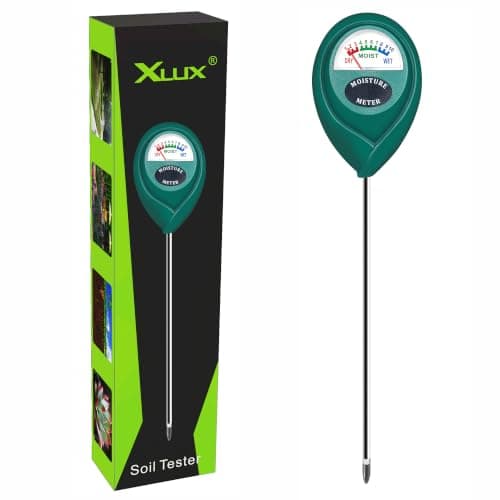
The default answer in this category, and it earns it: a single probe, no battery, a 1-to-10 dial with dry, moist and wet bands, and a probe long enough to reach the root zone of a real pot rather than the top inch.
#ad Price as of October 18, 2026, from Amazon. Prices change. How we make money.
Published specification
- Probe length
- About 7 in (17.5 cm)
- Power
- None required, since the probe generates its own signal in moist soil
- Scale
- 1 to 10, banded DRY, MOIST and WET
- Probe design
- Single probe, to limit root damage
- Weight
- About 2.5 oz (70 g)
- Probe length: XLUX published specification, via retail listing
- Power: XLUX published description
- Scale: XLUX published description
- Probe design: XLUX published description
- Weight: XLUX published specification, via retail listing
What is good about it
- No batteries means it works the day you dig it out of a drawer eighteen months later
- A 7-inch probe reaches the middle of a 6-inch pot, which is where the answer actually is
- The banded dial answers the only question you have, water or do not, without pretending to a percentage it cannot deliver
- Cheap enough to buy two and leave one in the room with the plants
What is not
- It reads conductivity, not water content, so heavily fertilized soil reads wetter than it is
- The 1-to-10 scale is relative, not calibrated to any standard, so two meters can disagree
- Single probe means one reading per insertion, and pots are not uniform
Skip this one if
Skip it if you have three plants and a finger. Virginia Tech's own guidance is to push a finger 1 to 3 inches into the mix and check, and for small pots that is genuinely as good. Buy a meter when the pots are deep enough that your finger cannot reach the root zone.
How it scored
- Published specification
- 8.5
- Probe reach
- 9.0
- Readability
- 9.0
- Value for money
- 10.0
- Measurement honesty
- 6.5
- Overall
- 8.7 / 10
Our editorial score, from published specifications and computed intervals. Not a test result. Specification source: XLUX T10 retail listing.
3-in-1 Soil Meter for Moisture, Light and pH
Someone who wants a light reading as well and will ignore the pH scale
The three-dial version that shows up first in every search. The moisture needle works on the same principle as a single-function meter. The pH needle on a cheap probe of this type is the part to distrust.
#ad We do not currently hold a live price for this, so we do not show one. How we make money.
Published specification
- Functions
- Moisture, light and pH on one probe
- Power
- None required for the moisture and light functions
- Probe length
- Commonly around 7 to 8 in
- pH accuracy
- Not published by the manufacturer
- Functions: Published retail listing specification
- Power: Published retail listing specification
- Probe length: Published retail listing specification
- pH accuracy: Checked listings, no accuracy figure or calibration method published
What is good about it
- The light meter is genuinely useful for working out whether a corner is as bright as you think
- Same battery-free moisture principle as a single-function meter
- Barely more expensive than a moisture-only probe
What is not
- The pH function on a two-electrode probe of this type has no published accuracy or calibration method, and we would not make a decision on it
- Three scales on one dial is harder to read at a glance than one
- Switching functions on the cheapest units is a source of confusion and misreadings
Skip this one if
Skip it if you actually need a soil pH reading. Buy a test kit for that. Treat this as a moisture meter with a light meter attached and you will not be disappointed.
How it scored
- Published specification
- 5.0
- Probe reach
- 8.5
- Readability
- 6.5
- Value for money
- 9.0
- Measurement honesty
- 4.0
- Overall
- 7.0 / 10
Our editorial score, from published specifications and computed intervals. Not a test result. Specification source: 3-in-1 soil meter retail listings.
Questions people actually ask
- Why is my soil moisture meter not working?
Most often an oxidized probe. Polish it with a fine abrasive pad until the metal is bright, then test it in a glass of tap water - a working meter reads firmly wet within a couple of seconds.
- Why does my moisture meter always say wet?
Usually dissolved fertilizer salts raising conductivity, or a probe that has been stored in the soil and corroded. Do not read within a day of feeding, and flush a heavily fed pot by watering thoroughly and draining several times.
- Why does my moisture meter always say dry?
Poor probe contact, usually in coarse bark or perlite-rich mix where the tip sits against an air pocket. Take three readings a few inches apart and push in more slowly and deeply.
- How do I test if a moisture meter works?
Put the probe in a glass of tap water. It should read firmly wet within a couple of seconds. If it does not move, the probe or the movement has failed.
- Can I clean a corroded moisture meter probe?
Yes. Polish along the probe with a fine abrasive pad or very fine sandpaper until the metal is bright, then wipe dry. Avoid steel wool, which leaves fragments that make the corrosion worse.
Sources
Sources
- XLUX T10 published specification, via retail listing
- Leaching Fraction: A Tool to Schedule Irrigation for Container-Grown Plants, Virginia Cooperative Extension SPES-128
- Criscione and Holliday-Goulart, Properly Watering Container Houseplants, Virginia Cooperative Extension SPES-804 (2026)
- Daughtry, Watering but Not Overwatering Houseplants, NC State Extension (2022)