Roundup
Best Self-Watering Inserts for Pots You Already Own
Cheaper than replacing a planter you like, provided your pot is deep enough. The depth requirement is the whole decision.
By Scooter M. - Enthusiast. Reads the manuals, compiles the specs, does the math. | Published
Disclosure
We earn a commission if you buy through our links. It does not change what we recommend or what you pay. Full disclosure.
The short answer
Why an insert is usually the cheaper answer
Most people arriving at this category already own pots. They chose them, they fit the room, and the only thing wrong with them is that they need watering. An insert fixes exactly that for a fraction of the cost of replacing the pot, and it does not force a new aesthetic on a room.
The trade is root volume. Whatever the reservoir occupies, the roots do not get. In a 12-inch-deep pot with a 4-inch insert, that is a reasonable exchange. In a 7-inch-deep pot, you have converted a third of the root zone into a quart and a half of water, and a quart and a half on an 8-inch plant is six to twelve days - barely better than remembering.
The depth table
| Internal pot depth | Practical insert | Reservoir | Computed interval |
|---|---|---|---|
| Under 8 in | None worth fitting | - | Buy a planter instead |
| 8 to 10 in | Adjustable, compressed | About 1.4 L | 6 to 12 days |
| 10 to 14 in | GroBuddy or adjustable, mid | About 3.8 L | 17 to 35 days |
| Over 14 in | Adjustable, extended | About 4.7 L | 21 to 42 days |
Fitting one without ruining the plant
Take the plant out and check the root ball depth before you buy anything. If the roots already occupy the bottom third of the pot, an insert means either a smaller root zone or a bigger pot, and repotting into a bigger pot is frequently the better move on its own.
Set the insert level. A tilted reservoir wicks unevenly, so one side of the root ball stays wet while the other dries, which is a slow route to the same rot problem you were avoiding. Fill the mix in around the wick or the standpipe rather than dropping the whole root ball on top of it, and prime the system by watering thoroughly from the top once before switching to the fill tube.
After that, stop top-watering. The whole point of the air gap is that the roots are not sitting in the reservoir, and the fastest way to defeat it is to saturate the mix from above as well. That is the mechanism behind almost every root-rot complaint in this category.
When an insert is not the answer
If the pot has no drainage hole at all, an insert does not fix that - a sealed cachepot with an insert in it has nowhere to dump an overfill. Drill it, use it as an outer sleeve for a properly drained inner pot, or buy a planter designed for the job.
If you are converting because you are going away, an insert is a slow way to solve a fast problem. A bottle spike costs less and computes to a longer interval, and you can remove it when you get back. If you are converting because you keep forgetting on ordinary weeks, an insert is exactly right - and the indoor planter roundup is worth reading alongside it to see whether replacing beats converting.
Ranked picks
Quick picks
Ranked on published specifications and the computed refill interval, not on looks. Tap any row for the full write-up, including who should skip it.
| # | Product | Best for | Score | Price |
|---|---|---|---|---|
| 1 | 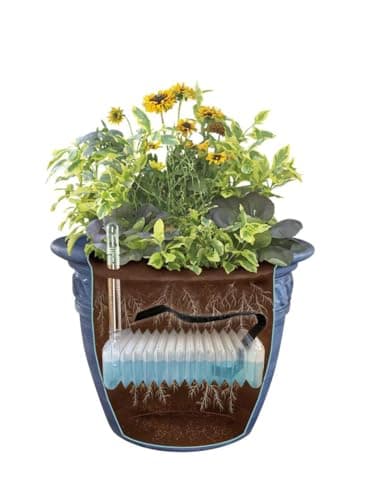 Gardener's Supply Adjustable Self-Watering InsertTurning a planter you already own and like into a self-watering one Gardener's Supply Adjustable Self-Watering InsertTurning a planter you already own and like into a self-watering one | Best published range | 8.6 | $36.99 - View on Amazon |
| 2 | GroBucket GroBuddy Self-Watering Pot InsertA medium floor plant in a pot deep enough to hide the insert | Biggest fixed reservoir | 8.1 | Check price on Amazon |
| 3 | 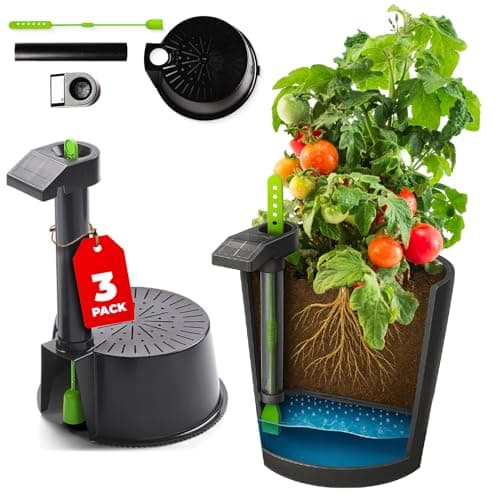 GroBucket Self-Watering Planter InsertCheap outdoor food growing in buckets you already have GroBucket Self-Watering Planter InsertCheap outdoor food growing in buckets you already have | Cheapest per pot | 7.6 | $55.99 - View on Amazon |
Scores are our editorial judgment from published specifications. They are not test results, and they are deliberately not marked up as ratings in this page’s structured data.
Pick #1 - Best published range
Gardener's Supply Adjustable Self-Watering Insert
Turning a planter you already own and like into a self-watering one
The one conversion kit here that publishes its reservoir capacity at both ends of its adjustment range, so you can work out what you are getting before you buy. Compressed it is a week. Extended it is a month and a half.
#ad Price as of October 18, 2026, from Amazon. Prices change. How we make money.
Published specification
- Reservoir capacity, compressed
- 1.5 quarts (about 1.4 liters)
- Reservoir capacity, extended
- 5 quarts (about 4.7 liters)
- Fill tube height
- Adjustable 11.5 to 22 in
- Container shapes
- Round, square and rectangular
- Watering method
- Wicking from a below-soil reservoir, filled through a tube
- Reservoir capacity, compressed: Gardener's Supply published specification, via retail listing
- Reservoir capacity, extended: Gardener's Supply published specification, via retail listing
- Fill tube height: Gardener's Supply published specification, via retail listing
- Container shapes: Gardener's Supply published description
- Watering method: Gardener's Supply published description
Refill interval - computed, not tested
About 6 days compressed, up to about 6 weeks fully extended
Compressed: 1,420 ml divided by 800 ml per thorough watering of an 8-inch pot is 1.8 waterings, so 6 to 12 days at once or twice a week. Extended: 4,732 ml divided by 800 ml is 5.9 waterings, so 21 to 42 days.
Assumes: 8-inch tropical root ball, indoors. Light, temperature, humidity, soil mix and season all change how fast a pot dries, so treat this as a planning range and not a guarantee.
What is good about it
- Publishes capacity at both ends of the adjustment, so the range is checkable rather than a marketing claim
- Lets you keep a planter you already like instead of buying a new one for its plumbing
- The tall fill tube means you top up without disturbing the plant
What is not
- Useful capacity depends entirely on how deep your existing pot is, and a shallow pot gets the 1.5-quart end of the range
- Costs a meaningful fraction of what a new self-watering planter costs
Skip this one if
Skip it if your pots are shallow. Compressed to fit an 8-inch-deep container it holds a quart and a half, which for a medium houseplant is about a week, barely better than remembering.
How it scored
- Published capacity
- 10.0
- Computed interval
- 8.0
- Flexibility
- 9.5
- Value for money
- 7.5
- Ease of setup
- 7.5
- Overall
- 8.6 / 10
Our editorial score, from published specifications and computed intervals. Not a test result. Specification source: Gardener's Supply adjustable insert retail listing.
Pick #2 - Biggest fixed reservoir
GroBucket GroBuddy Self-Watering Pot Insert
A medium floor plant in a pot deep enough to hide the insert
A one-gallon reservoir with a refill indicator, dropped into a pot you already own. The published gallon figure is the reason it makes this list ahead of the unlabeled inserts sitting next to it in the search results.
#ad We do not currently hold a live price for this, so we do not show one. How we make money.
Published specification
- Reservoir capacity
- 1 gallon (about 3.8 liters)
- Refill indicator
- Yes
- Watering method
- Below-soil reservoir with wicking to the root zone
- Reservoir capacity: GroBucket published specification, via retail listing
- Refill indicator: GroBucket published description
- Watering method: GroBucket published description
Refill interval - computed, not tested
About 2.5 to 5 weeks
3,785 ml divided by 800 ml per thorough watering of an 8-inch pot is 4.7 waterings. At once or twice a week, that is 17 to 35 days.
Assumes: 8-inch tropical root ball, indoors. Light, temperature, humidity, soil mix and season all change how fast a pot dries, so treat this as a planning range and not a guarantee.
What is good about it
- A published gallon of reservoir is genuinely large for an insert
- The refill indicator removes the guesswork that sinks most conversion kits
- Cheaper than replacing a pot you already like
What is not
- Needs real depth to disappear. In a shallow pot the insert eats the root zone
- One fixed size, so it fits the pots it fits
Skip this one if
Skip it if your pot is under about 10 inches deep. The insert takes up the bottom of the container, and in a shallow pot you are trading root room for reservoir at a bad exchange rate.
How it scored
- Published capacity
- 9.0
- Computed interval
- 8.5
- Flexibility
- 6.5
- Value for money
- 8.5
- Ease of setup
- 8.0
- Overall
- 8.1 / 10
Our editorial score, from published specifications and computed intervals. Not a test result. Specification source: GroBuddy insert retail listing.
Pick #3 - Cheapest per pot
GroBucket Self-Watering Planter Insert
Cheap outdoor food growing in buckets you already have
Turns an ordinary 5-gallon bucket into a sub-irrigated planter: a reservoir in the base, a barrier above it and a side fill port with overflow. It is the most flexible way to own the mechanism, and worth pricing against a complete grow box before you buy - inserts are no longer automatically the cheap option.
#ad Price as of October 18, 2026, from Amazon. Prices change. How we make money.
Published specification
- Reservoir capacity
- Not published by the manufacturer
- Fits
- Standard 5-gallon bucket
- Watering method
- Sub-irrigation, reservoir formed in the bottom of the bucket
- Fill
- Side fill port with overflow
- Reservoir capacity: Checked GroBucket listings, reservoir volume not published as a figure
- Fits: GroBucket published description
- Watering method: GroBucket published description
- Fill: GroBucket published description
What is good about it
- By far the cheapest way to get a real sub-irrigated planter
- Buckets are free or nearly free, and food-safe ones are easy to find
- Scales sideways: ten buckets cost what one designer planter does
What is not
- GroBucket does not publish the reservoir volume as a number, so we cannot compute an interval for it
- It is a bucket. It looks like a bucket
- Outdoor summer use anyway, where the indoor frequency band does not apply
Skip this one if
Skip it if the planter is going indoors or anywhere it will be looked at. This is a utility solution for a back step or a community plot, not a living-room object.
How it scored
- Published capacity
- 2.0
- Computed interval
- 3.0
- Flexibility
- 8.0
- Value for money
- 10.0
- Looks
- 3.0
- Overall
- 7.6 / 10
Our editorial score, from published specifications and computed intervals. Not a test result. Specification source: GroBucket insert retail listing.
Questions people actually ask
- How deep does a pot need to be for a self-watering insert?
About ten inches of internal depth before the trade starts working in your favor. Below eight inches we would not fit one at all: the reservoir you get is small enough that you have given up root room for less than a week of water.
- Can I convert a pot with no drainage hole?
Not safely. An insert needs somewhere for an overfill to go. Either drill the pot, or use it as an outer sleeve around a properly drained inner pot with the insert in that.
- Do conversion inserts work as well as a purpose-built planter?
Broadly yes, on the mechanism. The difference is engineering around it: built-in planters usually have a float gauge and a designed overflow, and inserts often do not. A refill indicator is the feature worth paying for.
- Will the insert rot or clog over time?
Wicks and standpipes accumulate mineral deposits and fine roots over a couple of years. Plan on lifting the plant at repotting time and rinsing the insert. Plastic inserts do not rot, but a clogged wick stops wicking and the symptom looks exactly like a dry pot with a full reservoir.
Sources