Guide
Are Soil Moisture Meters Accurate?
Not in the sense the word usually means. They are useful anyway, and knowing exactly why is what stops you being misled by one.
By Scooter M. - Enthusiast. Reads the manuals, compiles the specs, does the math. | Published
Disclosure
We earn a commission if you buy through our links. It does not change what we recommend or what you pay. Full disclosure.
The short answer
What the probe is actually doing
Most inexpensive analog meters are galvanic. Two dissimilar metals in the probe, separated by moist soil, form a weak electrochemical cell, and the resulting current moves the needle. That is why they need no battery - and it is also why the reading depends on what is dissolved in the water, not just how much water there is.
Digital units usually measure resistance or capacitance instead, then convert to the same style of scale. The underlying quantity is still conductivity, and the conversion to a display number is a manufacturer’s choice rather than a calibrated transformation.
The three things that skew the reading
Dissolved salts. The biggest one. Fertilizer raises the conductivity of the soil water, so a recently fed pot reads wetter than it is. The same objection applies with more force to the pH scale on a 3-in-1 probe, which is why we rank chemical pH kits above probes. This is not a marginal effect: salt accumulation in containers is a real and well-documented phenomenon, and it is why Virginia Cooperative Extension publishes work on leaching fraction as an irrigation-scheduling tool. If you feed heavily and rely on a meter, you will underwater.
Probe contact. In a coarse, bark-heavy or perlite-rich mix, the probe may sit against an air pocket. The reading comes back low and you water a pot that did not need it. Taking three readings at different points and discarding a wild outlier is the practical defense.
Where you insert it. The top inch of a pot dries fastest, so a shallow insertion reads dry over a wet root zone. Two thirds of the pot depth, near the root ball, is the right target - and it is the single most common usage error.
| Question | Can the meter answer it? |
|---|---|
| Is this pot drier than it was last week? | Yes, reliably |
| Is the root zone wetter than the surface? | Yes, that is its best use |
| Should I water this plant today? | Yes, with the plant type in mind |
| What percentage water is this soil? | No |
| Is this pot wetter than that pot? | Not reliably, mixes differ |
| Does my meter agree with your meter? | No, the scale is not standardized |
Why they are still worth buying
Because the decision they inform is binary and coarse. You are not choosing an irrigation volume to two significant figures; you are choosing between watering today and not. A relative instrument is entirely adequate for a relative decision.
And because the alternative in practice is not a better instrument, it is a calendar. The RHS is explicit that you should avoid a routine such as watering once a week, and instead water less often but more thoroughly, letting the surface dry first. An uncalibrated meter that gets you to check is a large improvement on a schedule that never checks at all.
What would be genuinely accurate
Weighing the pot. Water has a known mass, and a pot weighed dry and again after a thorough watering gives you a real, absolute measure of how much water it holds and how fast it loses it. Growers do exactly this. It is more work than a probe and vastly more accurate, and for a single valuable plant it is worth doing once to calibrate your own intuition.
Short of that, your hand is a decent gravimetric instrument: lift the pot. A lightweight container is listed by Virginia Cooperative Extension among the signs of underwatering, and after a few lifts you will read a pot faster and more reliably than any dial. The free methods compared properly.
What we would buy for this
The gear that fits this problem
Chosen from the same registry as our roundups, on published specifications and the computed refill interval.
XLUX T10 Soil Moisture Meter
Anyone who has killed a plant by watering on a schedule
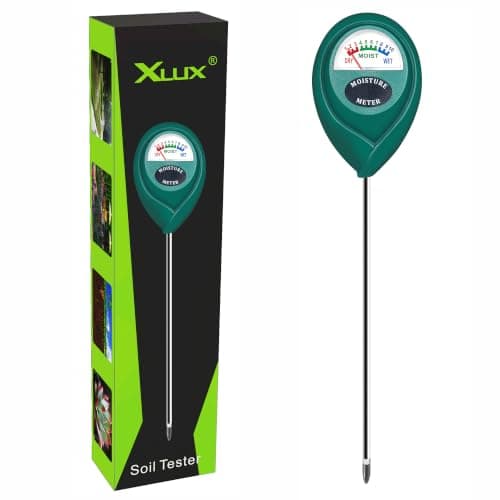
The default answer in this category, and it earns it: a single probe, no battery, a 1-to-10 dial with dry, moist and wet bands, and a probe long enough to reach the root zone of a real pot rather than the top inch.
#ad Price as of October 18, 2026, from Amazon. Prices change. How we make money.
Published specification
- Probe length
- About 7 in (17.5 cm)
- Power
- None required, since the probe generates its own signal in moist soil
- Scale
- 1 to 10, banded DRY, MOIST and WET
- Probe design
- Single probe, to limit root damage
- Weight
- About 2.5 oz (70 g)
- Probe length: XLUX published specification, via retail listing
- Power: XLUX published description
- Scale: XLUX published description
- Probe design: XLUX published description
- Weight: XLUX published specification, via retail listing
What is good about it
- No batteries means it works the day you dig it out of a drawer eighteen months later
- A 7-inch probe reaches the middle of a 6-inch pot, which is where the answer actually is
- The banded dial answers the only question you have, water or do not, without pretending to a percentage it cannot deliver
- Cheap enough to buy two and leave one in the room with the plants
What is not
- It reads conductivity, not water content, so heavily fertilized soil reads wetter than it is
- The 1-to-10 scale is relative, not calibrated to any standard, so two meters can disagree
- Single probe means one reading per insertion, and pots are not uniform
Skip this one if
Skip it if you have three plants and a finger. Virginia Tech's own guidance is to push a finger 1 to 3 inches into the mix and check, and for small pots that is genuinely as good. Buy a meter when the pots are deep enough that your finger cannot reach the root zone.
How it scored
- Published specification
- 8.5
- Probe reach
- 9.0
- Readability
- 9.0
- Value for money
- 10.0
- Measurement honesty
- 6.5
- Overall
- 8.7 / 10
Our editorial score, from published specifications and computed intervals. Not a test result. Specification source: XLUX T10 retail listing.
Digital Soil Moisture Meter with Backlit Display
Reading a pot in a dark corner, or wanting a number to track over time
A battery-powered probe with a numeric readout instead of a needle. The number looks more precise than the analog dial and is measuring exactly the same thing, which is worth knowing before you pay extra for it.
#ad We do not currently hold a live price for this, so we do not show one. How we make money.
Published specification
- Display
- Backlit LCD with numeric readout
- Power
- Battery required, usually AAA or a coin cell
- Calibration standard
- Not published by the manufacturer
- Display: Published retail listing specification
- Power: Published retail listing specification
- Calibration standard: Checked listings, no traceable calibration or accuracy figure published
What is good about it
- Backlit display is genuinely easier in a dim corner than squinting at a needle
- A repeatable number is easier to track across weeks than a needle position
- Often adds a temperature reading, which is a real input to how fast a pot dries
What is not
- Needs a battery, which is the failure mode for a device you use twice a month
- The extra decimal place is false precision, because the underlying measurement is the same conductivity reading
- No published calibration standard on any listing we checked, so the number is not comparable between meters
Skip this one if
Skip it if you were paying for accuracy. You are paying for a backlight and a battery compartment. The analog meter measures the same thing for less and never goes flat.
How it scored
- Published specification
- 4.5
- Probe reach
- 7.5
- Readability
- 9.0
- Value for money
- 6.0
- Measurement honesty
- 4.5
- Overall
- 6.8 / 10
Our editorial score, from published specifications and computed intervals. Not a test result. Specification source: Digital soil moisture meter retail listings.
Questions people actually ask
- Are soil moisture meters accurate?
Not in a calibrated sense. They measure electrical conductivity on a relative 1-to-10 scale, and no meter in this category publishes an accuracy figure or a calibration method. They are reliable for comparing a pot against itself over time, which is what the decision needs.
- Why does my moisture meter always read wet?
Most often dissolved fertilizer salts, which raise conductivity and read as moisture. It can also be a probe left permanently in soil and corroded. Do not read within a day of feeding, and store the probe dry.
- Why does my moisture meter always read dry?
Usually poor probe contact in a coarse or bark-heavy mix, where the tip sits against an air pocket. Take three readings at different points. It can also be a damaged or heavily corroded probe.
- Do moisture meters need calibrating?
They cannot be, in any meaningful sense - none of them publishes a calibration method or a reference standard. Use one meter consistently and read the trend rather than the absolute value.
- What is more accurate than a moisture meter?
Weighing the pot. Water has a known mass, so a pot weighed dry and again after a thorough watering gives a genuinely absolute measure. Lifting the pot by hand is the practical version and it is surprisingly reliable.
Sources
Sources
- Leaching Fraction: A Tool to Schedule Irrigation for Container-Grown Plants, Virginia Cooperative Extension SPES-128
- Criscione and Holliday-Goulart, Properly Watering Container Houseplants, Virginia Cooperative Extension SPES-804 (2026)
- Royal Horticultural Society, Watering plants wisely
- XLUX T10 published specification, via retail listing