Guide
Signs of Overwatering
The published symptom list, in the order the symptoms usually appear, so you can catch it while it is still reversible.
By Scooter M. - Enthusiast. Reads the manuals, compiles the specs, does the math. | Published

Disclosure
We earn a commission if you buy through our links. It does not change what we recommend or what you pay. Full disclosure.
The short answer
The order they usually appear
| Stage | What you see | Still reversible? |
|---|---|---|
| Early | Fungus gnats. Soil surface stays damp for days | Yes, easily |
| Early | Lower leaves yellow, starting at the oldest | Yes |
| Middle | Wilting despite wet soil. Pot feels heavy | Yes, with intervention |
| Middle | Leaf drop. Growth stalls | Usually |
| Late | Mushy stems, soft leaf bases | Sometimes |
| Late | Rotten smell from the mix | Sometimes |
| Terminal | Stem soft and brown at soil level | Take cuttings instead |
Sign by sign, and what each one means
Fungus gnats. The earliest and most under-read signal. They breed in persistently damp mix, so a population of them is direct evidence that the top of the pot never dries. Catching it here means you have lost nothing yet. Getting rid of them is a separate job - dry the surface first, then treat the larvae. Check underneath too: a saucer left full keeps the mix wet from below however carefully you water from above.
Yellowing lower leaves. Older leaves go first because the plant sacrifices them under stress. Yellowing appears on the overwatering list and not the underwatering one, which makes it usefully diagnostic - though it is also caused by other things, so check the soil before concluding.
Wilting with wet soil. The most misread symptom in houseplant care. Damaged roots cannot take up water, so a plant with a saturated root ball wilts exactly like a thirsty one. NC State Extension is explicit that people misinterpret wilting lower leaves as insufficient water and add more. The diagnostic checks are here.
A heavy pot. The counterpart of the lightweight container on the underwatering list. Lift it. A saturated root ball is dramatically heavier, and this is fast, free and reliable.
Mushy leaves and stems. Soft, sometimes translucent tissue, particularly at the base of leaves and where stems meet the soil. This is structural damage rather than stress and it does not reverse - the affected tissue is gone.
Rotten-smelling soil. Anaerobic conditions and decomposing roots. Healthy mix smells earthy. A sour or sulfurous smell means the process is well under way, and it is time for the full root-rot procedure.
Stunted growth. Appears under both stresses, so it is a signal that something is wrong rather than which thing.
Things that look like overwatering but are not
Brown crispy leaf tips. That is on the underwatering list, along with dry brittle leaves and curling. It can also be low humidity or salt build-up. It is not overwatering.
White crust on the soil surface. Accumulated mineral and fertilizer salts, especially where a pot has been bottom watered without periodic flushing. It indicates a watering-method problem, not a volume problem.
Sudden leaf drop after moving the plant. Usually acclimation to a light change rather than water. Check the soil before treating it as anything else.
Old lower leaves yellowing slowly on a healthy plant. Normal. A plant sheds its oldest leaves as it grows. The signal is the rate and how many.
Catching it earlier next time
Overwatering is a frequency problem, not a volume problem: the root zone stays wet too often and never gets air. The RHS corrective is to water less often but more thoroughly and let the surface dry between times, and the way to make that operational is to check before every watering rather than counting days.
For pots deep enough that a finger will not reach the root zone, a probe is the practical answer, and it is the honest purchase for someone whose failure mode is overwatering - a reservoir planter is not.
The full case for choosing between those two is set out separately, because buying the wrong one is how people spend money and change nothing.
What we would buy for this
The gear that fits this problem
Chosen from the same registry as our roundups, on published specifications and the computed refill interval.
XLUX T10 Soil Moisture Meter
Anyone who has killed a plant by watering on a schedule
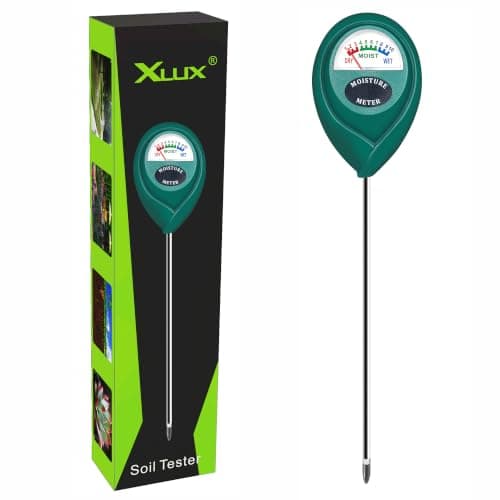
The default answer in this category, and it earns it: a single probe, no battery, a 1-to-10 dial with dry, moist and wet bands, and a probe long enough to reach the root zone of a real pot rather than the top inch.
#ad Price as of October 19, 2026, from Amazon. Prices change. How we make money.
Published specification
- Probe length
- About 7 in (17.5 cm)
- Power
- None required, since the probe generates its own signal in moist soil
- Scale
- 1 to 10, banded DRY, MOIST and WET
- Probe design
- Single probe, to limit root damage
- Weight
- About 2.5 oz (70 g)
- Probe length: XLUX published specification, via retail listing
- Power: XLUX published description
- Scale: XLUX published description
- Probe design: XLUX published description
- Weight: XLUX published specification, via retail listing
What is good about it
- No batteries means it works the day you dig it out of a drawer eighteen months later
- A 7-inch probe reaches the middle of a 6-inch pot, which is where the answer actually is
- The banded dial answers the only question you have, water or do not, without pretending to a percentage it cannot deliver
- Cheap enough to buy two and leave one in the room with the plants
What is not
- It reads conductivity, not water content, so heavily fertilized soil reads wetter than it is
- The 1-to-10 scale is relative, not calibrated to any standard, so two meters can disagree
- Single probe means one reading per insertion, and pots are not uniform
Skip this one if
Skip it if you have three plants and a finger. Virginia Tech's own guidance is to push a finger 1 to 3 inches into the mix and check, and for small pots that is genuinely as good. Buy a meter when the pots are deep enough that your finger cannot reach the root zone.
How it scored
- Published specification
- 8.5
- Probe reach
- 9.0
- Readability
- 9.0
- Value for money
- 10.0
- Measurement honesty
- 6.5
- Overall
- 8.7 / 10
Our editorial score, from published specifications and computed intervals. Not a test result. Specification source: XLUX T10 retail listing.
Questions people actually ask
- What are the signs of overwatering a plant?
Wilting, yellowing foliage, mushy leaves and stems, leaf drop, stunted growth, rotten-smelling soil and fungus gnats. Mushy tissue, the smell and the gnats are the most diagnostic, because none of them appears on the underwatering list.
- Do fungus gnats mean overwatering?
Usually yes. They breed in persistently damp mix, so a population is direct evidence that the top of the pot is not drying between waterings. It is also the earliest signal you will get.
- Why is my plant wilting when the soil is wet?
Because damaged roots cannot take up water. A saturated root ball with rotting roots produces exactly the same wilt as a dry one, which is why extension guidance says to inspect the roots and the moisture before adding more water.
- Are yellow leaves always overwatering?
No. Yellowing is on the overwatering list and not the underwatering one, which makes it a useful signal, but it also comes from nutrient issues, light changes and simple age. Check the soil moisture at depth before concluding.
- How quickly does overwatering damage a plant?
Gradually. Fungus gnats and damp surface soil appear within a week or two, yellowing over several weeks, and mushy stems only once root damage is established. That slow onset is why it usually goes unnoticed until it is advanced.
Sources
Sources
- Criscione and Holliday-Goulart, Properly Watering Container Houseplants, Virginia Cooperative Extension SPES-804 (2026)
- Daughtry, Watering but Not Overwatering Houseplants, NC State Extension (2022)
- Royal Horticultural Society, Watering plants wisely
- Leaching Fraction: A Tool to Schedule Irrigation for Container-Grown Plants, Virginia Cooperative Extension SPES-128