Guide
Are Self-Watering Pots Worth It?
Yes if you forget, on tropical plants, and you buy one that publishes its capacity. No in most other cases, and we would rather say so.
By Scooter M. - Enthusiast. Reads the manuals, compiles the specs, does the math. | Published
Disclosure
We earn a commission if you buy through our links. It does not change what we recommend or what you pay. Full disclosure.
The short answer
Say yes if all three of these are true
You forget rather than fuss. A reservoir removes the need to remember. It does nothing for someone whose habit is to water attentively and too often - if anything it makes that worse. Establish which one you are first. People are usually confident and frequently wrong about this, because overwatering and underwatering produce nearly identical symptoms.
Your plants are tropical foliage. Pothos, monstera, philodendron, peace lily, ferns, calathea. These sit in the published band of once or twice a week, which is exactly what a continuously moist root zone suits. Succulents and cacti are published at once or twice a month and want the opposite.
The listing states a reservoir capacity. If it does not, you cannot compute anything and neither can we. Of the planters we surveyed, the brands that publish a figure are a minority, and the ones that do not are asking you to take the central claim on trust.
What it costs per week of freedom
The useful way to price these is per week of not thinking about it. A planter with a published 5-liter reservoir on a 6-inch tropical computes to 49 to 98 days between refills, against once or twice a week in a plain pot. Call it seven to fourteen weeks of freedom for the price of the planter, repeated for as long as the pot lasts, which for polypropylene is many years.
Against that, a plain pot plus a moisture meter costs a fraction as much, works with every plant including succulents, and fixes the root cause of most houseplant deaths - watering on a schedule instead of on a reading. It does not buy absence. If absence is what you need, the planter wins. If accuracy is what you need, the meter wins, and it is not close on price.
Say no in these three cases
You grow succulents. The published cadence is once or twice a month. A reservoir keeping the root zone continuously moist is not a convenience for these plants, it is the mechanism that kills them.
You are trying to cover a vacation. A planter is a permanent fixture solving an ordinary-week problem. For a two-week absence, a 2-liter bottle spike or a drip system costs less and computes to a longer interval, and you can put it away afterward.
You keep killing plants and do not know why. Buy nothing yet. Work out whether you are drowning them or drying them out, because half of the people who arrive at self-watering planters are overwaterers, and for them this purchase makes the problem worse.
The genuine downside nobody mentions
These fail silently. A clogged wick or a compacted mix stops moving water while the reservoir stays visibly full, and the water-level indicator continues to say everything is fine. In a plain pot, a dry plant droops and you notice. In a reservoir pot, you look at a full gauge and assume the plant is fine until it is not.
It is manageable - check the actual mix once a month rather than trusting the gauge - but it is a real cost and it is the reason we do not treat these as a universal upgrade. A tool that removes your feedback loop is only worth it if it genuinely removes the work too.
What we would buy for this
The gear that fits this problem
Chosen from the same registry as our roundups, on published specifications and the computed refill interval.
Lechuza Classico Color 21
A desk or shelf plant you want to stop thinking about
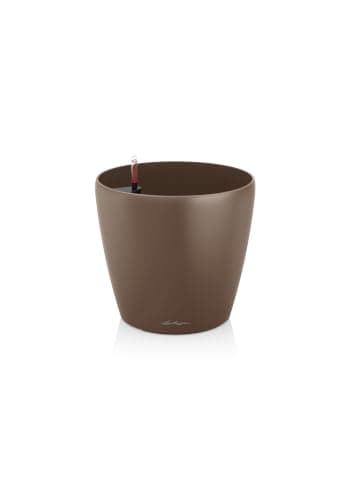
The only planter in this roundup whose maker publishes the reservoir capacity in liters, which is the single number that decides how long you can leave it. Five liters against a 6-inch tropical root ball is the longest computed interval on this page by a wide margin.
#ad Price as of October 18, 2026, from Amazon. Prices change. How we make money.
Published specification
- Reservoir capacity
- 5 liters
- External dimensions
- 9 x 9 x 8 in (21 x 21 x 20 cm)
- Water level indicator
- Yes, float gauge
- Drainage plug
- Yes, for outdoor use
- Material
- Frost and UV resistant polypropylene
- Reservoir capacity: Lechuza published specification, via retail listing
- External dimensions: Lechuza published specification, via retail listing
- Water level indicator: Lechuza published specification
- Drainage plug: Lechuza published specification
- Material: Lechuza published specification
Refill interval - computed, not tested
Roughly 7 to 14 weeks between refills
5,000 ml reservoir divided by 350 ml per thorough watering of a 6-inch pot is 14.3 waterings. At the published cadence for a tropical houseplant of once or twice a week, that is 49 to 98 days.
Assumes: 6-inch tropical root ball, indoors, average room conditions. Light, temperature, humidity, soil mix and season all change how fast a pot dries, so treat this as a planning range and not a guarantee.
What is good about it
- Publishes the reservoir capacity, which almost nothing else in this category does
- The float gauge means you never have to guess whether it needs topping up
- The drainage plug lets the same planter work outdoors without drowning the plant in a wet week
- Sub-irrigation from a granulate layer rather than a wick, so there is no wick to rot or clog
What is not
- Expensive for a 9-inch pot, and the price is most of the argument against it
- The system is built around Lechuza's own mineral granulate, so you are buying into a way of potting, not just a pot
- A 5-liter reservoir under an 8-inch or larger plant is a much shorter interval than the headline suggests
Skip this one if
Skip it if you want one pot to cover a large floor plant. The reservoir is sized for a small-to-medium root ball, and the interval collapses as the plant gets bigger. Skip it too if you like repotting into ordinary potting mix, because the granulate layer is part of the design.
How it scored
- Published capacity
- 10.0
- Computed interval
- 9.5
- Build and materials
- 9.0
- Value for money
- 6.5
- Ease of setup
- 8.5
- Overall
- 8.8 / 10
Our editorial score, from published specifications and computed intervals. Not a test result. Specification source: Lechuza Classico Color 21 retail listing.
Gardener's Supply Adjustable Self-Watering Insert
Turning a planter you already own and like into a self-watering one
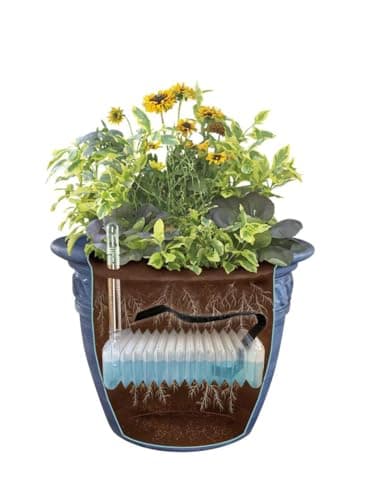
The one conversion kit here that publishes its reservoir capacity at both ends of its adjustment range, so you can work out what you are getting before you buy. Compressed it is a week. Extended it is a month and a half.
#ad Price as of October 18, 2026, from Amazon. Prices change. How we make money.
Published specification
- Reservoir capacity, compressed
- 1.5 quarts (about 1.4 liters)
- Reservoir capacity, extended
- 5 quarts (about 4.7 liters)
- Fill tube height
- Adjustable 11.5 to 22 in
- Container shapes
- Round, square and rectangular
- Watering method
- Wicking from a below-soil reservoir, filled through a tube
- Reservoir capacity, compressed: Gardener's Supply published specification, via retail listing
- Reservoir capacity, extended: Gardener's Supply published specification, via retail listing
- Fill tube height: Gardener's Supply published specification, via retail listing
- Container shapes: Gardener's Supply published description
- Watering method: Gardener's Supply published description
Refill interval - computed, not tested
About 6 days compressed, up to about 6 weeks fully extended
Compressed: 1,420 ml divided by 800 ml per thorough watering of an 8-inch pot is 1.8 waterings, so 6 to 12 days at once or twice a week. Extended: 4,732 ml divided by 800 ml is 5.9 waterings, so 21 to 42 days.
Assumes: 8-inch tropical root ball, indoors. Light, temperature, humidity, soil mix and season all change how fast a pot dries, so treat this as a planning range and not a guarantee.
What is good about it
- Publishes capacity at both ends of the adjustment, so the range is checkable rather than a marketing claim
- Lets you keep a planter you already like instead of buying a new one for its plumbing
- The tall fill tube means you top up without disturbing the plant
What is not
- Useful capacity depends entirely on how deep your existing pot is, and a shallow pot gets the 1.5-quart end of the range
- Costs a meaningful fraction of what a new self-watering planter costs
Skip this one if
Skip it if your pots are shallow. Compressed to fit an 8-inch-deep container it holds a quart and a half, which for a medium houseplant is about a week, barely better than remembering.
How it scored
- Published capacity
- 10.0
- Computed interval
- 8.0
- Flexibility
- 9.5
- Value for money
- 7.5
- Ease of setup
- 7.5
- Overall
- 8.6 / 10
Our editorial score, from published specifications and computed intervals. Not a test result. Specification source: Gardener's Supply adjustable insert retail listing.
XLUX T10 Soil Moisture Meter
Anyone who has killed a plant by watering on a schedule
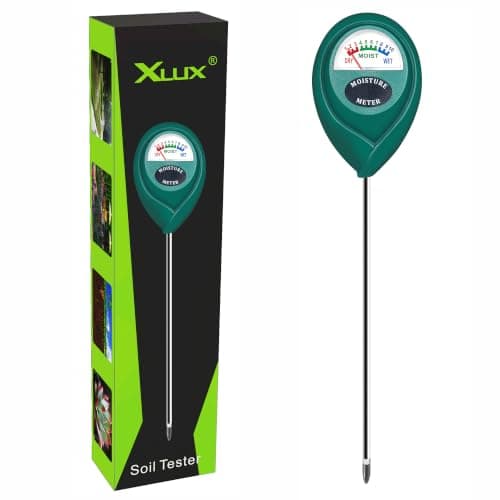
The default answer in this category, and it earns it: a single probe, no battery, a 1-to-10 dial with dry, moist and wet bands, and a probe long enough to reach the root zone of a real pot rather than the top inch.
#ad Price as of October 18, 2026, from Amazon. Prices change. How we make money.
Published specification
- Probe length
- About 7 in (17.5 cm)
- Power
- None required, since the probe generates its own signal in moist soil
- Scale
- 1 to 10, banded DRY, MOIST and WET
- Probe design
- Single probe, to limit root damage
- Weight
- About 2.5 oz (70 g)
- Probe length: XLUX published specification, via retail listing
- Power: XLUX published description
- Scale: XLUX published description
- Probe design: XLUX published description
- Weight: XLUX published specification, via retail listing
What is good about it
- No batteries means it works the day you dig it out of a drawer eighteen months later
- A 7-inch probe reaches the middle of a 6-inch pot, which is where the answer actually is
- The banded dial answers the only question you have, water or do not, without pretending to a percentage it cannot deliver
- Cheap enough to buy two and leave one in the room with the plants
What is not
- It reads conductivity, not water content, so heavily fertilized soil reads wetter than it is
- The 1-to-10 scale is relative, not calibrated to any standard, so two meters can disagree
- Single probe means one reading per insertion, and pots are not uniform
Skip this one if
Skip it if you have three plants and a finger. Virginia Tech's own guidance is to push a finger 1 to 3 inches into the mix and check, and for small pots that is genuinely as good. Buy a meter when the pots are deep enough that your finger cannot reach the root zone.
How it scored
- Published specification
- 8.5
- Probe reach
- 9.0
- Readability
- 9.0
- Value for money
- 10.0
- Measurement honesty
- 6.5
- Overall
- 8.7 / 10
Our editorial score, from published specifications and computed intervals. Not a test result. Specification source: XLUX T10 retail listing.
Questions people actually ask
- Are self-watering pots worth the money?
For a tropical foliage houseplant owned by someone who forgets, yes: a published 5-liter reservoir computes to seven to fourteen weeks between refills against once or twice a week in a plain pot. For succulents, for overwaterers and for vacation cover, no.
- Are self-watering pots bad for plants?
Not inherently. They are bad for plants that want to dry out between waterings, and they become bad for any plant if you top-water them as well as filling the reservoir, because that closes the air gap that keeps roots out of standing water.
- What is cheaper, a self-watering pot or just being more organized?
Being organized is free but has a poor track record. The realistic cheap alternative is a plain pot and a moisture meter, which costs a fraction of a planter and works with every plant. It tells you when to water. It does not water for you.
- How long do self-watering pots last?
The pot itself, years - frost and UV resistant polypropylene is specified for outdoor use. The consumable parts are wicks and, on some systems, the granulate. Expect to rinse or replace a wick every couple of years, because a mineralized wick stops moving water while the reservoir stays full.
Sources