Head to head
DIY Vacation Watering vs Buying a System
Two of the classic DIY rigs work about as well as the products. Two of them are worse than doing nothing. Here is which is which.
By Scooter M. - Enthusiast. Reads the manuals, compiles the specs, does the math. | Published
Disclosure
We earn a commission if you buy through our links. It does not change what we recommend or what you pay. Full disclosure.
The short answer
The four common DIY rigs, assessed
String wick into a jug. Works. A cotton or nylon rope with one end buried a few inches into the mix and the other in a jug beside the pot moves water by the same capillary action a commercial wicking insert uses. It is slow, self-limiting and hard to get badly wrong. The jug must sit at or below pot level, and the wick has to be genuinely absorbent - synthetic cord that repels water does nothing. Expect a rate similar to a slow spike.
Towel or capillary mat in the bathtub. Works. Lay a wet towel in a bath or a large tray, run one end into a few inches of water, and stand pots with drainage holes on it. This is the greenhouse technique and it is sound. Bottom-watering keeps the surface dry, which suppresses fungus gnats, and it is the cheapest way to cover a lot of small pots at once. Do not do it with succulents - continuous bottom moisture against a plant published at once or twice a month is a rot sentence.
Upended plastic bottle in the soil. Does not work as intended. A bottle with holes punched in the cap, pushed into the mix, releases most of its contents quickly as the surrounding soil absorbs it, then stalls once the local zone is saturated and air stops entering. You get a soggy patch and a dry pot. This is the DIY version of the watering globe, and it has the same problem for the same reason.
Plastic bag over the plant. Risky. It does reduce transpiration, which is the theory. It also raises humidity around wet foliage for a fortnight in a warm room, and Virginia Cooperative Extension’s overwatering symptom list - mushy leaves and stems, rotten-smelling soil, fungus gnats - describes exactly the environment you have created. In direct sun it also cooks the plant.
The comparison
| DIY | Bought | |
|---|---|---|
| Cost | Free to a few dollars | Low to moderate |
| Volume held | Whatever jug or bottle you use | Same, plus purpose-made larger tanks |
| Flow control | Wick thickness, by trial | Fired ceramic porosity, consistent unit to unit |
| Setup time | Ten minutes | Ten minutes plus a soak |
| Predictability | Varies with your materials | Repeatable between pots |
| Failure mode | Wick dries out and stops wicking | Ceramic clogs, or pump fails |
| Works for many pots | Bathtub tray, yes | Drip kit, yes |
The honest verdict
For one or two plants and a week away, a string wick into a jug is genuinely competitive with anything you can buy, and we would rather you did that than bought a globe. For a tray of small pots, the bathtub-and-towel method is as good as a commercial capillary mat, which is the same thing with a nicer edge finish.
Where bought kit wins is consistency and scale. A terracotta spike costs a few dollars, screws onto the 2-liter bottle you were going to bury, and computes to 20 to 42 days on a 6-inch pot - far better than the buried bottle and better than most wicks. And for a room full of plants over a month, a drip system is not something you can improvise.
One rule applies to both sides equally: run whatever you build for a week while you are at home. DIY rigs vary far more between builds than products vary between units, so the rehearsal matters more, not less.
What we would buy for this
The gear that fits this problem
Chosen from the same registry as our roundups, on published specifications and the computed refill interval.
Plant Nanny Watering Spikes with Bottle Adapter
The longest unattended stretch you can get without a pump
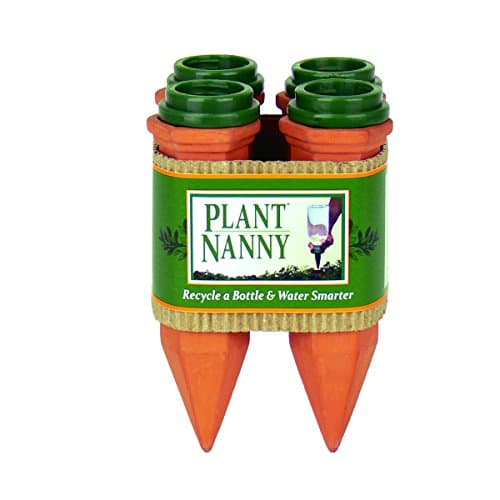
The soda-bottle version: a 5.5-inch terracotta spike with a screw adapter that takes a standard plastic bottle. Two liters on the end of it is the largest gravity reservoir on this site that still costs almost nothing.
#ad Price as of October 18, 2026, from Amazon. Prices change. How we make money.
Published specification
- Spike length
- 5.5 in
- Reservoir
- Any screw-top plastic bottle, with 2 liter the common choice
- Manufacturer duration claim
- Up to 2 weeks with a 2 liter bottle
- Material
- Unglazed terracotta with a plastic screw adapter
- Spike length: Lee Valley published specification
- Reservoir: Lee Valley published description
- Manufacturer duration claim: Lee Valley published description
- Material: Lee Valley published description
Refill interval - computed, not tested
About 20 to 42 days on a 6-inch pot
2,000 ml divided by 350 ml per thorough watering of a 6-inch pot is 5.7 waterings. At once or twice a week, that is 20 to 42 days. The published claim of up to two weeks is well inside that, which is the direction you want a claim to be wrong in.
Assumes: 6-inch tropical root ball, indoors, 2 liter bottle. Light, temperature, humidity, soil mix and season all change how fast a pot dries, so treat this as a planning range and not a guarantee.
What is good about it
- The published claim is conservative against the arithmetic by a wide margin
- Two liters for the price of an empty soda bottle is the best cost per milliliter on this site
- Terracotta throttles delivery by soil moisture rather than pouring on a schedule
What is not
- A 2 liter bottle upside down in a houseplant is genuinely ugly
- Top-heavy in a light pot, and it will tip a small plastic pot over
- Needs the ceramic soaked and de-aerated before it works properly
Skip this one if
Skip it if the plant lives somewhere you look at every day. This is a solution for the week you are away, not a permanent fixture.
How it scored
- Published capacity
- 9.5
- Computed interval
- 9.5
- Honesty of claims
- 9.5
- Value for money
- 10.0
- Looks
- 3.0
- Overall
- 8.7 / 10
Our editorial score, from published specifications and computed intervals. Not a test result. Specification source: Lee Valley Plant Nanny watering spikes listing.
Capillary Matting for Plant Trays
A tray of small pots on a windowsill while you are away
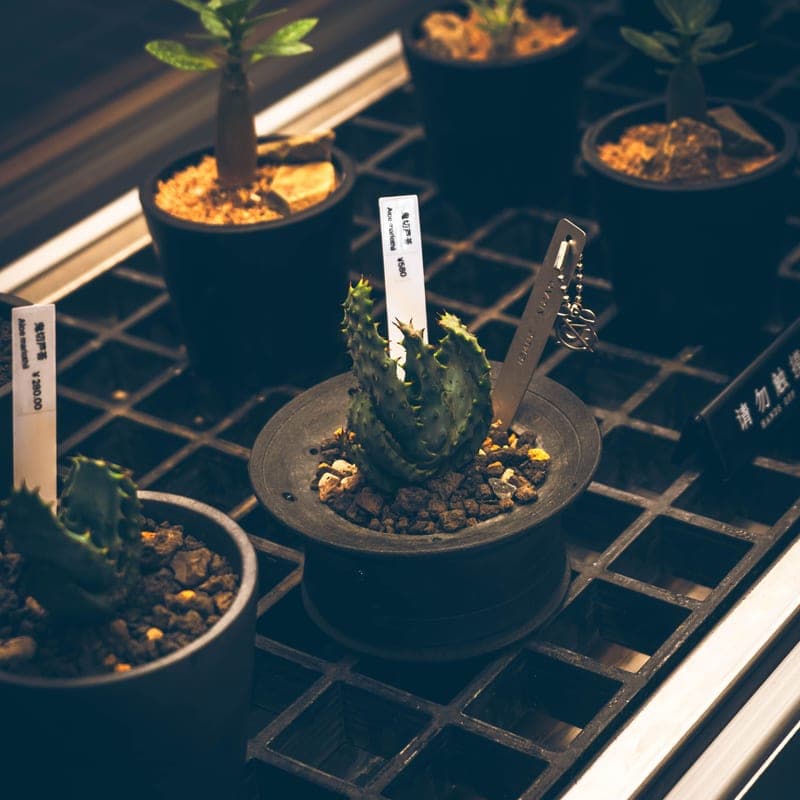
The greenhouse trick, scaled down: a felt mat with one end in a water tray wicks moisture up into every pot standing on it. No mechanism, no batteries, and it works for as long as the tray holds out.
#ad We do not currently hold a live price for this, so we do not show one. How we make money.
Published specification
- Reservoir
- Whatever tray or basin you supply
- Watering method
- Capillary wicking through a felt mat into drainage holes
- Requirement
- Pots must have drainage holes and sit flat on the mat
- Reservoir: Published product descriptions
- Watering method: Published product descriptions
- Requirement: Published product descriptions
Refill interval - computed, not tested
Set by the tray, and the tray is usually the weak point
A 2 liter tray split across six 4-inch pots at 100 ml per thorough watering each is 3.3 waterings per pot, or about 12 to 23 days, if the tray does not evaporate first. In a sunny window it will.
Assumes: Six 4-inch pots on a 2 liter tray, indoors out of direct sun. Light, temperature, humidity, soil mix and season all change how fast a pot dries, so treat this as a planning range and not a guarantee.
What is good about it
- No moving parts at all, so nothing to fail while you are away
- One tray serves every pot standing on it, so cost per plant is trivial
- Bottom watering by design, which keeps the surface dry and discourages fungus gnats
What is not
- Only works with pots that have drainage holes and flat bases
- The mat has to stay in contact with the mix, so no thick layer of decorative gravel
- Evaporation from an open tray in a sunny window can beat the plants to the water
- Constant moisture at the base is a root-rot risk for succulents
Skip this one if
Skip it for succulents and cacti. Continuous bottom moisture is precisely wrong for plants whose published cadence is once or twice a month, and you will come home to rot.
How it scored
- Published specification
- 5.5
- Computed interval
- 7.0
- Reliability risk
- 9.5
- Value for money
- 9.5
- Plant compatibility
- 5.0
- Overall
- 7.4 / 10
Our editorial score, from published specifications and computed intervals. Not a test result. Specification source: Capillary matting retail listings.
Blumat Classic Watering Stakes
Set-and-forget watering of 6-inch pots, for as long as the jug lasts
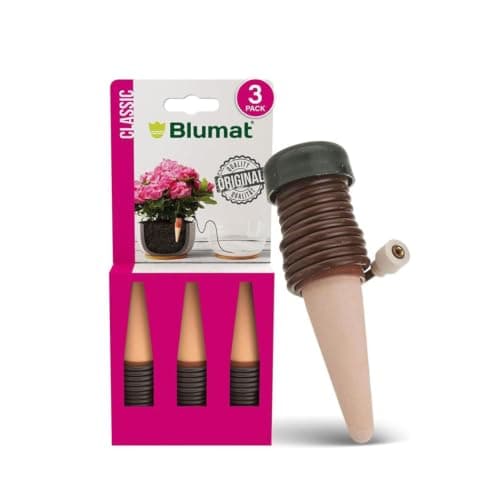
The only device in this category with a published flow rate rather than a published duration, which changes the question entirely: it is limited by how fast it can deliver, not by how much it holds. About 75 ml a day is a near-exact match for a 6-inch tropical houseplant.
#ad Price as of October 18, 2026, from Amazon. Prices change. How we make money.
Published specification
- Delivery rate
- About 75 ml per day for the Classic, about 150 ml per day for the XL
- Maximum lift
- Draws water up to 12 in (30 cm)
- Reservoir
- Any container you supply, sited no more than 12 in below the cone
- Watering method
- Ceramic cone. Soil drying creates a vacuum that pulls water from the reservoir
- Setup requirement
- Soak the cone and cap for at least 15 minutes and knock out air bubbles under water
- Delivery rate: Blumat retailer published specification
- Maximum lift: Blumat retailer published specification
- Reservoir: Blumat published description
- Watering method: Blumat published description
- Setup requirement: Blumat published instructions
Refill interval - computed, not tested
Duration is set by the jug you attach, not by the device
A 6-inch tropical houseplant draws 350 ml every 3.5 to 7 days, which is 50 to 100 ml a day. The Classic's published maximum of about 75 ml a day sits inside that band, so it can keep a 6-inch pot going but cannot keep up with a thirsty 8-inch one at 114 to 229 ml a day. That is what the XL at about 150 ml a day is for. Attach a 2 liter jug and, at a real draw of 50 ml a day, that is about 40 days.
Assumes: 6-inch tropical root ball, indoors, reservoir within 12 in below the cone. Light, temperature, humidity, soil mix and season all change how fast a pot dries, so treat this as a planning range and not a guarantee.
What is good about it
- Publishes a flow rate, which is the correct spec for a demand-driven device and which nobody else in the category gives you
- Genuinely demand-driven: when the soil is wet the flow stops, so it does not drown the plant on a cool week
- Duration is whatever reservoir you can find room for, rather than a fixed bulb
- The XL doubles the rate for larger pots, so the range actually scales with plant size
What is not
- Fiddly setup, because the cone has to be soaked and de-aerated or it simply will not siphon
- The 12-inch lift limit constrains where the reservoir can sit, and it is easy to get wrong
- More expensive per pot than a spike or a globe
- Ceramic clogs in hard water and needs periodic cleaning
Skip this one if
Skip it if you want to unbox something and push it into the soil. This rewards a careful setup and punishes a casual one, and a Blumat that was not de-aerated properly is a Blumat that does nothing at all.
How it scored
- Published specification
- 10.0
- Computed interval
- 9.0
- Honesty of claims
- 9.5
- Value for money
- 7.0
- Ease of setup
- 5.5
- Overall
- 8.9 / 10
Our editorial score, from published specifications and computed intervals. Not a test result. Specification source: Blumat Classic published specification, via Sustainable Village.
Questions people actually ask
- Does the string wick method really work for vacation watering?
Yes. It is the same capillary action a commercial wicking insert uses. Use an absorbent cotton or nylon rope, bury one end a few inches into the mix, and keep the jug at or below pot level. Synthetic cord that repels water will not work.
- Can I just stick a water bottle upside down in the soil?
It rarely works as intended. Most of the volume goes in the first hour as the soil absorbs it, then flow stalls once the local zone saturates and air stops entering. You get a soggy patch and a dry pot. A terracotta spike on the same bottle solves it for a few dollars.
- Is the plastic bag greenhouse trick safe?
We would not. It creates a warm, high-humidity environment around wet foliage for a fortnight, which is exactly the condition that produces mushy stems, rotten-smelling soil and fungus gnats. In any direct sun it also overheats the plant.
- Is the bathtub method safe for all plants?
Not for succulents and cacti. Their published cadence is once or twice a month, and continuous bottom moisture is precisely wrong for them. For tropical foliage in pots with drainage holes, it is one of the best free options there is.
Sources