Roundup
Best Automatic Plant Watering Systems
The only category here that covers a month with a straight face, and the only one with something to break. Both facts matter.
By Scooter M. - Enthusiast. Reads the manuals, compiles the specs, does the math. | Published
Disclosure
We earn a commission if you buy through our links. It does not change what we recommend or what you pay. Full disclosure.
The short answer
What these actually publish
Unusually for this category, the specifications are real and comparable. The bundled-reservoir kits state 5 or 7 gallons of tank, a 22-watt pump, an interval range of 0.1 to 30 days between cycles and a run time of 1 to 99 seconds per cycle. The bring-your-own-reservoir kits state the number of pots supported - typically 15 to 20 - and an interval range from hourly to monthly, with USB power and battery backup.
That is more genuine specification than the entire passive half of this site combined, and it is one of the reasons drip kits are the right answer for a long absence: you can actually work out what you are buying.
Setting the schedule so it does not drown anything
This is where most people go wrong, because the natural instinct is to set it generously. The arithmetic is the same as everywhere else on this site: a 6-inch tropical houseplant needs about 350 ml every 3.5 to 7 days. So the target is one cycle every three to four days delivering roughly 350 ml per pot, not a small trickle every day.
Virginia Cooperative Extension is explicit that containers should be watered thoroughly - wet all the way through, then drained. A daily trickle does the opposite: it keeps the top of the mix damp while the root zone below stays dry, and it accumulates salts at the surface. Fewer, bigger cycles is the correct setting and it also matches the RHS advice to water less often but more thoroughly.
| Pot size | Target per cycle | Suggested interval | Reservoir per plant per month |
|---|---|---|---|
| 4 in | 100 ml | Every 4 days | 0.75 to 1.5 L |
| 6 in | 350 ml | Every 4 days | 2.6 to 3 L |
| 8 in | 800 ml | Every 4 days | 6 L |
| 10 in | 1.6 L | Every 3 to 4 days | 12 L |
Read that right-hand column against a 19-liter reservoir and the plant count falls out: three 10-inch plants, or six 6-inch ones, for a month. Beyond that you need a second reservoir or a shorter trip.
The four failure modes, and what to do about each
A clogged emitter. Fine particles and mineral scale block the tiny orifice. One plant gets nothing while the others are fine, and there is no signal. Mitigation: use clean water, fit the inline filter if the kit has one, and check each emitter is actually dripping during the rehearsal week.
A tube that pops off. The worst one, because it empties the reservoir onto your floor in an afternoon and every plant then gets nothing for the rest of the trip. Mitigation: push every barb fully home, secure the tubing so nobody trips it, and stand the reservoir in a tray.
Pump failure. These are inexpensive submersible pumps and the cheap ones do seize. Mitigation: the rehearsal week, and buying the kit with the better-documented pump rather than the cheapest.
Power interruption. A blink in the mains resets an unbacked timer. Mitigation: choose a model with battery backup, which many now include precisely for this.
When not to buy one
For three plants and a long weekend, this is a lot of machinery to solve a problem that a terracotta spike and a wine bottle handles for a fraction of the cost and with nothing to break. The drip kit earns its place at scale - many pots, long absence - or where the plants are valuable enough that the reliability engineering is worth it.
And if you want automation without electricity, the demand-driven ceramic option throttles itself by soil moisture, which is a genuinely different and in some ways better behavior than a timer.
Ranked picks
Quick picks
Ranked on published specifications and the computed refill interval, not on looks. Tap any row for the full write-up, including who should skip it.
| # | Product | Best for | Score | Price |
|---|---|---|---|---|
| 1 | Automatic Drip Irrigation Kit with 5-Gallon ReservoirTrips of two weeks or longer, or a whole room of plants at once | Best all-in-one | 8.3 | Check price on Amazon |
| 2 | 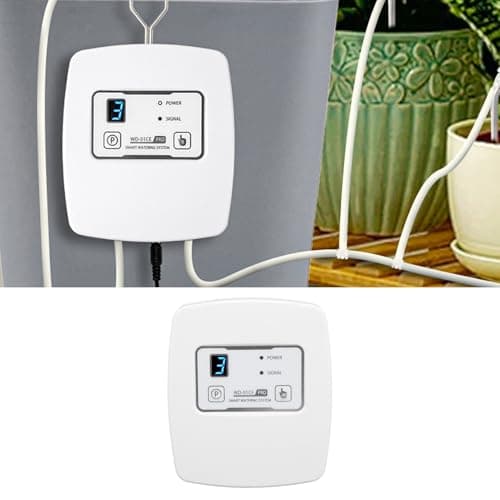 USB Automatic Plant Watering Kit, Bring Your Own ReservoirA room of houseplants, when you would rather choose your own reservoir USB Automatic Plant Watering Kit, Bring Your Own ReservoirA room of houseplants, when you would rather choose your own reservoir | Best value, bring your own tank | 7.7 | $55.91 - View on Amazon |
| 3 | 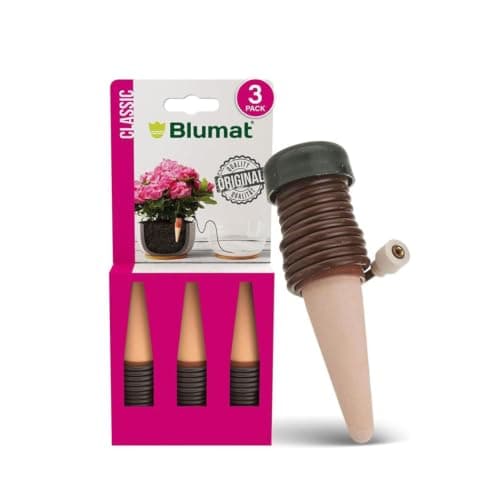 Blumat Classic Watering StakesSet-and-forget watering of 6-inch pots, for as long as the jug lasts Blumat Classic Watering StakesSet-and-forget watering of 6-inch pots, for as long as the jug lasts | Best no-power alternative | 8.9 | $16.88 - View on Amazon |
Scores are our editorial judgment from published specifications. They are not test results, and they are deliberately not marked up as ratings in this page’s structured data.
Pick #1 - Best all-in-one
Automatic Drip Irrigation Kit with 5-Gallon Reservoir
Trips of two weeks or longer, or a whole room of plants at once
The only category here that covers a month with a straight face. A five-gallon bucket, a 22-watt pump and a programmable timer will outlast any bulb, any spike and any reservoir planter by an order of magnitude, at the cost of running hose across your floor.
#ad We do not currently hold a live price for this, so we do not show one. How we make money.
Published specification
- Reservoir capacity
- 5 gallons (about 19 liters), with 7-gallon versions also sold
- Pump
- 22 W
- Programmable interval
- 0.1 to 30 days between cycles
- Run time per cycle
- 1 to 99 seconds, model dependent
- Tubing
- 1/4 in, with individual emitters per pot
- Reservoir capacity: Published retail listing specification
- Pump: Published retail listing specification
- Programmable interval: Published retail listing specification
- Run time per cycle: Published retail listing specification
- Tubing: Published retail listing specification
Refill interval - computed, not tested
Months of water, if the pump behaves
19,000 ml divided by 350 ml per thorough watering of a 6-inch pot is 54 waterings for a single plant, which is more than half a year of capacity. Split across ten plants that is still five weeks. Capacity stops being the limiting factor entirely, and reliability becomes the thing to worry about.
Assumes: 6-inch tropical pots, indoors, 5 gallon reservoir. Light, temperature, humidity, soil mix and season all change how fast a pot dries, so treat this as a planning range and not a guarantee.
What is good about it
- Genuinely covers a long trip, which nothing passive on this site does
- One reservoir serves many pots, so cost per plant drops fast as you add plants
- Publishes real specifications, including reservoir volume, pump wattage and interval range, unlike most of the passive category
- Battery backup on many models keeps the schedule if the power blinks
What is not
- It is a pump with moving parts and a program, and any of those can fail while you are away
- Tubing to every pot, which is visible and easy to dislodge
- Fixed timing rather than demand-driven, so it waters on schedule whether the soil needs it or not
- Setup takes an evening, not five minutes
Skip this one if
Skip it for a long weekend, or for three plants. The complexity only pays back over long absences or a lot of pots. And never leave on a two-week trip having installed it the night before. Run it for a full week while you are home first.
How it scored
- Published specification
- 9.0
- Computed interval
- 10.0
- Reliability risk
- 5.5
- Value for money
- 7.5
- Ease of setup
- 4.5
- Overall
- 8.3 / 10
Our editorial score, from published specifications and computed intervals. Not a test result. Specification source: Drip irrigation kit with 5-gallon reservoir retail listing.
Pick #2 - Best value, bring your own tank
USB Automatic Plant Watering Kit, Bring Your Own Reservoir
A room of houseplants, when you would rather choose your own reservoir
The bucket-less version: a small programmable pump you drop into any container you already own, feeding up to fifteen or twenty pots. Cheaper and less intrusive than a bundled-reservoir kit, and the reservoir size becomes your decision instead of the manufacturer's.
#ad Price as of October 18, 2026, from Amazon. Prices change. How we make money.
Published specification
- Reservoir
- Not included, so any container you supply
- Plants supported
- Commonly 15 to 20 pots per kit
- Programmable interval
- Once an hour to once every 30 days, model dependent
- Power
- USB, with 4 x AA battery backup on many models
- Tubing
- 1/4 in with per-pot emitters and flow adjusters
- Reservoir: Published retail listing specification
- Plants supported: Published retail listing specification
- Programmable interval: Published retail listing specification
- Power: Published retail listing specification
- Tubing: Published retail listing specification
Refill interval - computed, not tested
Whatever your container holds, divided by the number of pots
Capacity is entirely your choice. A 19 liter bucket split across ten 6-inch tropical pots at 350 ml each per watering is 5.4 waterings per plant, or roughly 19 to 38 days.
Assumes: Ten 6-inch tropical pots, 19 liter reservoir you supply. Light, temperature, humidity, soil mix and season all change how fast a pot dries, so treat this as a planning range and not a guarantee.
What is good about it
- You choose the reservoir, so you choose the duration
- Battery backup means a power cut does not silently end the schedule
- Per-emitter flow adjusters let a small pot and a large one share one system
- Considerably cheaper than the kits that bundle a bucket
What is not
- Small pumps in this bracket are the least reliable part of the whole category
- Fixed schedule, not demand-driven, so a cool wet week gets the same water as a hot one
- Emitters clog, and a clogged emitter is invisible until you come home
Skip this one if
Skip it if you cannot test it for a full week before you travel. An untested pump is worse than no pump, because you have stopped worrying about the plants.
How it scored
- Published specification
- 8.0
- Computed interval
- 9.5
- Reliability risk
- 4.5
- Value for money
- 9.0
- Ease of setup
- 5.0
- Overall
- 7.7 / 10
Our editorial score, from published specifications and computed intervals. Not a test result. Specification source: USB automatic drip irrigation kit retail listing.
Pick #3 - Best no-power alternative
Blumat Classic Watering Stakes
Set-and-forget watering of 6-inch pots, for as long as the jug lasts
The only device in this category with a published flow rate rather than a published duration, which changes the question entirely: it is limited by how fast it can deliver, not by how much it holds. About 75 ml a day is a near-exact match for a 6-inch tropical houseplant.
#ad Price as of October 18, 2026, from Amazon. Prices change. How we make money.
Published specification
- Delivery rate
- About 75 ml per day for the Classic, about 150 ml per day for the XL
- Maximum lift
- Draws water up to 12 in (30 cm)
- Reservoir
- Any container you supply, sited no more than 12 in below the cone
- Watering method
- Ceramic cone. Soil drying creates a vacuum that pulls water from the reservoir
- Setup requirement
- Soak the cone and cap for at least 15 minutes and knock out air bubbles under water
- Delivery rate: Blumat retailer published specification
- Maximum lift: Blumat retailer published specification
- Reservoir: Blumat published description
- Watering method: Blumat published description
- Setup requirement: Blumat published instructions
Refill interval - computed, not tested
Duration is set by the jug you attach, not by the device
A 6-inch tropical houseplant draws 350 ml every 3.5 to 7 days, which is 50 to 100 ml a day. The Classic's published maximum of about 75 ml a day sits inside that band, so it can keep a 6-inch pot going but cannot keep up with a thirsty 8-inch one at 114 to 229 ml a day. That is what the XL at about 150 ml a day is for. Attach a 2 liter jug and, at a real draw of 50 ml a day, that is about 40 days.
Assumes: 6-inch tropical root ball, indoors, reservoir within 12 in below the cone. Light, temperature, humidity, soil mix and season all change how fast a pot dries, so treat this as a planning range and not a guarantee.
What is good about it
- Publishes a flow rate, which is the correct spec for a demand-driven device and which nobody else in the category gives you
- Genuinely demand-driven: when the soil is wet the flow stops, so it does not drown the plant on a cool week
- Duration is whatever reservoir you can find room for, rather than a fixed bulb
- The XL doubles the rate for larger pots, so the range actually scales with plant size
What is not
- Fiddly setup, because the cone has to be soaked and de-aerated or it simply will not siphon
- The 12-inch lift limit constrains where the reservoir can sit, and it is easy to get wrong
- More expensive per pot than a spike or a globe
- Ceramic clogs in hard water and needs periodic cleaning
Skip this one if
Skip it if you want to unbox something and push it into the soil. This rewards a careful setup and punishes a casual one, and a Blumat that was not de-aerated properly is a Blumat that does nothing at all.
How it scored
- Published specification
- 10.0
- Computed interval
- 9.0
- Honesty of claims
- 9.5
- Value for money
- 7.0
- Ease of setup
- 5.5
- Overall
- 8.9 / 10
Our editorial score, from published specifications and computed intervals. Not a test result. Specification source: Blumat Classic published specification, via Sustainable Village.
Questions people actually ask
- How often should an automatic watering system run for indoor plants?
Aim for one thorough cycle every three to four days rather than a daily trickle. For a 6-inch pot, target about 350 ml per cycle. Extension guidance is to water containers thoroughly and then let them drain, and a small daily dose does the opposite.
- How many plants can one drip kit water?
The kits state 15 to 20 emitters, but the real limit is reservoir volume. A 19-liter tank covers about six 6-inch plants for a month, or three 10-inch ones. More plants than that means a bigger reservoir or a shorter trip.
- Do automatic plant watering systems fail?
Yes, in four ways: a clogged emitter, a tube popping off, pump failure, and a power interruption resetting the timer. All four are invisible from a distance, which is why a full week of testing at home is not optional.
- Do I need a pump, or is gravity enough?
Gravity works if the reservoir sits above the pots, and ceramic-cone systems actively prefer it - they are specified to draw water up no more than about 12 inches. A pump buys you placement freedom and volume, at the cost of having something to break.
Sources