Guide
Bottom Watering: How Often and How Long
A genuinely useful technique with two specific advantages and one accumulating problem that nobody mentions.
By Scooter M. - Enthusiast. Reads the manuals, compiles the specs, does the math. | Published
Disclosure
We earn a commission if you buy through our links. It does not change what we recommend or what you pay. Full disclosure.
The short answer
What it actually solves
Hydrophobic mix. Peat-based potting mix that has dried out completely repels water. Poured from the top - even carefully, from a long-spouted can - it runs down the gap between the mix and the pot wall and straight out of the drainage hole, so the pot feels watered and the root ball stays dry. Standing the pot in water lets the mix rewet from below, slowly and completely. This is the single best use of the technique.
Fungus gnats. They lay in the top layer of moist mix. Bottom watering keeps that surface layer drier while the root zone gets wet, which breaks the cycle. Since fungus gnats are on the extension list of overwatering signs, this is a real fix rather than a cosmetic one.
Plants that hate wet foliage or crowns. African violets, cyclamen, and anything with a dense low rosette. Water sitting in the crown invites rot, and bottom watering avoids the issue entirely.
How long, exactly
| Pot size | Water depth | Typical soak | Maximum |
|---|---|---|---|
| 4 in | 1 to 2 in | 10 to 15 min | 60 min |
| 6 in | 2 in | 15 to 25 min | 60 min |
| 8 in | 2 to 3 in | 20 to 30 min | 60 min |
| 10 in and up | 3 in | 30 to 45 min | 60 min |
The hard limit is not arbitrary. Virginia Cooperative Extension states that if a container is in a drainage tray, it should not be kept in water for more than 60 minutes. Past that you are no longer bottom watering, you are waterlogging, and the conditions root-rot organisms need are exactly wet and poorly drained.
The practical signal is the surface. When the top of the mix darkens and feels damp, capillary rise has reached the top and the job is done. Lift the pot out and let it drain properly before it goes back on its saucer.
How often
Exactly as often as you would top-water, because the plant’s water use has not changed. Tropical foliage plants are published at sometimes once or twice a week and succulents at once or twice a month, and bottom watering does not alter either.
Check before each soak the same way you would otherwise - a finger one to three inches into the mix, or the weight of the pot. Bottom watering is a delivery method, not a schedule. The cadence page covers the timing properly.
The problem nobody mentions
Salt accumulation. Every watering carries dissolved minerals and fertilizer salts into the mix. When you water from the top and let some run out of the bottom, a portion of those salts leaves with it - that is why Virginia Cooperative Extension publishes on leaching fraction as an irrigation-scheduling tool.
Bottom watering never leaches. Nothing runs out, so the salts stay and concentrate, and because capillary rise carries them upward they concentrate hardest at the surface. The visible sign is a white crust on the top of the mix or around the pot rim. The invisible signs are root damage and, incidentally, a moisture meter that reads too wet, since these meters respond to conductivity.
The fix is simple: every fourth or fifth watering, water thoroughly from the top until a good amount runs out of the drainage hole, and discard it. That one habit removes the only real drawback of the technique.
The tray version, for many pots at once
The greenhouse technique is a capillary mat with one end in a shallow reservoir, with pots standing on it. It bottom waters continuously rather than in a soak, and it is the cheapest way to keep a lot of small pots going, including while you are away. A wet towel in a bathtub does the same job for nothing. For seedlings, it comes built into a kit: the self-watering seed starter trays worth buying put a reservoir, a mat and a cell tray in one box.
The caveats are the same and one more: pots need drainage holes and flat bases, the mat has to touch the mix rather than a layer of decorative gravel, and continuous contact is wrong for succulents. Salt build-up is worse on a permanent mat than on occasional soaks, so the periodic top-water flush matters more, not less.
What we would buy for this
The gear that fits this problem
Chosen from the same registry as our roundups, on published specifications and the computed refill interval.
Capillary Matting for Plant Trays
A tray of small pots on a windowsill while you are away
The greenhouse trick, scaled down: a felt mat with one end in a water tray wicks moisture up into every pot standing on it. No mechanism, no batteries, and it works for as long as the tray holds out.
#ad We do not currently hold a live price for this, so we do not show one. How we make money.
Published specification
- Reservoir
- Whatever tray or basin you supply
- Watering method
- Capillary wicking through a felt mat into drainage holes
- Requirement
- Pots must have drainage holes and sit flat on the mat
- Reservoir: Published product descriptions
- Watering method: Published product descriptions
- Requirement: Published product descriptions
Refill interval - computed, not tested
Set by the tray, and the tray is usually the weak point
A 2 liter tray split across six 4-inch pots at 100 ml per thorough watering each is 3.3 waterings per pot, or about 12 to 23 days, if the tray does not evaporate first. In a sunny window it will.
Assumes: Six 4-inch pots on a 2 liter tray, indoors out of direct sun. Light, temperature, humidity, soil mix and season all change how fast a pot dries, so treat this as a planning range and not a guarantee.
What is good about it
- No moving parts at all, so nothing to fail while you are away
- One tray serves every pot standing on it, so cost per plant is trivial
- Bottom watering by design, which keeps the surface dry and discourages fungus gnats
What is not
- Only works with pots that have drainage holes and flat bases
- The mat has to stay in contact with the mix, so no thick layer of decorative gravel
- Evaporation from an open tray in a sunny window can beat the plants to the water
- Constant moisture at the base is a root-rot risk for succulents
Skip this one if
Skip it for succulents and cacti. Continuous bottom moisture is precisely wrong for plants whose published cadence is once or twice a month, and you will come home to rot.
How it scored
- Published specification
- 5.5
- Computed interval
- 7.0
- Reliability risk
- 9.5
- Value for money
- 9.5
- Plant compatibility
- 5.0
- Overall
- 7.4 / 10
Our editorial score, from published specifications and computed intervals. Not a test result. Specification source: Capillary matting retail listings.
XLUX T10 Soil Moisture Meter
Anyone who has killed a plant by watering on a schedule
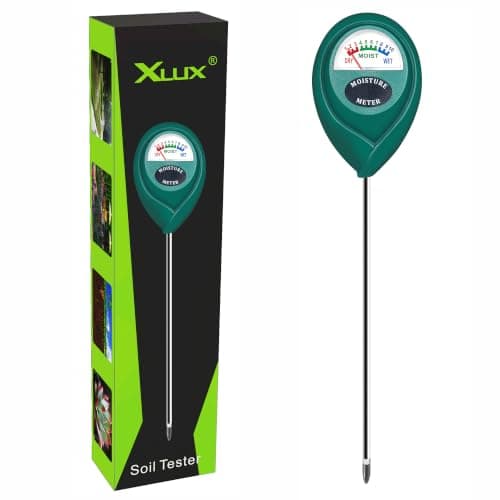
The default answer in this category, and it earns it: a single probe, no battery, a 1-to-10 dial with dry, moist and wet bands, and a probe long enough to reach the root zone of a real pot rather than the top inch.
#ad Price as of October 18, 2026, from Amazon. Prices change. How we make money.
Published specification
- Probe length
- About 7 in (17.5 cm)
- Power
- None required, since the probe generates its own signal in moist soil
- Scale
- 1 to 10, banded DRY, MOIST and WET
- Probe design
- Single probe, to limit root damage
- Weight
- About 2.5 oz (70 g)
- Probe length: XLUX published specification, via retail listing
- Power: XLUX published description
- Scale: XLUX published description
- Probe design: XLUX published description
- Weight: XLUX published specification, via retail listing
What is good about it
- No batteries means it works the day you dig it out of a drawer eighteen months later
- A 7-inch probe reaches the middle of a 6-inch pot, which is where the answer actually is
- The banded dial answers the only question you have, water or do not, without pretending to a percentage it cannot deliver
- Cheap enough to buy two and leave one in the room with the plants
What is not
- It reads conductivity, not water content, so heavily fertilized soil reads wetter than it is
- The 1-to-10 scale is relative, not calibrated to any standard, so two meters can disagree
- Single probe means one reading per insertion, and pots are not uniform
Skip this one if
Skip it if you have three plants and a finger. Virginia Tech's own guidance is to push a finger 1 to 3 inches into the mix and check, and for small pots that is genuinely as good. Buy a meter when the pots are deep enough that your finger cannot reach the root zone.
How it scored
- Published specification
- 8.5
- Probe reach
- 9.0
- Readability
- 9.0
- Value for money
- 10.0
- Measurement honesty
- 6.5
- Overall
- 8.7 / 10
Our editorial score, from published specifications and computed intervals. Not a test result. Specification source: XLUX T10 retail listing.
Questions people actually ask
- How long should you bottom water house plants?
Fifteen to thirty minutes for most pots, until the surface of the mix darkens. Never more than about 60 minutes - extension guidance gives that as the limit for a container standing in water.
- How often should you bottom water house plants?
At the same frequency you would top-water, since the plant’s water use is unchanged: once or twice a week for tropical foliage, once or twice a month for succulents. Bottom watering is a delivery method, not a schedule.
- Is bottom watering better than top watering?
For rewetting hydrophobic mix, for fungus gnats, and for plants with crowns that should stay dry, yes. But it never leaches salts, so you still need to water thoroughly from the top every fourth or fifth time and let it drain out.
- Why is there a white crust on my soil from bottom watering?
Accumulated mineral and fertilizer salts. Bottom watering carries them upward and nothing washes them out. Water thoroughly from the top until a good amount drains away, and discard it.
- Can you bottom water succulents?
Occasionally, yes - a short soak and a thorough drain is fine. As a routine on a capillary mat, no. Continuous bottom moisture against a plant published at once or twice a month is a rot risk.
Sources
Sources
- Criscione and Holliday-Goulart, Properly Watering Container Houseplants, Virginia Cooperative Extension SPES-804 (2026)
- Leaching Fraction: A Tool to Schedule Irrigation for Container-Grown Plants, Virginia Cooperative Extension SPES-128
- Daughtry, Watering but Not Overwatering Houseplants, NC State Extension (2022)
- Royal Horticultural Society, Watering plants wisely