Roundup
Best Plant Watering Spikes and Stakes
The reservoir is a bottle you already own, which makes capacity a number you control. It is why spikes beat globes on every axis except looks.
By Scooter M. - Enthusiast. Reads the manuals, compiles the specs, does the math. | Published
Disclosure
We earn a commission if you buy through our links. It does not change what we recommend or what you pay. Full disclosure.
The short answer
The one category where the claims hold up
We check every duration claim in this category against our own arithmetic, and the spike makers come out unusually well.
| Product | Published claim | Our computed interval | Verdict |
|---|---|---|---|
| Plant Nanny wine bottle stake | Up to 10 days, medium to large plant | 8 to 15 days | Claim sits inside our range |
| Plant Nanny spike, 2 L bottle | Up to 2 weeks | 20 to 42 days | Claim is conservative |
| Generic terracotta, 1 L bottle | Roughly 7 to 10 days | 10 to 20 days | Claim is conservative |
| Typical watering globe | 1 to 2 weeks, no stated capacity | 1 to 2 days at 118 ml | Claim is not supported |
That table is the argument for this whole section. Spikes publish or imply a capacity because the capacity is a bottle, and once a capacity exists the claim can be checked. Globes do not, and the claims do not survive.
The ceramic cone exception
Blumat sells a different thing under a similar name, and it deserves its own paragraph. Instead of a capacity, Blumat publishes a delivery rate: about 75 ml a day for the Classic and about 150 for the XL, with a maximum lift of 12 inches from the reservoir to the cone.
That is the correct specification for a demand-driven device, and it changes the sizing question entirely. A 6-inch tropical houseplant draws 350 ml every 3.5 to 7 days, which is 50 to 100 ml a day - so the Classic’s 75 ml a day sits inside the band and can genuinely keep up. An 8-inch pot draws 114 to 229 ml a day, which the Classic cannot cover and the XL can. Nobody else in the category gives you the numbers to make that call.
Setting one up so it works
- Water the pot thoroughly first. A spike is a top-up, not an initial watering. Pushing one into bone-dry mix produces a rush and then nothing.
- Soak the terracotta. At least fifteen minutes, fully submerged. Blumat is explicit about this for its cones and it applies to plain terracotta too - dry clay pulls air rather than water.
- Knock the air out under water. For a ceramic cone, hold cone and cap submerged and press the top on tightly with no bubble trapped inside. A cone with air in it does not siphon and does nothing at all.
- Push the cone fully into the soil. All of the clay in contact with mix. An exposed portion is a route for evaporation rather than delivery.
- Site the reservoir correctly. A gravity spike wants the bottle above the cone. A ceramic siphon system wants it below, and no more than 12 inches below.
Which one to buy
For one or two plants and a trip of up to two weeks, the Plant Nanny wine bottle stake is the pick. Its claim survives our arithmetic, the reservoir is a known 750 ml, and it is a few dollars.
For the longest passive interval available, the same maker’s bottle-adapter spike on a 2-liter soda bottle computes to 20 to 42 days on a 6-inch pot. It is genuinely ugly and it is the best value on this site. Our full Plant Nanny review checks every figure the maker publishes against our own arithmetic.
For a permanent setup on a plant you care about, the Blumat Classic is worth the extra because it is the only one that throttles by soil moisture with a published rate. Budget the careful setup, though - a Blumat that was not de-aerated is an ornament.
For a windowsill of six pots before a trip, a multipack of generic terracotta spikes costs less than one branded unit and works on the same principle, with more unit-to-unit variation. And for a raised bed rather than a windowsill, a buried olla is the same porous clay holding liters instead of a bottle.
Ranked picks
Quick picks
Ranked on published specifications and the computed refill interval, not on looks. Tap any row for the full write-up, including who should skip it.
| # | Product | Best for | Score | Price |
|---|---|---|---|---|
| 1 | 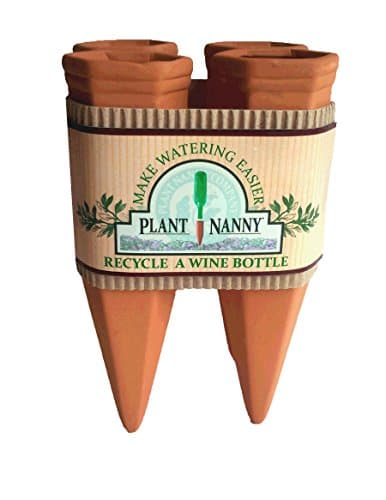 Plant Nanny Terracotta Wine Bottle StakesA one-to-two week trip, on medium indoor pots Plant Nanny Terracotta Wine Bottle StakesA one-to-two week trip, on medium indoor pots | Best overall watering spike | 9.1 | $19.99 - View on Amazon |
| 2 | 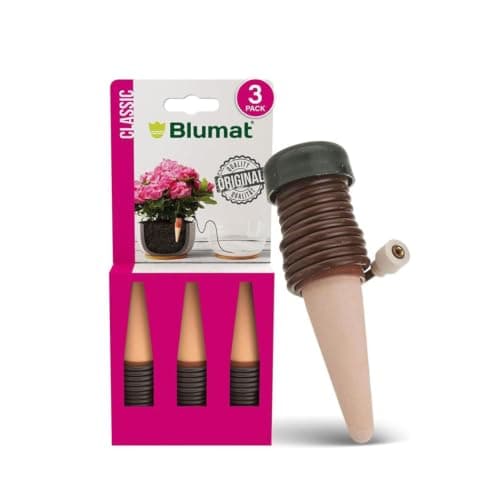 Blumat Classic Watering StakesSet-and-forget watering of 6-inch pots, for as long as the jug lasts Blumat Classic Watering StakesSet-and-forget watering of 6-inch pots, for as long as the jug lasts | Best published flow rate | 8.9 | $16.88 - View on Amazon |
| 3 | 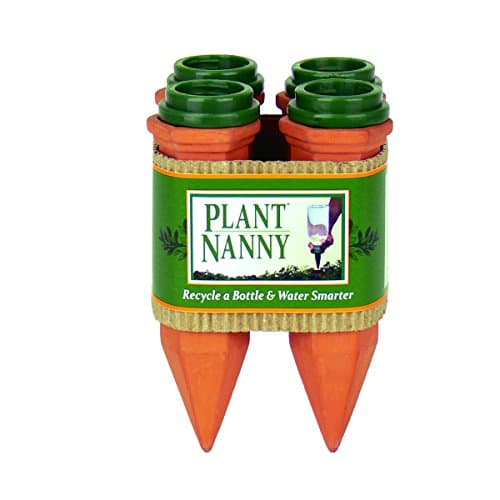 Plant Nanny Watering Spikes with Bottle AdapterThe longest unattended stretch you can get without a pump Plant Nanny Watering Spikes with Bottle AdapterThe longest unattended stretch you can get without a pump | Longest interval | 8.7 | $19.99 - View on Amazon |
| 4 | Blumat XL Classic Watering StakesLarger floor pots that out-drink a standard Classic | Best for large pots | 8.5 | Check price on Amazon |
| 5 | 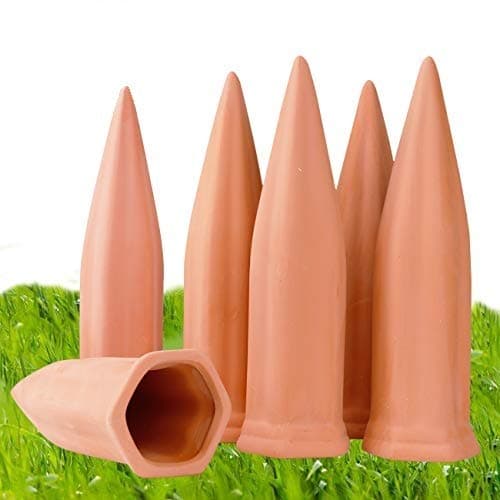 Terracotta Watering Spikes, MultipackCovering a whole windowsill of plants cheaply before a trip Terracotta Watering Spikes, MultipackCovering a whole windowsill of plants cheaply before a trip | Cheapest per pot | 7.8 | $18.39 - View on Amazon |
Scores are our editorial judgment from published specifications. They are not test results, and they are deliberately not marked up as ratings in this page’s structured data.
Pick #1 - Best overall watering spike
Plant Nanny Terracotta Wine Bottle Stakes
A one-to-two week trip, on medium indoor pots
Our top pick for one honest reason: it is one of the very few products in the watering-device category whose manufacturer's duration claim survives our arithmetic. A 750 ml bottle on a 6-inch pot computes to 8 to 15 days, and Plant Nanny claims up to 10.
#ad Price as of October 18, 2026, from Amazon. Prices change. How we make money.
Published specification
- Reservoir
- Any 750 ml wine bottle
- Manufacturer duration claim
- Up to 10 days for a medium to large plant
- Material
- Unglazed terracotta
- Watering method
- Porous terracotta releases water as the surrounding soil dries
- Reservoir: Plant Nanny published description
- Manufacturer duration claim: Plant Nanny published description
- Material: Plant Nanny published description
- Watering method: Plant Nanny published description
Refill interval - computed, not tested
About 8 to 15 days on a 6-inch pot, so the claim holds
750 ml divided by 350 ml per thorough watering of a 6-inch pot is 2.1 waterings. At once or twice a week, that is 8 to 15 days. Plant Nanny's own claim of up to 10 days sits inside that range rather than above it.
Assumes: 6-inch tropical root ball, indoors, 750 ml bottle. Light, temperature, humidity, soil mix and season all change how fast a pot dries, so treat this as a planning range and not a guarantee.
What is good about it
- The manufacturer's duration claim is conservative against our arithmetic, which is genuinely rare here
- The reservoir is a wine bottle, so capacity is a known 750 ml rather than a mystery
- Terracotta releases water in response to soil dryness, so it self-throttles in a way a glass globe does not
- Swap to a 2 liter soda bottle with the right adapter and the computed interval goes to 20 to 42 days
What is not
- A wine bottle standing in a plant pot is a look, and not everyone wants it
- Terracotta can clog with mineral deposits over time and needs an occasional soak
- On an 8-inch or larger pot the same 750 ml drops to 3 to 7 days
Skip this one if
Skip it if your plants are in large floor pots. A 750 ml bottle on a 10-inch pot is under two days of water, and no amount of terracotta changes the volume.
How it scored
- Published capacity
- 9.5
- Computed interval
- 9.0
- Honesty of claims
- 10.0
- Value for money
- 9.0
- Looks
- 6.0
- Overall
- 9.1 / 10
Our editorial score, from published specifications and computed intervals. Not a test result. Specification source: Plant Nanny wine bottle stake retail listing.
Pick #2 - Best published flow rate
Blumat Classic Watering Stakes
Set-and-forget watering of 6-inch pots, for as long as the jug lasts
The only device in this category with a published flow rate rather than a published duration, which changes the question entirely: it is limited by how fast it can deliver, not by how much it holds. About 75 ml a day is a near-exact match for a 6-inch tropical houseplant.
#ad Price as of October 18, 2026, from Amazon. Prices change. How we make money.
Published specification
- Delivery rate
- About 75 ml per day for the Classic, about 150 ml per day for the XL
- Maximum lift
- Draws water up to 12 in (30 cm)
- Reservoir
- Any container you supply, sited no more than 12 in below the cone
- Watering method
- Ceramic cone. Soil drying creates a vacuum that pulls water from the reservoir
- Setup requirement
- Soak the cone and cap for at least 15 minutes and knock out air bubbles under water
- Delivery rate: Blumat retailer published specification
- Maximum lift: Blumat retailer published specification
- Reservoir: Blumat published description
- Watering method: Blumat published description
- Setup requirement: Blumat published instructions
Refill interval - computed, not tested
Duration is set by the jug you attach, not by the device
A 6-inch tropical houseplant draws 350 ml every 3.5 to 7 days, which is 50 to 100 ml a day. The Classic's published maximum of about 75 ml a day sits inside that band, so it can keep a 6-inch pot going but cannot keep up with a thirsty 8-inch one at 114 to 229 ml a day. That is what the XL at about 150 ml a day is for. Attach a 2 liter jug and, at a real draw of 50 ml a day, that is about 40 days.
Assumes: 6-inch tropical root ball, indoors, reservoir within 12 in below the cone. Light, temperature, humidity, soil mix and season all change how fast a pot dries, so treat this as a planning range and not a guarantee.
What is good about it
- Publishes a flow rate, which is the correct spec for a demand-driven device and which nobody else in the category gives you
- Genuinely demand-driven: when the soil is wet the flow stops, so it does not drown the plant on a cool week
- Duration is whatever reservoir you can find room for, rather than a fixed bulb
- The XL doubles the rate for larger pots, so the range actually scales with plant size
What is not
- Fiddly setup, because the cone has to be soaked and de-aerated or it simply will not siphon
- The 12-inch lift limit constrains where the reservoir can sit, and it is easy to get wrong
- More expensive per pot than a spike or a globe
- Ceramic clogs in hard water and needs periodic cleaning
Skip this one if
Skip it if you want to unbox something and push it into the soil. This rewards a careful setup and punishes a casual one, and a Blumat that was not de-aerated properly is a Blumat that does nothing at all.
How it scored
- Published specification
- 10.0
- Computed interval
- 9.0
- Honesty of claims
- 9.5
- Value for money
- 7.0
- Ease of setup
- 5.5
- Overall
- 8.9 / 10
Our editorial score, from published specifications and computed intervals. Not a test result. Specification source: Blumat Classic published specification, via Sustainable Village.
Pick #3 - Longest interval
Plant Nanny Watering Spikes with Bottle Adapter
The longest unattended stretch you can get without a pump
The soda-bottle version: a 5.5-inch terracotta spike with a screw adapter that takes a standard plastic bottle. Two liters on the end of it is the largest gravity reservoir on this site that still costs almost nothing.
#ad Price as of October 18, 2026, from Amazon. Prices change. How we make money.
Published specification
- Spike length
- 5.5 in
- Reservoir
- Any screw-top plastic bottle, with 2 liter the common choice
- Manufacturer duration claim
- Up to 2 weeks with a 2 liter bottle
- Material
- Unglazed terracotta with a plastic screw adapter
- Spike length: Lee Valley published specification
- Reservoir: Lee Valley published description
- Manufacturer duration claim: Lee Valley published description
- Material: Lee Valley published description
Refill interval - computed, not tested
About 20 to 42 days on a 6-inch pot
2,000 ml divided by 350 ml per thorough watering of a 6-inch pot is 5.7 waterings. At once or twice a week, that is 20 to 42 days. The published claim of up to two weeks is well inside that, which is the direction you want a claim to be wrong in.
Assumes: 6-inch tropical root ball, indoors, 2 liter bottle. Light, temperature, humidity, soil mix and season all change how fast a pot dries, so treat this as a planning range and not a guarantee.
What is good about it
- The published claim is conservative against the arithmetic by a wide margin
- Two liters for the price of an empty soda bottle is the best cost per milliliter on this site
- Terracotta throttles delivery by soil moisture rather than pouring on a schedule
What is not
- A 2 liter bottle upside down in a houseplant is genuinely ugly
- Top-heavy in a light pot, and it will tip a small plastic pot over
- Needs the ceramic soaked and de-aerated before it works properly
Skip this one if
Skip it if the plant lives somewhere you look at every day. This is a solution for the week you are away, not a permanent fixture.
How it scored
- Published capacity
- 9.5
- Computed interval
- 9.5
- Honesty of claims
- 9.5
- Value for money
- 10.0
- Looks
- 3.0
- Overall
- 8.7 / 10
Our editorial score, from published specifications and computed intervals. Not a test result. Specification source: Lee Valley Plant Nanny watering spikes listing.
Pick #4 - Best for large pots
Blumat XL Classic Watering Stakes
Larger floor pots that out-drink a standard Classic
The same ceramic-cone mechanism at roughly double the delivery rate, which is the version that actually covers an 8-inch pot. If you sized a Classic to a large plant and it dried out anyway, this is why.
#ad We do not currently hold a live price for this, so we do not show one. How we make money.
Published specification
- Delivery rate
- About 150 ml per day, roughly double the Classic
- Maximum lift
- Draws water up to 12 in (30 cm)
- Watering method
- Ceramic cone, vacuum-driven by soil dryness
- Delivery rate: Blumat retailer published specification
- Maximum lift: Blumat retailer published specification
- Watering method: Blumat published description
Refill interval - computed, not tested
Covers an 8-inch pot's 114 to 229 ml a day at the low end
An 8-inch tropical houseplant draws 800 ml every 3.5 to 7 days, which is 114 to 229 ml a day. The XL's published rate of about 150 ml a day sits inside that band. The Classic's 75 ml a day does not.
Assumes: 8-inch tropical root ball, indoors. Light, temperature, humidity, soil mix and season all change how fast a pot dries, so treat this as a planning range and not a guarantee.
What is good about it
- The only spec-published option here that scales to a genuinely large pot
- Same demand-driven behavior as the Classic, so it still stops when the soil is wet
What is not
- Same fussy soak-and-de-aerate setup as the Classic
- At 150 ml a day a large plant empties a small jug quickly, so it needs a proper reservoir
- Overkill and slow-flowing for small pots
Skip this one if
Skip it for anything under about 8 inches. On a small pot the higher rate is not an advantage, and you have paid extra for headroom you will not use.
How it scored
- Published specification
- 10.0
- Computed interval
- 8.5
- Honesty of claims
- 9.5
- Value for money
- 6.5
- Ease of setup
- 5.5
- Overall
- 8.5 / 10
Our editorial score, from published specifications and computed intervals. Not a test result. Specification source: Blumat XL published specification, via Sustainable Village.
Pick #5 - Cheapest per pot
Terracotta Watering Spikes, Multipack
Covering a whole windowsill of plants cheaply before a trip
Generic unbranded terracotta spikes, usually four to ten a pack, all working on the same porous-clay principle as Plant Nanny at a fraction of the price. Capacity is whatever bottle you screw on, which is exactly why they beat globes.
#ad Price as of October 18, 2026, from Amazon. Prices change. How we make money.
Published specification
- Reservoir
- Any screw-top bottle you supply
- Common listed capacity claim
- Some listings state 1 liter, giving roughly 7 to 10 days
- Material
- Unglazed terracotta
- Pack size
- Commonly 4, 6 or 10 per pack
- Reservoir: Published product descriptions across the category
- Common listed capacity claim: Published retail listings
- Material: Published product descriptions
- Pack size: Published retail listings
Refill interval - computed, not tested
About 10 to 20 days with a 1 liter bottle on a 6-inch pot
1,000 ml divided by 350 ml per thorough watering of a 6-inch pot is 2.9 waterings. At once or twice a week, that is 10 to 20 days. The commonly listed claim of 7 to 10 days is conservative against that.
Assumes: 6-inch tropical root ball, indoors, 1 liter bottle. Light, temperature, humidity, soil mix and season all change how fast a pot dries, so treat this as a planning range and not a guarantee.
What is good about it
- Cheapest way to cover a lot of pots at once
- Capacity is set by your bottle, so it is a number you actually control
- Same self-throttling porous-clay behavior as the branded versions
What is not
- Quality varies pack to pack, and some spikes are fired too dense to release water usefully
- Thread fit with real bottles is hit and miss on the cheapest packs
- Fragile, so expect to break one pushing it into dense soil
Skip this one if
Skip it if you only have one or two plants to cover. For that, the branded Plant Nanny is a couple of dollars more and far more consistent between units.
How it scored
- Published capacity
- 6.5
- Computed interval
- 8.5
- Honesty of claims
- 8.0
- Value for money
- 9.5
- Build consistency
- 5.0
- Overall
- 7.8 / 10
Our editorial score, from published specifications and computed intervals. Not a test result. Specification source: Terracotta watering spike multipack retail listing.
Questions people actually ask
- Do terracotta watering spikes actually work?
Yes, and better than globes, because the reservoir is a bottle whose capacity you know and the clay releases water in response to soil dryness. The published duration claims are the only ones in this category that survive our arithmetic.
- What bottle fits a watering spike?
Wine-bottle stakes take a standard 750 ml wine bottle. Adapter spikes take a screw-top plastic bottle, and a 2-liter soda bottle is the usual choice because it gives the longest interval for nothing.
- Why is my terracotta spike not releasing water?
Usually air. The clay has to be soaked for at least fifteen minutes and the air knocked out under water before assembly. A cone with a trapped bubble will not siphon. The other cause is clay fired too dense to be usefully porous, which happens on cheap multipacks.
- How many watering spikes do I need per plant?
One for a pot up to about 8 inches. For larger pots, either use two or step up to a higher-rate cone - a Blumat Classic at about 75 ml a day cannot keep up with an 8-inch plant’s 114 to 229 ml a day, but the XL at about 150 can.
- Can I leave watering spikes in permanently?
Yes, and ceramic cone systems are designed for it. Plain terracotta accumulates mineral deposits over months and needs an occasional soak in water or a weak vinegar solution to stay porous.
Sources
Sources
- Plant Nanny terracotta wine bottle stake published description
- Lee Valley, Plant Nanny watering spikes published specification
- Blumat Classic published specification, via Sustainable Village
- Criscione and Holliday-Goulart, Properly Watering Container Houseplants, Virginia Cooperative Extension SPES-804 (2026)