Head to head
Watering Globes vs Terracotta Spikes
They look like alternatives. On capacity and on flow control, they are not close.
By Scooter M. - Enthusiast. Reads the manuals, compiles the specs, does the math. | Published
Disclosure
We earn a commission if you buy through our links. It does not change what we recommend or what you pay. Full disclosure.
The short answer
The comparison
| Watering globe | Terracotta spike | |
|---|---|---|
| Typical capacity | 118 to 500 ml | 750 ml to 2 L, your bottle |
| Capacity published? | Almost never | It is a bottle, so yes |
| Computed interval, 6 in pot | 1 to 10 days by size | 8 to 42 days by bottle |
| Flow control | Air ingress only, depends on seating | Soil moisture gradient, self-throttling |
| Manufacturer claim vs our math | Not supported | Conservative |
| Looks in a pot | Attractive | A bottle upside down |
| Breakage risk | Glass in soil | Clay chips, bottle is plastic |
| Typical failure | Empties in hours if seated at an angle | Clogs with mineral scale over months |
The mechanism difference, which explains everything else
A globe works by vacuum. Water can only leave the bulb as air enters through the stem, so the release rate is set by the geometry of that air path in the soil. Nothing about it responds to the plant. Seat the stem at an angle and you widen the path; the globe can then empty in hours, which is what The Indoor Nursery reported when they used one on a spider plant.
A terracotta spike works by porosity. Water passes through the clay wall at a rate set by the moisture gradient across it. Wet soil means a small gradient and slow flow. Dry soil means a large gradient and faster flow. It is genuinely demand-responsive without any moving part, which is the same principle the engineered ceramic cones use - and Blumat publishes the resulting rate at about 75 ml a day for its Classic.
That difference is why a globe can drown a plant and a spike rarely does. If you are away for a cool, dark fortnight, the globe delivers on the same schedule it would in a heatwave, and the spike slows down.
Where a globe is the right choice
Three cases, and they are real rather than consolation prizes.
Small pots. A 118 ml globe in a 4-inch pot computes to 4 to 8 days, which is a legitimate long weekend. The arithmetic only turns against globes as the pot grows.
Succulents. Their published cadence is once or twice a month, so a 500 ml globe on a 6-inch succulent computes to 21 to 42 days. In this one niche a globe outperforms most of the vacation category.
When it has to look acceptable. A globe on a shelf is ornamental. A 2-liter soda bottle upside down in the same pot is not, and there is no arguing anyone out of caring about that.
The verdict
If your pots are 6 inches or larger and your plants are tropical foliage, buy a spike. It costs about the same, holds several times more, behaves better, and the manufacturer claims survive checking rather than collapsing under it.
If your pots are small, or your plants are succulents, or you need it to look nice on a shelf, a large globe is a reasonable purchase - and buy the biggest one whose listing states a capacity in ml. If you want the full honest treatment of what globes can and cannot do, that is its own page, and our review of the top-ranked terracotta stake sets out why the spike side of this comparison wins on published numbers.
What we would buy for this
The gear that fits this problem
Chosen from the same registry as our roundups, on published specifications and the computed refill interval.
Plant Nanny Terracotta Wine Bottle Stakes
A one-to-two week trip, on medium indoor pots
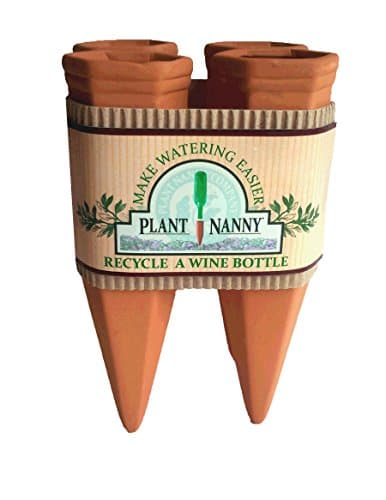
Our top pick for one honest reason: it is one of the very few products in the watering-device category whose manufacturer's duration claim survives our arithmetic. A 750 ml bottle on a 6-inch pot computes to 8 to 15 days, and Plant Nanny claims up to 10.
#ad Price as of October 18, 2026, from Amazon. Prices change. How we make money.
Published specification
- Reservoir
- Any 750 ml wine bottle
- Manufacturer duration claim
- Up to 10 days for a medium to large plant
- Material
- Unglazed terracotta
- Watering method
- Porous terracotta releases water as the surrounding soil dries
- Reservoir: Plant Nanny published description
- Manufacturer duration claim: Plant Nanny published description
- Material: Plant Nanny published description
- Watering method: Plant Nanny published description
Refill interval - computed, not tested
About 8 to 15 days on a 6-inch pot, so the claim holds
750 ml divided by 350 ml per thorough watering of a 6-inch pot is 2.1 waterings. At once or twice a week, that is 8 to 15 days. Plant Nanny's own claim of up to 10 days sits inside that range rather than above it.
Assumes: 6-inch tropical root ball, indoors, 750 ml bottle. Light, temperature, humidity, soil mix and season all change how fast a pot dries, so treat this as a planning range and not a guarantee.
What is good about it
- The manufacturer's duration claim is conservative against our arithmetic, which is genuinely rare here
- The reservoir is a wine bottle, so capacity is a known 750 ml rather than a mystery
- Terracotta releases water in response to soil dryness, so it self-throttles in a way a glass globe does not
- Swap to a 2 liter soda bottle with the right adapter and the computed interval goes to 20 to 42 days
What is not
- A wine bottle standing in a plant pot is a look, and not everyone wants it
- Terracotta can clog with mineral deposits over time and needs an occasional soak
- On an 8-inch or larger pot the same 750 ml drops to 3 to 7 days
Skip this one if
Skip it if your plants are in large floor pots. A 750 ml bottle on a 10-inch pot is under two days of water, and no amount of terracotta changes the volume.
How it scored
- Published capacity
- 9.5
- Computed interval
- 9.0
- Honesty of claims
- 10.0
- Value for money
- 9.0
- Looks
- 6.0
- Overall
- 9.1 / 10
Our editorial score, from published specifications and computed intervals. Not a test result. Specification source: Plant Nanny wine bottle stake retail listing.
Large Hand-Blown Glass Watering Globes
A 6-inch houseplant over a long weekend, where a small globe fails
The large end of the globe category, in the 200 to 500 ml bracket rather than the 80 to 120 ml bracket most globes actually occupy. At 500 ml the arithmetic finally supports something close to the category's promise, which is the whole reason size is the only spec that matters here.
#ad We do not currently hold a live price for this, so we do not show one. How we make money.
Published specification
- Reservoir capacity
- Typically listed 200 to 500 ml for large globes, though individual capacity is usually not published
- Material
- Hand-blown glass
- Fill method
- Invert and fill through the stem
- Reservoir capacity: Survey of retail listings across the globe category
- Material: Published product descriptions
- Fill method: Published product descriptions
Refill interval - computed, not tested
About 5 to 10 days at 500 ml on a 6-inch tropical
500 ml divided by 350 ml per thorough watering of a 6-inch pot is 1.4 waterings. At once or twice a week, that is 5 to 10 days. On a succulent at once or twice a month, the same globe stretches to 21 to 42 days.
Assumes: 500 ml globe, tropical houseplant indoors unless stated otherwise. Light, temperature, humidity, soil mix and season all change how fast a pot dries, so treat this as a planning range and not a guarantee.
What is good about it
- The only globes where the arithmetic supports anything like the advertised interval
- Attractive, and the large sizes are less prone to being knocked over than thin-stemmed small ones
- On succulents, where the published cadence is once or twice a month, even a mid-sized globe covers weeks
What is not
- Capacity is still almost never printed on the listing, so you are buying by eye
- A 500 ml sphere is large in a 6-inch pot and takes up visible root-zone space
- Same fundamental problem as all globes: flow depends on soil contact, not on a valve
Skip this one if
Skip it if the listing does not state a capacity in ml and does not show a size reference. In this category the number is the product, and a globe sold without one is a lottery ticket.
How it scored
- Published capacity
- 3.5
- Computed interval
- 7.5
- Build and materials
- 7.0
- Value for money
- 7.5
- Honesty of claims
- 5.0
- Overall
- 6.6 / 10
Our editorial score, from published specifications and computed intervals. Not a test result. Specification source: Garden Gate, watering bulb category overview.
Blumat Classic Watering Stakes
Set-and-forget watering of 6-inch pots, for as long as the jug lasts
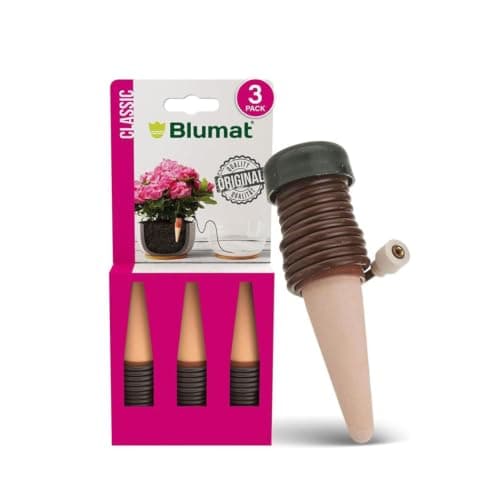
The only device in this category with a published flow rate rather than a published duration, which changes the question entirely: it is limited by how fast it can deliver, not by how much it holds. About 75 ml a day is a near-exact match for a 6-inch tropical houseplant.
#ad Price as of October 18, 2026, from Amazon. Prices change. How we make money.
Published specification
- Delivery rate
- About 75 ml per day for the Classic, about 150 ml per day for the XL
- Maximum lift
- Draws water up to 12 in (30 cm)
- Reservoir
- Any container you supply, sited no more than 12 in below the cone
- Watering method
- Ceramic cone. Soil drying creates a vacuum that pulls water from the reservoir
- Setup requirement
- Soak the cone and cap for at least 15 minutes and knock out air bubbles under water
- Delivery rate: Blumat retailer published specification
- Maximum lift: Blumat retailer published specification
- Reservoir: Blumat published description
- Watering method: Blumat published description
- Setup requirement: Blumat published instructions
Refill interval - computed, not tested
Duration is set by the jug you attach, not by the device
A 6-inch tropical houseplant draws 350 ml every 3.5 to 7 days, which is 50 to 100 ml a day. The Classic's published maximum of about 75 ml a day sits inside that band, so it can keep a 6-inch pot going but cannot keep up with a thirsty 8-inch one at 114 to 229 ml a day. That is what the XL at about 150 ml a day is for. Attach a 2 liter jug and, at a real draw of 50 ml a day, that is about 40 days.
Assumes: 6-inch tropical root ball, indoors, reservoir within 12 in below the cone. Light, temperature, humidity, soil mix and season all change how fast a pot dries, so treat this as a planning range and not a guarantee.
What is good about it
- Publishes a flow rate, which is the correct spec for a demand-driven device and which nobody else in the category gives you
- Genuinely demand-driven: when the soil is wet the flow stops, so it does not drown the plant on a cool week
- Duration is whatever reservoir you can find room for, rather than a fixed bulb
- The XL doubles the rate for larger pots, so the range actually scales with plant size
What is not
- Fiddly setup, because the cone has to be soaked and de-aerated or it simply will not siphon
- The 12-inch lift limit constrains where the reservoir can sit, and it is easy to get wrong
- More expensive per pot than a spike or a globe
- Ceramic clogs in hard water and needs periodic cleaning
Skip this one if
Skip it if you want to unbox something and push it into the soil. This rewards a careful setup and punishes a casual one, and a Blumat that was not de-aerated properly is a Blumat that does nothing at all.
How it scored
- Published specification
- 10.0
- Computed interval
- 9.0
- Honesty of claims
- 9.5
- Value for money
- 7.0
- Ease of setup
- 5.5
- Overall
- 8.9 / 10
Our editorial score, from published specifications and computed intervals. Not a test result. Specification source: Blumat Classic published specification, via Sustainable Village.
Questions people actually ask
- Are watering spikes better than watering globes?
For pots of 6 inches or more, yes, clearly. A spike takes a bottle you supply, so it holds six to seventeen times as much, and terracotta throttles flow by soil moisture where a globe does not throttle at all.
- Which is better for succulents?
Either works, and a globe is genuinely fine here. The succulent cadence is published at once or twice a month, so a 500 ml globe computes to 21 to 42 days on a 6-inch pot. Just do not leave a continuously wet device in a succulent permanently.
- Do watering globes drown plants?
They can. Because release depends on air ingress rather than plant demand, a globe seated loosely can dump its contents into one zone quickly. That is exactly what one published first-hand account describes, ending in a waterlogged spider plant.
- Can I use both together?
You can, but there is little point. Two devices in one pot means twice the disturbed root zone for the same total volume you would get from one bigger bottle on a spike.
Sources
Sources
- The Indoor Nursery, a first-hand account of using watering globes
- Plant Nanny terracotta wine bottle stake published description
- Blumat Classic published specification, via Sustainable Village
- Criscione and Holliday-Goulart, Properly Watering Container Houseplants, Virginia Cooperative Extension SPES-804 (2026)