Guide
Do Watering Globes Actually Work?
Yes, on small pots, for a few days. The gap between that and what is advertised is the largest in this whole category, and it is a volume problem.
By Scooter M. - Enthusiast. Reads the manuals, compiles the specs, does the math. | Published
Disclosure
We earn a commission if you buy through our links. It does not change what we recommend or what you pay. Full disclosure.
The short answer
The whole argument in one calculation
Every input here is published or measurable, and you can check all three.
- What a globe holds. Manufacturers do not publish this, which is itself the story. The one measured figure we could find comes from The Indoor Nursery, who describe filling a small globe with about half a cup of water - roughly 118 ml. Listings across the category put small globes at 80 to 120 ml and large ones at 200 to 500 ml.
- What one watering takes. About 350 ml for a 6-inch pot, derived from pot geometry and set out in full on our methodology page so you can substitute your own assumption.
- How often. Virginia Cooperative Extension publishes “sometimes once or twice a week” for tropical houseplants and “once or twice a month” for succulents and cacti.
118 divided by 350 is 0.34 of a watering. At one watering every 3.5 to 7 days, that is 1.2 to 2.4 days. There is no interpretation involved and no product being singled out - it is the same arithmetic for every small globe on the market.
Where the advertised claim comes from
The one-to-two-week claim is not necessarily dishonest. It is a claim about an unstated pot. On a 4-inch pot needing 100 ml per watering, a 118 ml globe holds 1.2 waterings, which is four to eight days - and a small pot with a succulent in it genuinely gets to two weeks and beyond. The claim is defensible for the smallest case and simply never states which case it is.
That is the pattern across this whole category: a duration quoted without a pot size, which makes it a claim about nothing. It is why every number on this site names its pot.
The one published account of someone actually using them
We looked for first-hand evidence rather than more opinions. The Indoor Nursery published a genuinely useful account: their small globes emptied overnight or within a few hours, against an advertised one to two weeks, and rather than keeping the plant watered they waterlogged a spider plant. A commenter reported the same on a prayer plant before a two-week trip.
Their conclusion was blunt - the globes drained too quickly and would not work for someone on vacation, as it is advertised. One commenter also worked out the most useful fix in the thread: inserting the globe straight down rather than at an angle slowed it considerably, because an angled stem admits more air.
That is exactly what our arithmetic predicts, arrived at independently, which is about as much corroboration as a category with no published specifications can offer.
When a globe is genuinely the right product
| Situation | Globe size | Computed interval | Verdict |
|---|---|---|---|
| 4 in tropical pot | 118 ml small | 4 to 8 days | Works |
| 6 in tropical pot | 500 ml large | 5 to 10 days | Works |
| 6 in succulent | 500 ml large | 21 to 42 days | Works well |
| 6 in tropical pot | 118 ml small | 1 to 2 days | Does not work |
| 8 in tropical pot | Any globe | Under 4 days | Does not work |
What to do instead, when it does not work
Buy volume. A terracotta spike costs about the same as a pack of globes, screws onto a bottle you already own, and holds 750 ml or 2 liters instead of 118. The computed interval on a 6-inch pot goes from one to two days to eight to fifteen, or twenty to forty-two with the bigger bottle. We review that stake in full, and the full comparison is here.
And if you already own globes, they are not wasted. Use them on your smallest pots, top them up as part of a normal weekly routine rather than as trip cover, and insert them straight down into pre-moistened soil, which is the single change that most improves how long they last.
If it is one specific product you are weighing up, our review of the original Aqua Globes runs the same arithmetic on the bulb that set this whole category’s expectations.
What we would buy for this
The gear that fits this problem
Chosen from the same registry as our roundups, on published specifications and the computed refill interval.
Large Hand-Blown Glass Watering Globes
A 6-inch houseplant over a long weekend, where a small globe fails
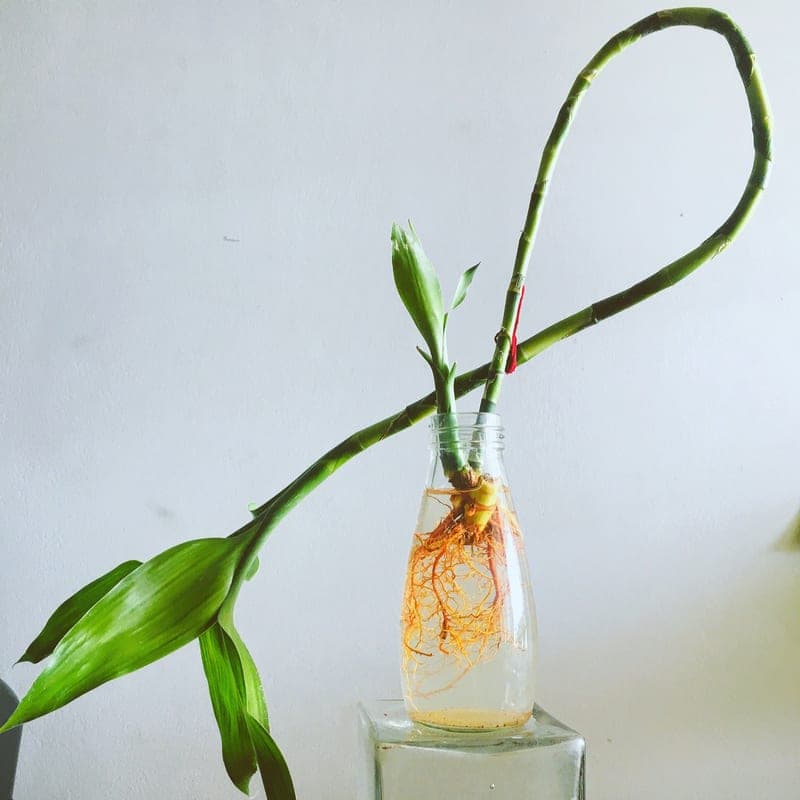
The large end of the globe category, in the 200 to 500 ml bracket rather than the 80 to 120 ml bracket most globes actually occupy. At 500 ml the arithmetic finally supports something close to the category's promise, which is the whole reason size is the only spec that matters here.
#ad We do not currently hold a live price for this, so we do not show one. How we make money.
Published specification
- Reservoir capacity
- Typically listed 200 to 500 ml for large globes, though individual capacity is usually not published
- Material
- Hand-blown glass
- Fill method
- Invert and fill through the stem
- Reservoir capacity: Survey of retail listings across the globe category
- Material: Published product descriptions
- Fill method: Published product descriptions
Refill interval - computed, not tested
About 5 to 10 days at 500 ml on a 6-inch tropical
500 ml divided by 350 ml per thorough watering of a 6-inch pot is 1.4 waterings. At once or twice a week, that is 5 to 10 days. On a succulent at once or twice a month, the same globe stretches to 21 to 42 days.
Assumes: 500 ml globe, tropical houseplant indoors unless stated otherwise. Light, temperature, humidity, soil mix and season all change how fast a pot dries, so treat this as a planning range and not a guarantee.
What is good about it
- The only globes where the arithmetic supports anything like the advertised interval
- Attractive, and the large sizes are less prone to being knocked over than thin-stemmed small ones
- On succulents, where the published cadence is once or twice a month, even a mid-sized globe covers weeks
What is not
- Capacity is still almost never printed on the listing, so you are buying by eye
- A 500 ml sphere is large in a 6-inch pot and takes up visible root-zone space
- Same fundamental problem as all globes: flow depends on soil contact, not on a valve
Skip this one if
Skip it if the listing does not state a capacity in ml and does not show a size reference. In this category the number is the product, and a globe sold without one is a lottery ticket.
How it scored
- Published capacity
- 3.5
- Computed interval
- 7.5
- Build and materials
- 7.0
- Value for money
- 7.5
- Honesty of claims
- 5.0
- Overall
- 6.6 / 10
Our editorial score, from published specifications and computed intervals. Not a test result. Specification source: Garden Gate, watering bulb category overview.
Plant Nanny Terracotta Wine Bottle Stakes
A one-to-two week trip, on medium indoor pots
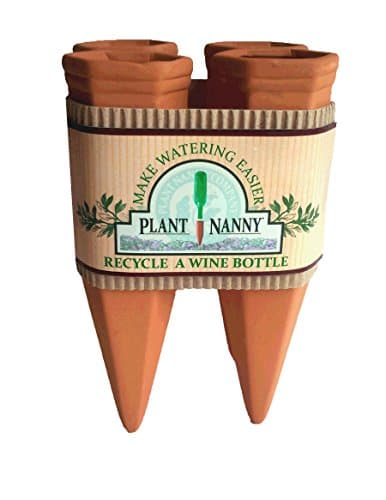
Our top pick for one honest reason: it is one of the very few products in the watering-device category whose manufacturer's duration claim survives our arithmetic. A 750 ml bottle on a 6-inch pot computes to 8 to 15 days, and Plant Nanny claims up to 10.
#ad Price as of October 19, 2026, from Amazon. Prices change. How we make money.
Published specification
- Reservoir
- Any 750 ml wine bottle
- Manufacturer duration claim
- Up to 10 days for a medium to large plant
- Material
- Unglazed terracotta
- Watering method
- Porous terracotta releases water as the surrounding soil dries
- Reservoir: Plant Nanny published description
- Manufacturer duration claim: Plant Nanny published description
- Material: Plant Nanny published description
- Watering method: Plant Nanny published description
Refill interval - computed, not tested
About 8 to 15 days on a 6-inch pot, so the claim holds
750 ml divided by 350 ml per thorough watering of a 6-inch pot is 2.1 waterings. At once or twice a week, that is 8 to 15 days. Plant Nanny's own claim of up to 10 days sits inside that range rather than above it.
Assumes: 6-inch tropical root ball, indoors, 750 ml bottle. Light, temperature, humidity, soil mix and season all change how fast a pot dries, so treat this as a planning range and not a guarantee.
What is good about it
- The manufacturer's duration claim is conservative against our arithmetic, which is genuinely rare here
- The reservoir is a wine bottle, so capacity is a known 750 ml rather than a mystery
- Terracotta releases water in response to soil dryness, so it self-throttles in a way a glass globe does not
- Swap to a 2 liter soda bottle with the right adapter and the computed interval goes to 20 to 42 days
What is not
- A wine bottle standing in a plant pot is a look, and not everyone wants it
- Terracotta can clog with mineral deposits over time and needs an occasional soak
- On an 8-inch or larger pot the same 750 ml drops to 3 to 7 days
Skip this one if
Skip it if your plants are in large floor pots. A 750 ml bottle on a 10-inch pot is under two days of water, and no amount of terracotta changes the volume.
How it scored
- Published capacity
- 9.5
- Computed interval
- 9.0
- Honesty of claims
- 10.0
- Value for money
- 9.0
- Looks
- 6.0
- Overall
- 9.1 / 10
Our editorial score, from published specifications and computed intervals. Not a test result. Specification source: Plant Nanny wine bottle stake retail listing.
Aqua Globes Glass Watering Bulbs
A small pot on a shelf, topped up as part of a normal routine

The original as-seen-on-TV watering globe, and the product that set the category's expectation that a glass bulb covers a two-week vacation. Our arithmetic says a globe this size covers a day or two on a medium houseplant, and the one publisher we found who actually used a set reported theirs emptied overnight.
#ad Price as of October 19, 2026, from Amazon. Prices change. How we make money.
Published specification
- Reservoir capacity
- Not published by the manufacturer
- Representative fill
- About 118 ml (half a cup) for a small globe
- Material
- Blown glass
- Fill method
- Invert and fill through the stem
- Reservoir capacity: Checked listings across the globe category, capacity is essentially never published
- Representative fill: The Indoor Nursery, measured fill while using a small globe
- Material: Published product description
- Fill method: Published product description
Refill interval - computed, not tested
About 1 to 2 days on a 6-inch tropical houseplant
118 ml divided by 350 ml per thorough watering of a 6-inch pot is 0.3 of a watering. At once or twice a week, that is 1.2 to 2.4 days. On a 4-inch pot needing 100 ml, the same globe gives 1.2 waterings, or about 4 to 8 days.
Assumes: Small globe, representative 118 ml fill, tropical houseplant indoors. Light, temperature, humidity, soil mix and season all change how fast a pot dries, so treat this as a planning range and not a guarantee.
What is good about it
- Cheap, and pleasant to look at in a pot
- For a genuinely small pot, 4 inches or under, the arithmetic works out to most of a week
- No mechanism to fail, no batteries, nothing to program
What is not
- No published capacity, so the buyer has no way to check the vacation claim before purchase
- On a 6-inch pot the volume simply is not there, whatever the marketing says
- Glass in soil, near a floor, around pets and children
- Reports of globes emptying in hours when pushed in at an angle, because the air path opens up
Skip this one if
Skip it if you are leaving for more than a long weekend, or if your pots are 6 inches or bigger. This is the most over-promised product in the category and the volume is not a matter of opinion.
How it scored
- Published capacity
- 1.0
- Computed interval
- 2.5
- Build and materials
- 6.0
- Value for money
- 7.0
- Honesty of claims
- 2.0
- Overall
- 4.8 / 10
Our editorial score, from published specifications and computed intervals. Not a test result. Specification source: The Indoor Nursery, first-hand account of using watering globes.
Questions people actually ask
- Do watering globes really work?
Within their volume, yes. A small globe of about 118 ml covers a 4-inch tropical pot for four to eight days. On a 6-inch pot it covers one to two days, because one thorough watering of that pot is about 350 ml and the published cadence is once or twice a week.
- Are watering globes a gimmick?
The mechanism is sound - vacuum release into soil is real physics. The problem is that duration claims are quoted without a pot size, and for the pot sizes most people own, the volume is not there.
- Why did my watering globe empty in one night?
Usually the seating. Water leaves only as air enters, and an angled stem widens the air path. Very dry or coarse mix does it too, by absorbing the contents quickly. Insert straight down into soil that has already been watered thoroughly.
- Can watering globes overwater a plant?
Yes. Because release depends on air ingress rather than plant demand, a loosely seated globe can dump its volume into a small zone. The one published first-hand account we found ended with a waterlogged spider plant rather than a dry one.
- What size watering globe should I buy?
The largest whose listing states a capacity in milliliters. At 500 ml you get five to ten days on a 6-inch tropical pot. Below about 200 ml, treat it as a decoration with a top-up function rather than trip cover.
Sources