Roundup
Best Way to Water Indoor Plants While on Vacation
Every option here is costed in milliliters against a real pot. Buy the reservoir that covers your trip, not the one with the best packaging.
By Scooter M. - Enthusiast. Reads the manuals, compiles the specs, does the math. | Published
Disclosure
We earn a commission if you buy through our links. It does not change what we recommend or what you pay. Full disclosure.
The short answer
Start with your water budget, not with a product
Virginia Cooperative Extension publishes the cadence for a tropical houseplant as once or twice a week. We publish the volume of one thorough watering by pot diameter, derived from pot geometry on the methodology page. Multiply those together and you have exactly how much water each plant needs while you are gone. Then the shopping is trivial, because most options are eliminated by volume before you read a single review.
| Pot diameter | One thorough watering | One week needs | Two weeks needs |
|---|---|---|---|
| 4 in | 100 ml | 100 to 200 ml | 200 to 400 ml |
| 6 in | 350 ml | 350 to 700 ml | 700 ml to 1.4 L |
| 8 in | 800 ml | 800 ml to 1.6 L | 1.6 to 3.2 L |
| 10 in | 1.6 L | 1.6 to 3.2 L | 3.2 to 6.4 L |
Now compare that to what things hold. A small glass globe: about 118 ml. A wine bottle on a spike: 750 ml. A soda bottle on a spike: 2 liters. A jug feeding a Blumat: whatever you can fit. A 5-gallon drip reservoir: 19 liters. The gap between the first and the last is a factor of a hundred and sixty, and every one of them is sold under the same promise.
Why the top pick is a spike and not a globe
Two reasons, both checkable. The first is volume: a bottle you supply is six to seventeen times a small globe, and volume is the only thing that decides duration. The second is behavior. Unglazed terracotta releases water in response to how dry the soil around it is - wet soil slows it, dry soil speeds it. A glass globe has no throttle at all; it releases when air can get in, which depends on how it happens to be seated in the mix.
That difference is not theoretical. The one first-hand account we could find of somebody actually using globes reported theirs emptying overnight against an advertised one to two weeks, and waterlogging a spider plant in the process. Pushing a globe in at an angle widens the air path, which is enough to turn days into hours.
The Blumat exception
One product in this category publishes a flow rate rather than a duration, and it changes the shape of the problem. The Blumat Classic is specified at about 75 ml per day, and its ceramic cone only draws when the surrounding soil dries. A 6-inch tropical houseplant needs 350 ml every 3.5 to 7 days, which is 50 to 100 ml a day, so the Classic sits neatly inside that band. Duration then depends only on the jug you attach: a 2-liter jug at a real draw of 50 ml a day is about 40 days.
The catch is that it does not work if you set it up carelessly. The cone has to be soaked and de-aerated under water before use, and the reservoir has to sit within 12 inches below the cone. Get either wrong and it does nothing at all, silently, for the entire trip.
The free half of the job
Move plants away from windows and heat sources. Virginia Cooperative Extension lists temperature, humidity and light intensity among the factors that change how much water a plant needs, and the effect is large - a plant in a cool interior spot can last roughly twice as long as the same plant on a sunny sill. Group the pots together so they raise the local humidity around each other, and so you only have to set up one rig.
Water thoroughly the morning you go - all the way through until it drains - and then empty the saucer. Extension guidance is explicit that a container should not stand in water for more than 60 minutes, so a full saucer is a rot risk rather than a reserve.
If you are away longer than a fortnight, none of these passive options is honest cover and the long-trip page is the one you want.
Ranked picks
Quick picks
Ranked on published specifications and the computed refill interval, not on looks. Tap any row for the full write-up, including who should skip it.
| # | Product | Best for | Score | Price |
|---|---|---|---|---|
| 1 | 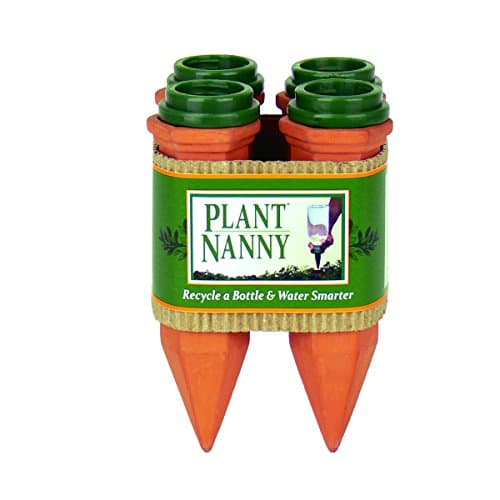 Plant Nanny Watering Spikes with Bottle AdapterThe longest unattended stretch you can get without a pump Plant Nanny Watering Spikes with Bottle AdapterThe longest unattended stretch you can get without a pump | Longest interval for the money | 8.7 | $19.99 - View on Amazon |
| 2 | 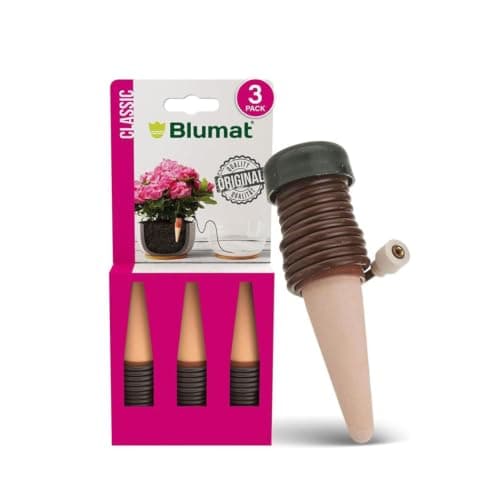 Blumat Classic Watering StakesSet-and-forget watering of 6-inch pots, for as long as the jug lasts Blumat Classic Watering StakesSet-and-forget watering of 6-inch pots, for as long as the jug lasts | Best demand-driven option | 8.9 | $16.88 - View on Amazon |
| 3 | 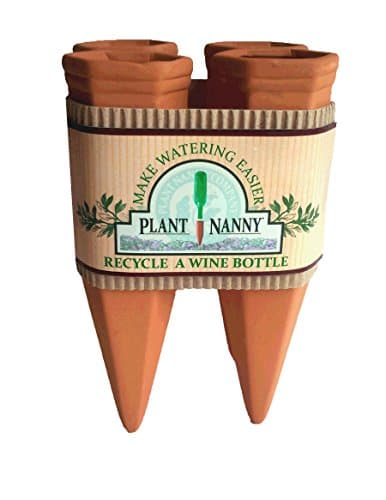 Plant Nanny Terracotta Wine Bottle StakesA one-to-two week trip, on medium indoor pots Plant Nanny Terracotta Wine Bottle StakesA one-to-two week trip, on medium indoor pots | Best claim that survives the math | 9.1 | $19.99 - View on Amazon |
| 4 | 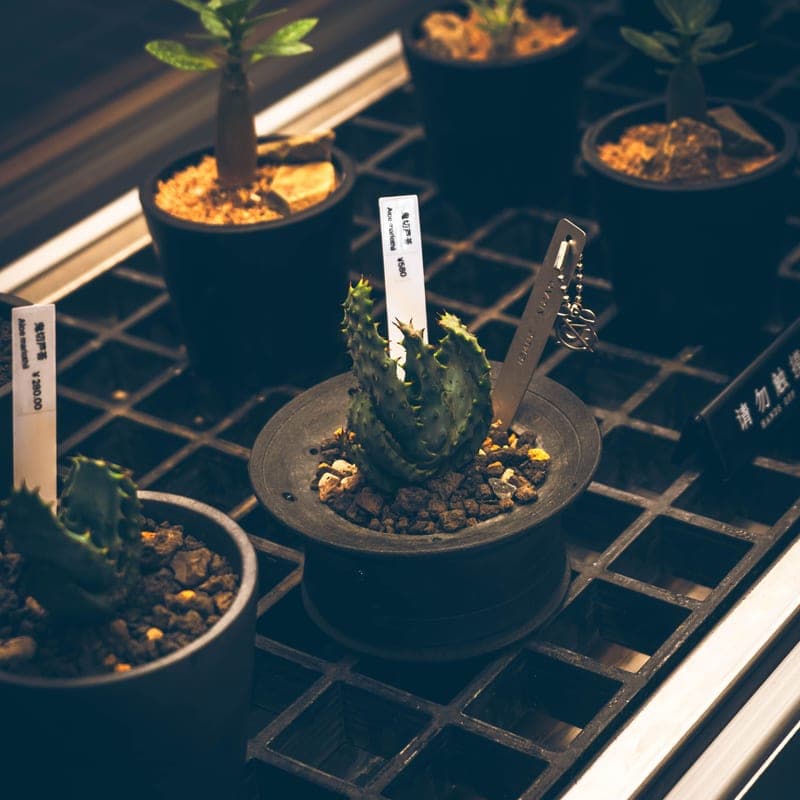 Capillary Matting for Plant TraysA tray of small pots on a windowsill while you are away Capillary Matting for Plant TraysA tray of small pots on a windowsill while you are away | Best for a tray of small pots | 7.4 | Check price on Amazon |
| 5 | 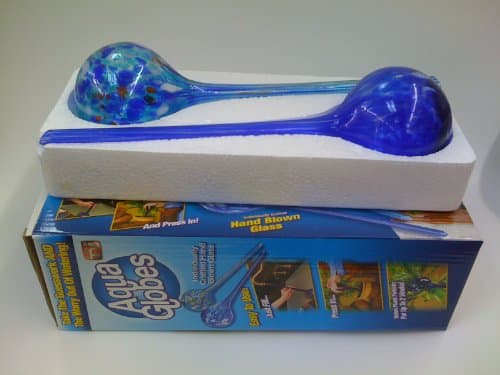 Aqua Globes Glass Watering BulbsA small pot on a shelf, topped up as part of a normal routine Aqua Globes Glass Watering BulbsA small pot on a shelf, topped up as part of a normal routine | Skip this one | 4.8 | $16.49 - View on Amazon |
Scores are our editorial judgment from published specifications. They are not test results, and they are deliberately not marked up as ratings in this page’s structured data.
Pick #1 - Longest interval for the money
Plant Nanny Watering Spikes with Bottle Adapter
The longest unattended stretch you can get without a pump
The soda-bottle version: a 5.5-inch terracotta spike with a screw adapter that takes a standard plastic bottle. Two liters on the end of it is the largest gravity reservoir on this site that still costs almost nothing.
#ad Price as of October 18, 2026, from Amazon. Prices change. How we make money.
Published specification
- Spike length
- 5.5 in
- Reservoir
- Any screw-top plastic bottle, with 2 liter the common choice
- Manufacturer duration claim
- Up to 2 weeks with a 2 liter bottle
- Material
- Unglazed terracotta with a plastic screw adapter
- Spike length: Lee Valley published specification
- Reservoir: Lee Valley published description
- Manufacturer duration claim: Lee Valley published description
- Material: Lee Valley published description
Refill interval - computed, not tested
About 20 to 42 days on a 6-inch pot
2,000 ml divided by 350 ml per thorough watering of a 6-inch pot is 5.7 waterings. At once or twice a week, that is 20 to 42 days. The published claim of up to two weeks is well inside that, which is the direction you want a claim to be wrong in.
Assumes: 6-inch tropical root ball, indoors, 2 liter bottle. Light, temperature, humidity, soil mix and season all change how fast a pot dries, so treat this as a planning range and not a guarantee.
What is good about it
- The published claim is conservative against the arithmetic by a wide margin
- Two liters for the price of an empty soda bottle is the best cost per milliliter on this site
- Terracotta throttles delivery by soil moisture rather than pouring on a schedule
What is not
- A 2 liter bottle upside down in a houseplant is genuinely ugly
- Top-heavy in a light pot, and it will tip a small plastic pot over
- Needs the ceramic soaked and de-aerated before it works properly
Skip this one if
Skip it if the plant lives somewhere you look at every day. This is a solution for the week you are away, not a permanent fixture.
How it scored
- Published capacity
- 9.5
- Computed interval
- 9.5
- Honesty of claims
- 9.5
- Value for money
- 10.0
- Looks
- 3.0
- Overall
- 8.7 / 10
Our editorial score, from published specifications and computed intervals. Not a test result. Specification source: Lee Valley Plant Nanny watering spikes listing.
Pick #2 - Best demand-driven option
Blumat Classic Watering Stakes
Set-and-forget watering of 6-inch pots, for as long as the jug lasts
The only device in this category with a published flow rate rather than a published duration, which changes the question entirely: it is limited by how fast it can deliver, not by how much it holds. About 75 ml a day is a near-exact match for a 6-inch tropical houseplant.
#ad Price as of October 18, 2026, from Amazon. Prices change. How we make money.
Published specification
- Delivery rate
- About 75 ml per day for the Classic, about 150 ml per day for the XL
- Maximum lift
- Draws water up to 12 in (30 cm)
- Reservoir
- Any container you supply, sited no more than 12 in below the cone
- Watering method
- Ceramic cone. Soil drying creates a vacuum that pulls water from the reservoir
- Setup requirement
- Soak the cone and cap for at least 15 minutes and knock out air bubbles under water
- Delivery rate: Blumat retailer published specification
- Maximum lift: Blumat retailer published specification
- Reservoir: Blumat published description
- Watering method: Blumat published description
- Setup requirement: Blumat published instructions
Refill interval - computed, not tested
Duration is set by the jug you attach, not by the device
A 6-inch tropical houseplant draws 350 ml every 3.5 to 7 days, which is 50 to 100 ml a day. The Classic's published maximum of about 75 ml a day sits inside that band, so it can keep a 6-inch pot going but cannot keep up with a thirsty 8-inch one at 114 to 229 ml a day. That is what the XL at about 150 ml a day is for. Attach a 2 liter jug and, at a real draw of 50 ml a day, that is about 40 days.
Assumes: 6-inch tropical root ball, indoors, reservoir within 12 in below the cone. Light, temperature, humidity, soil mix and season all change how fast a pot dries, so treat this as a planning range and not a guarantee.
What is good about it
- Publishes a flow rate, which is the correct spec for a demand-driven device and which nobody else in the category gives you
- Genuinely demand-driven: when the soil is wet the flow stops, so it does not drown the plant on a cool week
- Duration is whatever reservoir you can find room for, rather than a fixed bulb
- The XL doubles the rate for larger pots, so the range actually scales with plant size
What is not
- Fiddly setup, because the cone has to be soaked and de-aerated or it simply will not siphon
- The 12-inch lift limit constrains where the reservoir can sit, and it is easy to get wrong
- More expensive per pot than a spike or a globe
- Ceramic clogs in hard water and needs periodic cleaning
Skip this one if
Skip it if you want to unbox something and push it into the soil. This rewards a careful setup and punishes a casual one, and a Blumat that was not de-aerated properly is a Blumat that does nothing at all.
How it scored
- Published specification
- 10.0
- Computed interval
- 9.0
- Honesty of claims
- 9.5
- Value for money
- 7.0
- Ease of setup
- 5.5
- Overall
- 8.9 / 10
Our editorial score, from published specifications and computed intervals. Not a test result. Specification source: Blumat Classic published specification, via Sustainable Village.
Pick #3 - Best claim that survives the math
Plant Nanny Terracotta Wine Bottle Stakes
A one-to-two week trip, on medium indoor pots
Our top pick for one honest reason: it is one of the very few products in the watering-device category whose manufacturer's duration claim survives our arithmetic. A 750 ml bottle on a 6-inch pot computes to 8 to 15 days, and Plant Nanny claims up to 10.
#ad Price as of October 18, 2026, from Amazon. Prices change. How we make money.
Published specification
- Reservoir
- Any 750 ml wine bottle
- Manufacturer duration claim
- Up to 10 days for a medium to large plant
- Material
- Unglazed terracotta
- Watering method
- Porous terracotta releases water as the surrounding soil dries
- Reservoir: Plant Nanny published description
- Manufacturer duration claim: Plant Nanny published description
- Material: Plant Nanny published description
- Watering method: Plant Nanny published description
Refill interval - computed, not tested
About 8 to 15 days on a 6-inch pot, so the claim holds
750 ml divided by 350 ml per thorough watering of a 6-inch pot is 2.1 waterings. At once or twice a week, that is 8 to 15 days. Plant Nanny's own claim of up to 10 days sits inside that range rather than above it.
Assumes: 6-inch tropical root ball, indoors, 750 ml bottle. Light, temperature, humidity, soil mix and season all change how fast a pot dries, so treat this as a planning range and not a guarantee.
What is good about it
- The manufacturer's duration claim is conservative against our arithmetic, which is genuinely rare here
- The reservoir is a wine bottle, so capacity is a known 750 ml rather than a mystery
- Terracotta releases water in response to soil dryness, so it self-throttles in a way a glass globe does not
- Swap to a 2 liter soda bottle with the right adapter and the computed interval goes to 20 to 42 days
What is not
- A wine bottle standing in a plant pot is a look, and not everyone wants it
- Terracotta can clog with mineral deposits over time and needs an occasional soak
- On an 8-inch or larger pot the same 750 ml drops to 3 to 7 days
Skip this one if
Skip it if your plants are in large floor pots. A 750 ml bottle on a 10-inch pot is under two days of water, and no amount of terracotta changes the volume.
How it scored
- Published capacity
- 9.5
- Computed interval
- 9.0
- Honesty of claims
- 10.0
- Value for money
- 9.0
- Looks
- 6.0
- Overall
- 9.1 / 10
Our editorial score, from published specifications and computed intervals. Not a test result. Specification source: Plant Nanny wine bottle stake retail listing.
Pick #4 - Best for a tray of small pots
Capillary Matting for Plant Trays
A tray of small pots on a windowsill while you are away
The greenhouse trick, scaled down: a felt mat with one end in a water tray wicks moisture up into every pot standing on it. No mechanism, no batteries, and it works for as long as the tray holds out.
#ad We do not currently hold a live price for this, so we do not show one. How we make money.
Published specification
- Reservoir
- Whatever tray or basin you supply
- Watering method
- Capillary wicking through a felt mat into drainage holes
- Requirement
- Pots must have drainage holes and sit flat on the mat
- Reservoir: Published product descriptions
- Watering method: Published product descriptions
- Requirement: Published product descriptions
Refill interval - computed, not tested
Set by the tray, and the tray is usually the weak point
A 2 liter tray split across six 4-inch pots at 100 ml per thorough watering each is 3.3 waterings per pot, or about 12 to 23 days, if the tray does not evaporate first. In a sunny window it will.
Assumes: Six 4-inch pots on a 2 liter tray, indoors out of direct sun. Light, temperature, humidity, soil mix and season all change how fast a pot dries, so treat this as a planning range and not a guarantee.
What is good about it
- No moving parts at all, so nothing to fail while you are away
- One tray serves every pot standing on it, so cost per plant is trivial
- Bottom watering by design, which keeps the surface dry and discourages fungus gnats
What is not
- Only works with pots that have drainage holes and flat bases
- The mat has to stay in contact with the mix, so no thick layer of decorative gravel
- Evaporation from an open tray in a sunny window can beat the plants to the water
- Constant moisture at the base is a root-rot risk for succulents
Skip this one if
Skip it for succulents and cacti. Continuous bottom moisture is precisely wrong for plants whose published cadence is once or twice a month, and you will come home to rot.
How it scored
- Published specification
- 5.5
- Computed interval
- 7.0
- Reliability risk
- 9.5
- Value for money
- 9.5
- Plant compatibility
- 5.0
- Overall
- 7.4 / 10
Our editorial score, from published specifications and computed intervals. Not a test result. Specification source: Capillary matting retail listings.
Pick #5 - Skip this one
Aqua Globes Glass Watering Bulbs
A small pot on a shelf, topped up as part of a normal routine
The original as-seen-on-TV watering globe, and the product that set the category's expectation that a glass bulb covers a two-week vacation. Our arithmetic says a globe this size covers a day or two on a medium houseplant, and the one publisher we found who actually used a set reported theirs emptied overnight.
#ad Price as of October 18, 2026, from Amazon. Prices change. How we make money.
Published specification
- Reservoir capacity
- Not published by the manufacturer
- Representative fill
- About 118 ml (half a cup) for a small globe
- Material
- Blown glass
- Fill method
- Invert and fill through the stem
- Reservoir capacity: Checked listings across the globe category, capacity is essentially never published
- Representative fill: The Indoor Nursery, measured fill while using a small globe
- Material: Published product description
- Fill method: Published product description
Refill interval - computed, not tested
About 1 to 2 days on a 6-inch tropical houseplant
118 ml divided by 350 ml per thorough watering of a 6-inch pot is 0.3 of a watering. At once or twice a week, that is 1.2 to 2.4 days. On a 4-inch pot needing 100 ml, the same globe gives 1.2 waterings, or about 4 to 8 days.
Assumes: Small globe, representative 118 ml fill, tropical houseplant indoors. Light, temperature, humidity, soil mix and season all change how fast a pot dries, so treat this as a planning range and not a guarantee.
What is good about it
- Cheap, and pleasant to look at in a pot
- For a genuinely small pot, 4 inches or under, the arithmetic works out to most of a week
- No mechanism to fail, no batteries, nothing to program
What is not
- No published capacity, so the buyer has no way to check the vacation claim before purchase
- On a 6-inch pot the volume simply is not there, whatever the marketing says
- Glass in soil, near a floor, around pets and children
- Reports of globes emptying in hours when pushed in at an angle, because the air path opens up
Skip this one if
Skip it if you are leaving for more than a long weekend, or if your pots are 6 inches or bigger. This is the most over-promised product in the category and the volume is not a matter of opinion.
How it scored
- Published capacity
- 1.0
- Computed interval
- 2.5
- Build and materials
- 6.0
- Value for money
- 7.0
- Honesty of claims
- 2.0
- Overall
- 4.8 / 10
Our editorial score, from published specifications and computed intervals. Not a test result. Specification source: The Indoor Nursery, first-hand account of using watering globes.
Questions people actually ask
- How long can indoor plants go without water?
For a tropical houseplant, the published cadence is once or twice a week, so most will show stress within about a week and serious damage after two. Succulents are published at once or twice a month and can genuinely be left for weeks. The full breakdown is here.
- Do watering globes work for a two-week vacation?
Not for a 6-inch pot. A typical small globe holds about 118 ml, which is a third of one thorough watering for that pot size, or one to two days. Large 500 ml globes compute to five to ten days. Two weeks needs a bottle-based spike or a drip system.
- Should I water my plants heavily right before I leave?
Water thoroughly, yes - all the way through until it drains. Do not leave the saucer full to top it up. Extension guidance is that a container should not stand in water for more than an hour, and standing water is how you come home to root rot rather than a healthy plant.
- Is it better to move plants together before a trip?
Yes, for two reasons. Grouped plants raise the humidity around each other, which slightly reduces transpiration, and moving them away from windows cuts water use meaningfully because light and temperature are both drivers.
- What is the cheapest way to water plants while away?
A terracotta spike with a bottle you already have. The spike costs a few dollars, the 2-liter bottle is free, and the combination computes to 20 to 42 days on a 6-inch pot - a longer interval than most things costing ten times as much.
Sources
Sources
- Criscione and Holliday-Goulart, Properly Watering Container Houseplants, Virginia Cooperative Extension SPES-804 (2026)
- The Indoor Nursery, a first-hand account of using watering globes
- Lee Valley, Plant Nanny watering spikes published specification
- Blumat Classic published specification, via Sustainable Village
- Royal Horticultural Society, Watering plants wisely