Roundup
Cheap Soil Moisture Meters: What Price Actually Buys
This is one of the few categories where the cheapest respectable option is close to the best one. Here is what the extra money does and does not buy.
By Scooter M. - Enthusiast. Reads the manuals, compiles the specs, does the math. | Published
Disclosure
We earn a commission if you buy through our links. It does not change what we recommend or what you pay. Full disclosure.
The short answer
What actually changes with price
| Feature | Budget analog | Mid digital | Worth paying for? |
|---|---|---|---|
| Moisture measurement | Conductivity, relative | Conductivity, relative | No difference |
| Published accuracy | Not published | Not published | Never available |
| Probe length | About 7 in | Varies, often shorter | Yes, reach matters |
| Power | None required | Battery | Analog is better here |
| Display | Banded dial | Backlit numeric | Only in a dark corner |
| Extra sensors | Light and pH on 3-in-1 | Temperature on some | Light yes, pH no |
| Build | Plastic body, steel probe | Similar | Little difference |
The row that never changes is the important one. Everything in this category is a conductivity probe with an uncalibrated relative scale. Paying more moves you up the display and convenience ladder, not the measurement ladder.
Where cutting cost does hurt
Probe length. The cheapest meters sometimes have short probes, and a probe that only samples the top two inches reads the fastest-drying part of the pot. That produces a confident instruction to water a pot whose root zone is still wet, which is worse than no meter. Check the stated length before price.
Needle damping. Very cheap movements are twitchy and hard to read consistently, so the same pot gives different answers on consecutive insertions. A slightly better unit settles.
Probe finish. Poorly finished probes corrode faster, especially if left in soil. This is partly a usage issue - do not store the probe in the pot - but a decent finish helps.
The 3-in-1 question
The three-function meters cost barely more than a moisture-only probe, and the light meter is genuinely useful: most people badly overestimate how bright a corner is, and light is one of the factors Virginia Cooperative Extension lists as changing how much water a plant needs. Getting that right changes the watering problem at source.
The pH function is the part to ignore. None of these listings publishes an accuracy figure or a calibration method for it, and a two-electrode probe pushed into moist soil is not a credible way to measure pH. If you need a soil pH reading - for hydrangeas, blueberries or diagnosing a nutrient problem - buy a test kit. Treat the third dial as decoration.
What we would actually buy
One battery-free analog meter with a 7-inch probe, kept in the room with the plants rather than in a drawer. If you have more than a dozen plants, buy two and leave one in each room, because the meter you cannot find is a meter you do not use.
Spend the money you did not spend on a digital display on a self-watering insert for the plant you kill most often instead. Measurement tells you what is happening; a reservoir changes what happens.
Ranked picks
Quick picks
Ranked on published specifications and the computed refill interval, not on looks. Tap any row for the full write-up, including who should skip it.
| # | Product | Best for | Score | Price |
|---|---|---|---|---|
| 1 | 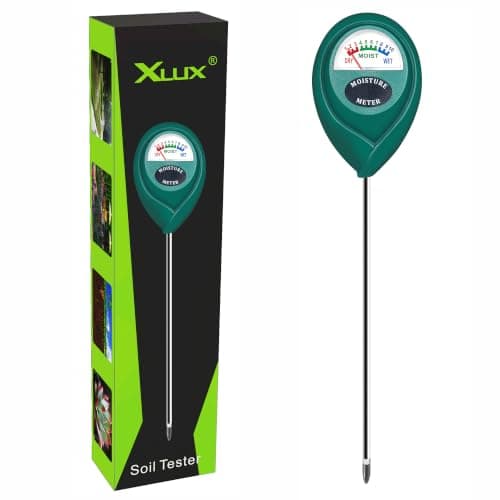 XLUX T10 Soil Moisture MeterAnyone who has killed a plant by watering on a schedule XLUX T10 Soil Moisture MeterAnyone who has killed a plant by watering on a schedule | Best value overall | 8.7 | $9.99 - View on Amazon |
| 2 | 3-in-1 Soil Meter for Moisture, Light and pHSomeone who wants a light reading as well and will ignore the pH scale | Most functions per dollar | 7.0 | Check price on Amazon |
| 3 | Digital Soil Moisture Meter with Backlit DisplayReading a pot in a dark corner, or wanting a number to track over time | Paying for a backlight | 6.8 | Check price on Amazon |
Scores are our editorial judgment from published specifications. They are not test results, and they are deliberately not marked up as ratings in this page’s structured data.
Pick #1 - Best value overall
XLUX T10 Soil Moisture Meter
Anyone who has killed a plant by watering on a schedule
The default answer in this category, and it earns it: a single probe, no battery, a 1-to-10 dial with dry, moist and wet bands, and a probe long enough to reach the root zone of a real pot rather than the top inch.
#ad Price as of October 18, 2026, from Amazon. Prices change. How we make money.
Published specification
- Probe length
- About 7 in (17.5 cm)
- Power
- None required, since the probe generates its own signal in moist soil
- Scale
- 1 to 10, banded DRY, MOIST and WET
- Probe design
- Single probe, to limit root damage
- Weight
- About 2.5 oz (70 g)
- Probe length: XLUX published specification, via retail listing
- Power: XLUX published description
- Scale: XLUX published description
- Probe design: XLUX published description
- Weight: XLUX published specification, via retail listing
What is good about it
- No batteries means it works the day you dig it out of a drawer eighteen months later
- A 7-inch probe reaches the middle of a 6-inch pot, which is where the answer actually is
- The banded dial answers the only question you have, water or do not, without pretending to a percentage it cannot deliver
- Cheap enough to buy two and leave one in the room with the plants
What is not
- It reads conductivity, not water content, so heavily fertilized soil reads wetter than it is
- The 1-to-10 scale is relative, not calibrated to any standard, so two meters can disagree
- Single probe means one reading per insertion, and pots are not uniform
Skip this one if
Skip it if you have three plants and a finger. Virginia Tech's own guidance is to push a finger 1 to 3 inches into the mix and check, and for small pots that is genuinely as good. Buy a meter when the pots are deep enough that your finger cannot reach the root zone.
How it scored
- Published specification
- 8.5
- Probe reach
- 9.0
- Readability
- 9.0
- Value for money
- 10.0
- Measurement honesty
- 6.5
- Overall
- 8.7 / 10
Our editorial score, from published specifications and computed intervals. Not a test result. Specification source: XLUX T10 retail listing.
Pick #2 - Most functions per dollar
3-in-1 Soil Meter for Moisture, Light and pH
Someone who wants a light reading as well and will ignore the pH scale
The three-dial version that shows up first in every search. The moisture needle works on the same principle as a single-function meter. The pH needle on a cheap probe of this type is the part to distrust.
#ad We do not currently hold a live price for this, so we do not show one. How we make money.
Published specification
- Functions
- Moisture, light and pH on one probe
- Power
- None required for the moisture and light functions
- Probe length
- Commonly around 7 to 8 in
- pH accuracy
- Not published by the manufacturer
- Functions: Published retail listing specification
- Power: Published retail listing specification
- Probe length: Published retail listing specification
- pH accuracy: Checked listings, no accuracy figure or calibration method published
What is good about it
- The light meter is genuinely useful for working out whether a corner is as bright as you think
- Same battery-free moisture principle as a single-function meter
- Barely more expensive than a moisture-only probe
What is not
- The pH function on a two-electrode probe of this type has no published accuracy or calibration method, and we would not make a decision on it
- Three scales on one dial is harder to read at a glance than one
- Switching functions on the cheapest units is a source of confusion and misreadings
Skip this one if
Skip it if you actually need a soil pH reading. Buy a test kit for that. Treat this as a moisture meter with a light meter attached and you will not be disappointed.
How it scored
- Published specification
- 5.0
- Probe reach
- 8.5
- Readability
- 6.5
- Value for money
- 9.0
- Measurement honesty
- 4.0
- Overall
- 7.0 / 10
Our editorial score, from published specifications and computed intervals. Not a test result. Specification source: 3-in-1 soil meter retail listings.
Pick #3 - Paying for a backlight
Digital Soil Moisture Meter with Backlit Display
Reading a pot in a dark corner, or wanting a number to track over time
A battery-powered probe with a numeric readout instead of a needle. The number looks more precise than the analog dial and is measuring exactly the same thing, which is worth knowing before you pay extra for it.
#ad We do not currently hold a live price for this, so we do not show one. How we make money.
Published specification
- Display
- Backlit LCD with numeric readout
- Power
- Battery required, usually AAA or a coin cell
- Calibration standard
- Not published by the manufacturer
- Display: Published retail listing specification
- Power: Published retail listing specification
- Calibration standard: Checked listings, no traceable calibration or accuracy figure published
What is good about it
- Backlit display is genuinely easier in a dim corner than squinting at a needle
- A repeatable number is easier to track across weeks than a needle position
- Often adds a temperature reading, which is a real input to how fast a pot dries
What is not
- Needs a battery, which is the failure mode for a device you use twice a month
- The extra decimal place is false precision, because the underlying measurement is the same conductivity reading
- No published calibration standard on any listing we checked, so the number is not comparable between meters
Skip this one if
Skip it if you were paying for accuracy. You are paying for a backlight and a battery compartment. The analog meter measures the same thing for less and never goes flat.
How it scored
- Published specification
- 4.5
- Probe reach
- 7.5
- Readability
- 9.0
- Value for money
- 6.0
- Measurement honesty
- 4.5
- Overall
- 6.8 / 10
Our editorial score, from published specifications and computed intervals. Not a test result. Specification source: Digital soil moisture meter retail listings.
Questions people actually ask
- Are cheap soil moisture meters any good?
Yes, unusually so. Every meter in this category is an uncalibrated conductivity probe, so paying more buys a display and convenience rather than accuracy. Check the probe length before the price - a short probe reads the wrong part of the pot.
- Is a 3-in-1 soil meter worth it?
For the light meter, yes - most people misjudge how bright a spot is, and light drives water use. For the pH function, no. No listing publishes an accuracy figure or calibration method for it, and a test kit is the right tool for pH.
- Why do two moisture meters give different readings?
Because the 1-to-10 scale is relative and not calibrated to any standard, so two units are not comparable to each other. Use one meter and compare the same pot over time.
- Should I buy a digital moisture meter instead?
Only for a genuinely dark corner where a backlight helps. The measurement is identical, and you have added a battery to a device you use twice a month, which is the usage pattern that finds a flat one.
Sources