Head to head
Moisture Meter vs the Finger Test
The free option is genuinely good, and for small pots it wins. Here are the four situations where a meter earns its place instead.
By Scooter M. - Enthusiast. Reads the manuals, compiles the specs, does the math. | Published
Disclosure
We earn a commission if you buy through our links. It does not change what we recommend or what you pay. Full disclosure.
The short answer
The comparison
| Finger test | Moisture meter | |
|---|---|---|
| Cost | Free | Ten to twenty dollars |
| Depth reached | 1 to 3 in | 7 in, or 24 in for garden probes |
| Affected by fertilizer salts | No | Yes, reads wetter |
| Tells you soil texture and compaction | Yes | No |
| Works on a 12 in floor pot | No | Yes |
| Works through dense surface roots | Poorly | Yes |
| Repeatable record over time | Subjective | A number you can note |
| Available when you need it | Always | If you can find it |
What the finger tells you that a meter cannot
Texture. Pushing a finger into the mix tells you whether it is compacted, whether it has gone hydrophobic and is repelling water, whether it is crumbly and exhausted, and whether there are roots filling the whole pot. Those are diagnostic facts a conductivity probe does not report and they frequently explain the problem better than the moisture reading does.
It also tells you the truth about salts. Virginia Cooperative Extension’s leaching-fraction work exists because soluble salts accumulate in container mixes, and a conductivity meter reads a salty pot as wetter than it is. Your finger is unaffected.
The four cases where the meter wins
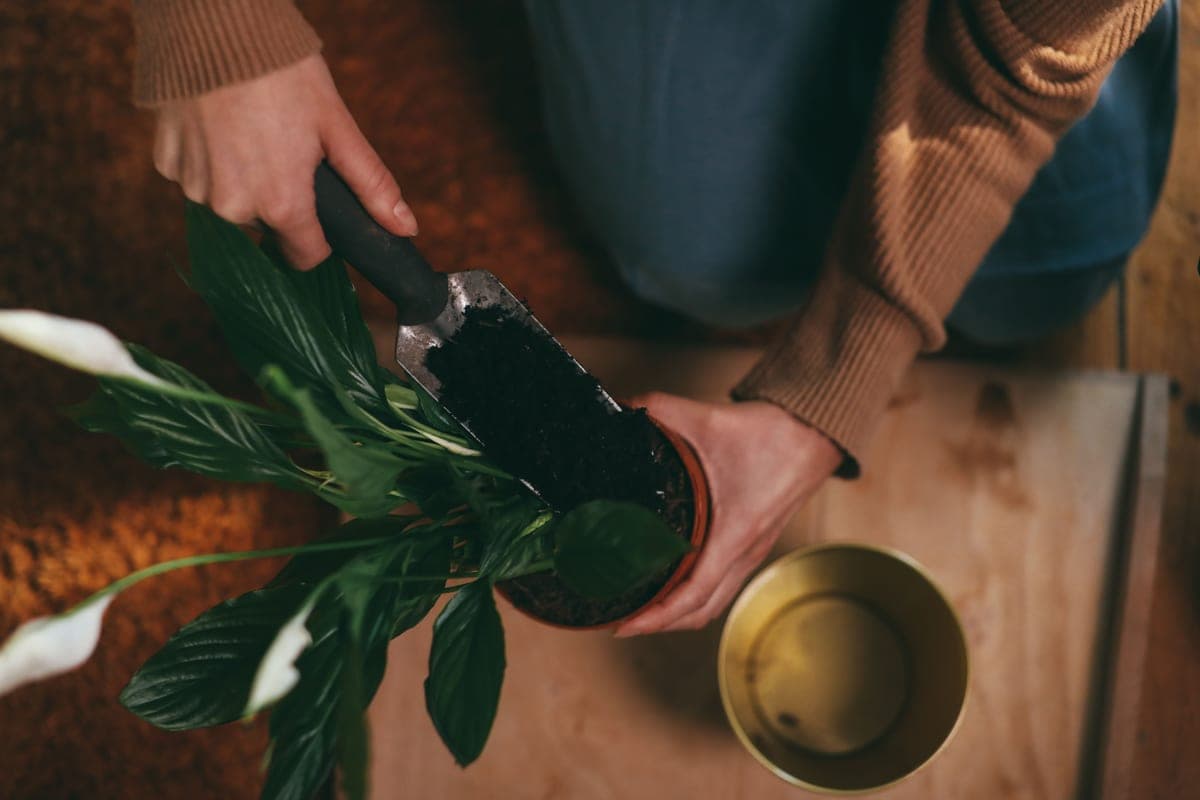
Deep pots. A 12-inch floor pot has its root zone six to eight inches down. Your finger reaches three. Reading the top three inches of a deep pot reliably tells you to water when the root zone is still wet, which is the mechanism behind a lot of dead floor plants.
A lot of plants. Once you have fifteen pots on different schedules, the failure is not accuracy, it is tracking. A meter turns each check into two seconds, which is the difference between doing it and not.
Dense surface roots. A root-bound plant has a mat at the top of the pot you cannot push a finger through without damaging it. A thin probe slips past.
Diagnosing a sick plant. Overwatering and underwatering share almost every above-soil symptom - wilting, leaf drop and stunted growth appear under both in extension guidance. When a plant is drooping and you need to know within seconds whether the pot is wet or dry at depth, the probe is the fast answer. The full diagnostic is here.
The third option most people skip
Weight. Pick the pot up. A pot with a saturated root ball is dramatically heavier than the same pot dry, and after two or three lifts you calibrate to it better than any instrument. Virginia Cooperative Extension lists a lightweight container among the symptoms of underwatering for exactly this reason.
It works on any pot you can lift, it costs nothing, it is unaffected by salts, and it samples the whole pot rather than one insertion point. For small and medium plants it is arguably the best method on this page.
Either way, the reading is not the fix
Both methods answer “is it dry.” Neither changes how you water when the answer is yes. Virginia Cooperative Extension is explicit that a container should be watered thoroughly - wet all the way through, drained until it stops dripping - and that it should not stand in water for more than 60 minutes afterward. Getting that part right matters more than which detection method you used. The cadence reference page covers it in full.
What we would buy for this
The gear that fits this problem
Chosen from the same registry as our roundups, on published specifications and the computed refill interval.
XLUX T10 Soil Moisture Meter
Anyone who has killed a plant by watering on a schedule
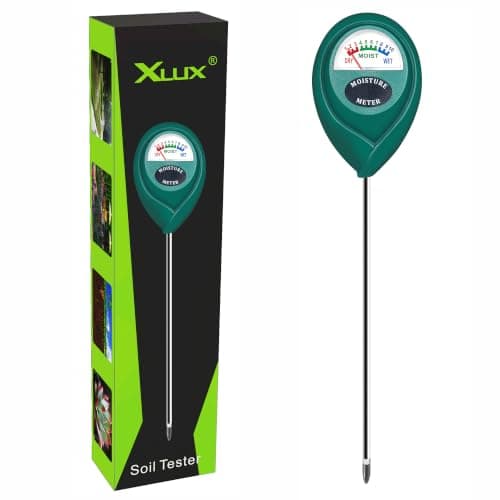
The default answer in this category, and it earns it: a single probe, no battery, a 1-to-10 dial with dry, moist and wet bands, and a probe long enough to reach the root zone of a real pot rather than the top inch.
#ad Price as of October 18, 2026, from Amazon. Prices change. How we make money.
Published specification
- Probe length
- About 7 in (17.5 cm)
- Power
- None required, since the probe generates its own signal in moist soil
- Scale
- 1 to 10, banded DRY, MOIST and WET
- Probe design
- Single probe, to limit root damage
- Weight
- About 2.5 oz (70 g)
- Probe length: XLUX published specification, via retail listing
- Power: XLUX published description
- Scale: XLUX published description
- Probe design: XLUX published description
- Weight: XLUX published specification, via retail listing
What is good about it
- No batteries means it works the day you dig it out of a drawer eighteen months later
- A 7-inch probe reaches the middle of a 6-inch pot, which is where the answer actually is
- The banded dial answers the only question you have, water or do not, without pretending to a percentage it cannot deliver
- Cheap enough to buy two and leave one in the room with the plants
What is not
- It reads conductivity, not water content, so heavily fertilized soil reads wetter than it is
- The 1-to-10 scale is relative, not calibrated to any standard, so two meters can disagree
- Single probe means one reading per insertion, and pots are not uniform
Skip this one if
Skip it if you have three plants and a finger. Virginia Tech's own guidance is to push a finger 1 to 3 inches into the mix and check, and for small pots that is genuinely as good. Buy a meter when the pots are deep enough that your finger cannot reach the root zone.
How it scored
- Published specification
- 8.5
- Probe reach
- 9.0
- Readability
- 9.0
- Value for money
- 10.0
- Measurement honesty
- 6.5
- Overall
- 8.7 / 10
Our editorial score, from published specifications and computed intervals. Not a test result. Specification source: XLUX T10 retail listing.
Long-Probe Soil Moisture Meter for Garden Beds
Raised beds, shrubs and newly planted trees
The outdoor version, with a probe long enough to reach below the top few inches that dry out first in a bed. For garden use this is the only probe length that answers a useful question.
#ad We do not currently hold a live price for this, so we do not show one. How we make money.
Published specification
- Probe length
- Commonly 10 to 24 in, model dependent
- Power
- Usually none required
- Scale
- 1 to 10, banded dry, moist and wet
- Probe length: Published retail listing specifications
- Power: Published retail listing specification
- Scale: Published retail listing specification
What is good about it
- Long enough to read below the surface crust, which is where a bed's real moisture story is
- Answers the specific question that matters for a new tree: is the root ball still wet
- Same battery-free simplicity as the indoor meters
What is not
- Too long to use comfortably in a houseplant pot
- Longer probes bend if you force them into compacted or stony ground
- Same uncalibrated conductivity reading as any other meter, over a longer distance
Skip this one if
Skip it if all your plants are indoors. A 24-inch probe in an 8-inch pot reads the bottom of the pot and the saucer, which tells you nothing you wanted to know.
How it scored
- Published specification
- 6.0
- Probe reach
- 10.0
- Readability
- 7.5
- Value for money
- 8.0
- Measurement honesty
- 5.5
- Overall
- 7.2 / 10
Our editorial score, from published specifications and computed intervals. Not a test result. Specification source: Long-probe soil moisture meter retail listings.
Questions people actually ask
- Is a moisture meter better than the finger test?
Not for pots up to about 6 inches, where extension guidance recommends pushing a finger one to three inches into the mix. A meter wins on deep pots, large collections, root-bound plants and fast diagnosis of a sick plant.
- How do you check if a plant needs water without a meter?
Two ways. Push a finger one to three inches into the mix and feel for moisture. And lift the pot: a saturated root ball is dramatically heavier than a dry one, and a lightweight container is listed by extension guidance as a sign of underwatering.
- Do moisture meters give false readings?
They can. They measure conductivity, so heavily fertilized mix reads wetter than it is, and poor probe contact in coarse mix reads drier. Your finger is unaffected by both.
- How deep should I stick my finger into the soil?
One to three inches, depending on container size, per Virginia Cooperative Extension. Deeper for a bigger pot. If the mix is dry at that depth for a tropical houseplant, it is time to water thoroughly.
Sources