Roundup
Best Soil Moisture Meter for Indoor Plants
The cheapest fix for the habit that kills most houseplants, which is watering on a schedule instead of on a reading.
By Scooter M. - Enthusiast. Reads the manuals, compiles the specs, does the math. | Published
Disclosure
We earn a commission if you buy through our links. It does not change what we recommend or what you pay. Full disclosure.
The short answer
What a meter is actually fixing
Not precision. The habit. The RHS is direct about the underlying error: avoid a routine such as watering once a week, and instead water less often but more thoroughly, letting the surface dry before watering again. Nearly every dead houseplant is a schedule that outlived its accuracy.
A meter makes the check trivial enough that you actually do it. That is the whole product. It happens to solve a second, physical problem too: the top inch of a pot dries first and fastest, so the surface is a poor proxy for the root zone. Virginia Cooperative Extension recommends pushing a finger one to three inches into the mix depending on container size, which is fine for a 4-inch pot and impossible for a 12-inch one.
How we ranked them
Probe reach first. A probe that only samples the top two inches reads the fastest-drying part of the pot and tells you to water when the root zone is still wet. Seven inches reaches the middle of a 6-inch pot; that is the minimum useful length indoors. Our full review of the XLUX T10 goes through what that specification actually buys you.
Power second. This is a device you use twice a month, which is the exact usage pattern that finds a flat battery. Battery-free meters generate their own signal from the probe in moist soil and work the day you dig them out.
Readability third. A banded dial that says dry, moist or wet answers the question you have. A number to one decimal place answers a question nobody can answer, which we come back to below.
| Type | Probe | Power | Published accuracy |
|---|---|---|---|
| XLUX T10 analog | About 7 in | None required | Not published |
| 3-in-1 analog | About 7 to 8 in | None for moisture | Not published |
| Digital LCD | Varies | Battery required | Not published |
| Long-probe garden | 10 to 24 in | Usually none | Not published |
The honest limitation on all of them
None of these meters publishes a calibration method or an accuracy figure. We checked the listings across the category, including the digital ones with a decimal place on the display, and there is no traceable standard behind any of the numbers.
What they measure is electrical conductivity between the probe and the soil, which correlates with moisture but also responds to dissolved salts. Heavily fertilized mix reads wetter than it is. Very pure water in a low-salt mix reads drier. Neither effect makes the tool useless, and both mean you should read the value as a comparison against the same pot last week rather than as a fact about water content. The full treatment of accuracy is here, and it may talk you out of a purchase - including out of a wireless sensor, which reports the same uncalibrated reading to a phone.
How to use one so the reading means something
Insert slowly to about two thirds of the pot depth, near the root ball rather than against the pot wall, and read after a few seconds. Take the reading in the same spot each time so the week-to-week comparison is like for like. Wipe the probe dry afterward and do not store it in the soil, because a permanently buried probe corrodes and drifts.
Then act on it. Most houseplants want the upper portion of the mix to dry before the next watering, so you are waiting for the reading to move from moist into dry - not bone dry. When you do water, water thoroughly: Virginia Cooperative Extension is explicit that the mix should be wet all the way through and the container drained until it stops dripping. A meter changes when. It does not change how. The step-by-step is here.
Ranked picks
Quick picks
Ranked on published specifications and the computed refill interval, not on looks. Tap any row for the full write-up, including who should skip it.
| # | Product | Best for | Score | Price |
|---|---|---|---|---|
| 1 | 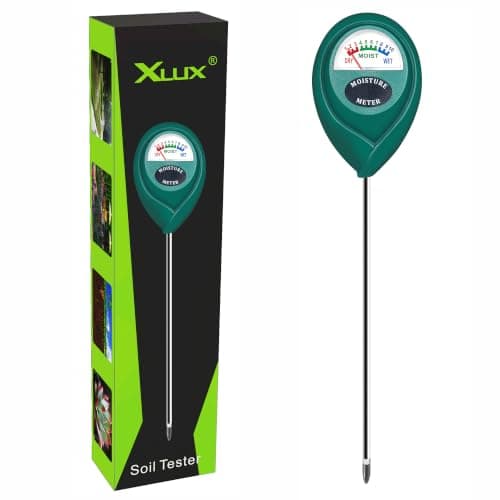 XLUX T10 Soil Moisture MeterAnyone who has killed a plant by watering on a schedule XLUX T10 Soil Moisture MeterAnyone who has killed a plant by watering on a schedule | Best overall indoor meter | 8.7 | $9.99 - View on Amazon |
| 2 |  3-in-1 Soil Meter for Moisture, Light and pHSomeone who wants a light reading as well and will ignore the pH scale 3-in-1 Soil Meter for Moisture, Light and pHSomeone who wants a light reading as well and will ignore the pH scale | Best if you also want light | 7.0 | Check price on Amazon |
| 3 | Digital Soil Moisture Meter with Backlit DisplayReading a pot in a dark corner, or wanting a number to track over time | Best for a dark corner | 6.8 | Check price on Amazon |
| 4 | Long-Probe Soil Moisture Meter for Garden BedsRaised beds, shrubs and newly planted trees | Skip this one indoors | 7.2 | Check price on Amazon |
Scores are our editorial judgment from published specifications. They are not test results, and they are deliberately not marked up as ratings in this page’s structured data.
Pick #1 - Best overall indoor meter
XLUX T10 Soil Moisture Meter
Anyone who has killed a plant by watering on a schedule
The default answer in this category, and it earns it: a single probe, no battery, a 1-to-10 dial with dry, moist and wet bands, and a probe long enough to reach the root zone of a real pot rather than the top inch.
#ad Price as of October 18, 2026, from Amazon. Prices change. How we make money.
Published specification
- Probe length
- About 7 in (17.5 cm)
- Power
- None required, since the probe generates its own signal in moist soil
- Scale
- 1 to 10, banded DRY, MOIST and WET
- Probe design
- Single probe, to limit root damage
- Weight
- About 2.5 oz (70 g)
- Probe length: XLUX published specification, via retail listing
- Power: XLUX published description
- Scale: XLUX published description
- Probe design: XLUX published description
- Weight: XLUX published specification, via retail listing
What is good about it
- No batteries means it works the day you dig it out of a drawer eighteen months later
- A 7-inch probe reaches the middle of a 6-inch pot, which is where the answer actually is
- The banded dial answers the only question you have, water or do not, without pretending to a percentage it cannot deliver
- Cheap enough to buy two and leave one in the room with the plants
What is not
- It reads conductivity, not water content, so heavily fertilized soil reads wetter than it is
- The 1-to-10 scale is relative, not calibrated to any standard, so two meters can disagree
- Single probe means one reading per insertion, and pots are not uniform
Skip this one if
Skip it if you have three plants and a finger. Virginia Tech's own guidance is to push a finger 1 to 3 inches into the mix and check, and for small pots that is genuinely as good. Buy a meter when the pots are deep enough that your finger cannot reach the root zone.
How it scored
- Published specification
- 8.5
- Probe reach
- 9.0
- Readability
- 9.0
- Value for money
- 10.0
- Measurement honesty
- 6.5
- Overall
- 8.7 / 10
Our editorial score, from published specifications and computed intervals. Not a test result. Specification source: XLUX T10 retail listing.
Pick #2 - Best if you also want light
3-in-1 Soil Meter for Moisture, Light and pH
Someone who wants a light reading as well and will ignore the pH scale
The three-dial version that shows up first in every search. The moisture needle works on the same principle as a single-function meter. The pH needle on a cheap probe of this type is the part to distrust.
#ad We do not currently hold a live price for this, so we do not show one. How we make money.
Published specification
- Functions
- Moisture, light and pH on one probe
- Power
- None required for the moisture and light functions
- Probe length
- Commonly around 7 to 8 in
- pH accuracy
- Not published by the manufacturer
- Functions: Published retail listing specification
- Power: Published retail listing specification
- Probe length: Published retail listing specification
- pH accuracy: Checked listings, no accuracy figure or calibration method published
What is good about it
- The light meter is genuinely useful for working out whether a corner is as bright as you think
- Same battery-free moisture principle as a single-function meter
- Barely more expensive than a moisture-only probe
What is not
- The pH function on a two-electrode probe of this type has no published accuracy or calibration method, and we would not make a decision on it
- Three scales on one dial is harder to read at a glance than one
- Switching functions on the cheapest units is a source of confusion and misreadings
Skip this one if
Skip it if you actually need a soil pH reading. Buy a test kit for that. Treat this as a moisture meter with a light meter attached and you will not be disappointed.
How it scored
- Published specification
- 5.0
- Probe reach
- 8.5
- Readability
- 6.5
- Value for money
- 9.0
- Measurement honesty
- 4.0
- Overall
- 7.0 / 10
Our editorial score, from published specifications and computed intervals. Not a test result. Specification source: 3-in-1 soil meter retail listings.
Pick #3 - Best for a dark corner
Digital Soil Moisture Meter with Backlit Display
Reading a pot in a dark corner, or wanting a number to track over time
A battery-powered probe with a numeric readout instead of a needle. The number looks more precise than the analog dial and is measuring exactly the same thing, which is worth knowing before you pay extra for it.
#ad We do not currently hold a live price for this, so we do not show one. How we make money.
Published specification
- Display
- Backlit LCD with numeric readout
- Power
- Battery required, usually AAA or a coin cell
- Calibration standard
- Not published by the manufacturer
- Display: Published retail listing specification
- Power: Published retail listing specification
- Calibration standard: Checked listings, no traceable calibration or accuracy figure published
What is good about it
- Backlit display is genuinely easier in a dim corner than squinting at a needle
- A repeatable number is easier to track across weeks than a needle position
- Often adds a temperature reading, which is a real input to how fast a pot dries
What is not
- Needs a battery, which is the failure mode for a device you use twice a month
- The extra decimal place is false precision, because the underlying measurement is the same conductivity reading
- No published calibration standard on any listing we checked, so the number is not comparable between meters
Skip this one if
Skip it if you were paying for accuracy. You are paying for a backlight and a battery compartment. The analog meter measures the same thing for less and never goes flat.
How it scored
- Published specification
- 4.5
- Probe reach
- 7.5
- Readability
- 9.0
- Value for money
- 6.0
- Measurement honesty
- 4.5
- Overall
- 6.8 / 10
Our editorial score, from published specifications and computed intervals. Not a test result. Specification source: Digital soil moisture meter retail listings.
Pick #4 - Skip this one indoors
Long-Probe Soil Moisture Meter for Garden Beds
Raised beds, shrubs and newly planted trees
The outdoor version, with a probe long enough to reach below the top few inches that dry out first in a bed. For garden use this is the only probe length that answers a useful question.
#ad We do not currently hold a live price for this, so we do not show one. How we make money.
Published specification
- Probe length
- Commonly 10 to 24 in, model dependent
- Power
- Usually none required
- Scale
- 1 to 10, banded dry, moist and wet
- Probe length: Published retail listing specifications
- Power: Published retail listing specification
- Scale: Published retail listing specification
What is good about it
- Long enough to read below the surface crust, which is where a bed's real moisture story is
- Answers the specific question that matters for a new tree: is the root ball still wet
- Same battery-free simplicity as the indoor meters
What is not
- Too long to use comfortably in a houseplant pot
- Longer probes bend if you force them into compacted or stony ground
- Same uncalibrated conductivity reading as any other meter, over a longer distance
Skip this one if
Skip it if all your plants are indoors. A 24-inch probe in an 8-inch pot reads the bottom of the pot and the saucer, which tells you nothing you wanted to know.
How it scored
- Published specification
- 6.0
- Probe reach
- 10.0
- Readability
- 7.5
- Value for money
- 8.0
- Measurement honesty
- 5.5
- Overall
- 7.2 / 10
Our editorial score, from published specifications and computed intervals. Not a test result. Specification source: Long-probe soil moisture meter retail listings.
Questions people actually ask
- What is the best soil moisture meter for houseplants?
A single-probe analog meter with a roughly 7-inch probe and no battery, such as the XLUX T10. The probe reaches the middle of a 6-inch pot, the banded dial answers the only question you have, and there is nothing to go flat.
- Do soil moisture meters need batteries?
Analog ones do not - the probe generates a small current in moist soil which moves the needle. Digital ones with an LCD do. For a device used twice a month, battery-free is a real advantage.
- How deep should I push a moisture meter?
About two thirds of the pot depth, near the root ball rather than against the wall. The top inch dries first and reading it will have you watering a pot whose root zone is still wet.
- Do I really need a moisture meter?
Not if your plants are in small pots and you will use your finger - extension guidance recommends exactly that, one to three inches into the mix. A meter earns its place on deep pots, on large collections, and when you need to tell overwatering from underwatering fast.
- What reading means it is time to water?
For most tropical houseplants, when the reading in the upper root zone moves from moist into dry - not bone dry. For succulents, wait until it is genuinely dry throughout. The scale is relative, so what matters is the change in the same pot rather than the absolute number.
Sources
Sources
- Criscione and Holliday-Goulart, Properly Watering Container Houseplants, Virginia Cooperative Extension SPES-804 (2026)
- Royal Horticultural Society, Watering plants wisely
- XLUX T10 published specification, via retail listing
- Daughtry, Watering but Not Overwatering Houseplants, NC State Extension (2022)