Guide
Root Rot Treatment for Houseplants
Named organisms, specific conditions, and a treatment that is mechanical rather than chemical. This is the deep version of the overwatering rescue.
By Scooter M. - Enthusiast. Reads the manuals, compiles the specs, does the math. | Published
Disclosure
We earn a commission if you buy through our links. It does not change what we recommend or what you pay. Full disclosure.
The short answer
What it is, precisely
It is not a disease the plant catches from being sad. NC State Extension names the causes directly: root rots are caused by several fungal and fungus-like organisms such as Pythium, Phytophthora, Rhizoctonia and Fusarium. These are commonly present in potting media already. What changes is the conditions - they thrive in wet, poorly drained soil and target plants already weakened.
That is why the treatment is about conditions rather than chemistry. You cannot sterilize the organisms out of a living pot, and you do not need to. You remove the tissue they have taken, and you remove the conditions that let them take it.
Identifying it
| Check | Healthy | Root rot |
|---|---|---|
| Root color | White or pale cream | Brown or reddish |
| Root texture | Firm | Mushy, outer sheath slides off |
| Feeder roots | Lots of thin ones | Few or none |
| Smell | Earthy | Sour or sulfurous |
| Above soil | Turgid leaves | Wilting, yellowing, mushy stems |
| Around the pot | Nothing | Fungus gnats |
The mushy-versus-firm test is the definitive one. A rotted root, pinched gently, gives way and the outer layer slides off leaving a thin thread of vascular tissue. A healthy root resists.
The treatment, in full
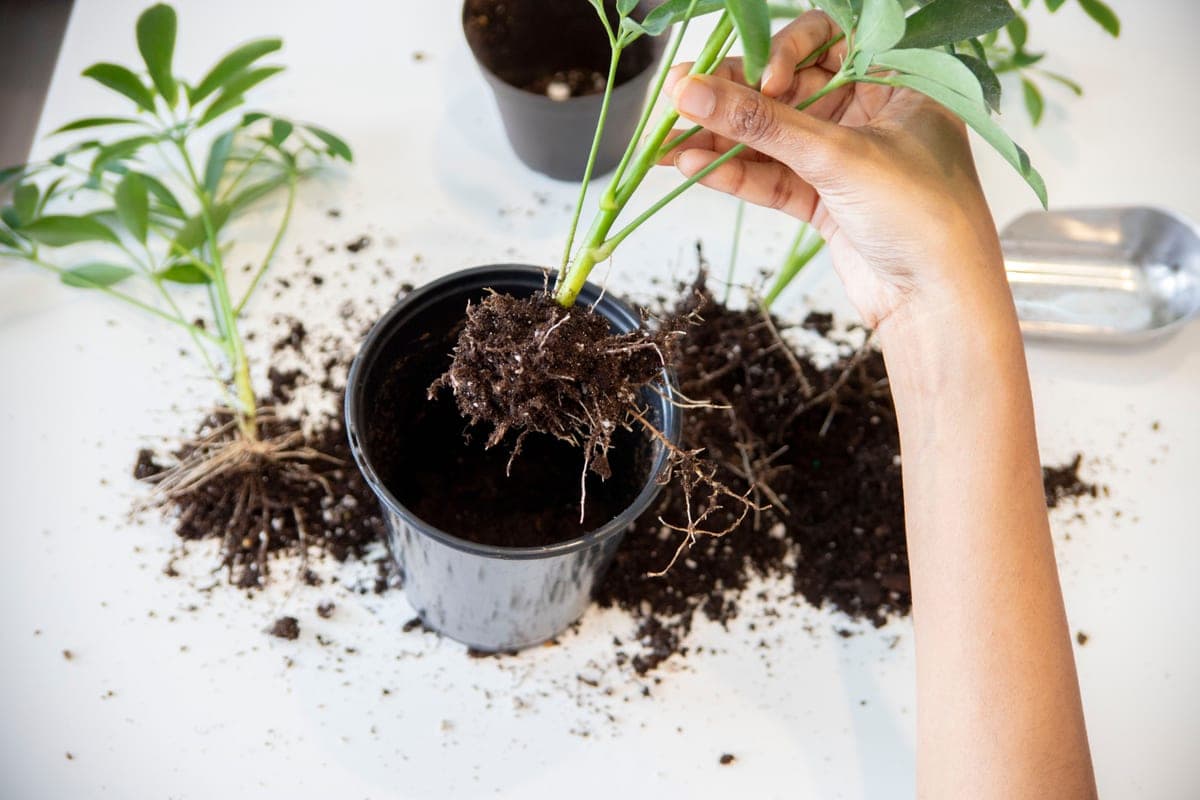
1. Take it out of the pot. Support the root ball and tip the plant out. If it is stuck, run a knife around the inside of the pot rather than pulling on the stem.
2. Remove the old mix. Work as much of it off the roots as you can without shredding what is healthy. Rinsing under a slow tap is fine and often makes the assessment easier. The old mix is saturated and carries the pathogen load, so it does not go back in the pot.
3. Cut back to firm white tissue. Clean scissors. Every mushy, brown or hollow root goes. This is the whole treatment and half measures do not work - rotted tissue left in the pot continues to rot and to host the organisms. Sterilize the blades between plants.
4. Reduce the foliage. Match the top to what the remaining roots can support. Removing half the roots and none of the leaves guarantees continued wilting and further stress. Cut proportionally, take off the worst-affected leaves first.
5. Repot small, in fresh open mix. A clean pot with a working drainage hole - NC State Extension specifically mentions checking that drainage holes have not become clogged. Size down if you removed a lot of root, because a small root system in a large volume of mix stays wet far too long. Use a light mix with perlite or bark to keep the structure open. No gravel layer in the bottom: a coarse layer under a fine mix creates a perched water table and makes the saturated zone worse.
6. Water once, then wait. Enough to settle the mix, drained fully, and then nothing until the upper root zone has genuinely dried down. No fertilizer - a damaged root system cannot use it and the salts make things worse.
Whether it will survive
It depends almost entirely on how much firm white root is left. More than half remaining is usually recoverable. A stem that has gone soft and brown at the base generally is not - the rot has moved out of the roots into the crown, and there is nothing below to rebuild from.
If the crown is gone but there is healthy top growth, take cuttings. On a pothos, philodendron or spider plant this is a very high-probability rescue and it sidesteps the whole problem. You end up with a smaller plant and no rot.
Prevention, which is the real fix
Three things, in order of impact.
Drainage that works. A hole that is not blocked, no gravel layer, and a pot that is not sitting in a full saucer. Extension guidance gives 60 minutes as the maximum a container should stand in water.
Water thoroughly and then wait. Small frequent watering causes this far more reliably than occasional heavy watering. The RHS advice is to water less often but more thoroughly and let the surface dry between times, and the cadence page makes that concrete by plant type.
Check before you water. The habit is the root cause. A finger two inches into the mix works for small pots; a probe reaches the root zone of a deep one. And if a self-watering pot was involved, the specific interaction is worth reading - it is usually top-watering on top of the reservoir rather than the pot itself.
What we would buy for this
The gear that fits this problem
Chosen from the same registry as our roundups, on published specifications and the computed refill interval.
XLUX T10 Soil Moisture Meter
Anyone who has killed a plant by watering on a schedule
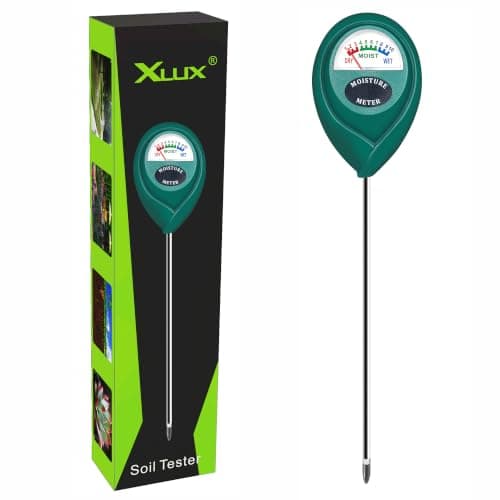
The default answer in this category, and it earns it: a single probe, no battery, a 1-to-10 dial with dry, moist and wet bands, and a probe long enough to reach the root zone of a real pot rather than the top inch.
#ad Price as of October 18, 2026, from Amazon. Prices change. How we make money.
Published specification
- Probe length
- About 7 in (17.5 cm)
- Power
- None required, since the probe generates its own signal in moist soil
- Scale
- 1 to 10, banded DRY, MOIST and WET
- Probe design
- Single probe, to limit root damage
- Weight
- About 2.5 oz (70 g)
- Probe length: XLUX published specification, via retail listing
- Power: XLUX published description
- Scale: XLUX published description
- Probe design: XLUX published description
- Weight: XLUX published specification, via retail listing
What is good about it
- No batteries means it works the day you dig it out of a drawer eighteen months later
- A 7-inch probe reaches the middle of a 6-inch pot, which is where the answer actually is
- The banded dial answers the only question you have, water or do not, without pretending to a percentage it cannot deliver
- Cheap enough to buy two and leave one in the room with the plants
What is not
- It reads conductivity, not water content, so heavily fertilized soil reads wetter than it is
- The 1-to-10 scale is relative, not calibrated to any standard, so two meters can disagree
- Single probe means one reading per insertion, and pots are not uniform
Skip this one if
Skip it if you have three plants and a finger. Virginia Tech's own guidance is to push a finger 1 to 3 inches into the mix and check, and for small pots that is genuinely as good. Buy a meter when the pots are deep enough that your finger cannot reach the root zone.
How it scored
- Published specification
- 8.5
- Probe reach
- 9.0
- Readability
- 9.0
- Value for money
- 10.0
- Measurement honesty
- 6.5
- Overall
- 8.7 / 10
Our editorial score, from published specifications and computed intervals. Not a test result. Specification source: XLUX T10 retail listing.
Questions people actually ask
- How do you treat root rot in potted plants?
Unpot the plant, remove the old mix, cut every mushy brown root back to firm white tissue with clean scissors, reduce the foliage to match, and repot into fresh open mix in a clean pot with working drainage. Then water once and wait for it to dry down.
- What causes root rot in houseplants?
Fungal and fungus-like organisms including Pythium, Phytophthora, Rhizoctonia and Fusarium, which thrive in wet, poorly drained soil and attack weakened plants. They are commonly present already - the wet conditions are what let them take hold.
- How long does root rot take to kill a plant?
It varies enormously with the plant, the pot and how wet it is staying - weeks in a small saturated pot, months in a larger one drying between episodes. The practical answer is that once the stem base has gone soft, it is generally too late.
- Can a plant recover from root rot?
Usually, if more than about half the root system is still firm and white and the crown is sound. If the stem base is soft and brown, take cuttings from healthy top growth instead - on pothos, philodendron and spider plants that is a very reliable rescue.
- Does hydrogen peroxide cure root rot?
We do not recommend it. The published extension guidance is mechanical and cultural: remove the rotted tissue, fix the drainage, and correct the watering. That addresses the conditions rather than trying to sterilize a pot the organisms already occupy.
Sources