Reference
How Often Should You Water Houseplants?
There are published bands, they differ by a factor of four, and the honest answer to the question is that you should check rather than count days.
By Scooter M. - Enthusiast. Reads the manuals, compiles the specs, does the math. | Published
Disclosure
We earn a commission if you buy through our links. It does not change what we recommend or what you pay. Full disclosure.
The short answer
The published bands
| Plant type | Published cadence | Days between | Examples |
|---|---|---|---|
| Tropical foliage | Sometimes once or twice a week | 3.5 to 7 | Pothos, monstera, philodendron, peace lily, calathea, ferns |
| Succulents and cacti | Once or twice a month | 15 to 30 | Snake plant, ZZ, jade, aloe, echeveria, most cacti |
The factor-of-four gap between those bands is the most useful single fact in houseplant care. It means the tolerance you have for being late is four times wider on one group than the other, and it is why plant choice matters more than any device if you travel or forget.
Why a fixed schedule kills plants
Because water use is not constant. Virginia Cooperative Extension lists the factors that change it: potting soil type, container type and size, time of year, plant species, temperature, humidity, light intensity and water type. A schedule that was right in July is wrong in January, and it will be wrong in the direction of too much - because light and growth have both fallen while the schedule has not.
That is the common route to overwatering, and it is worth being precise about what overwatering actually is: it is not too much water at once, it is water too often, so the root zone never gets air. NC State Extension names the organisms that take advantage in those conditions.
Watering thoroughly is easier to do than to judge. One thorough watering of a 6-inch pot is about 350 ml on our table, which is a figure you can pour if your can shows it - only one watering can we found has volume markings.
What actually shifts the interval
- Season. The biggest one. Lower light and slower growth in winter can easily double or triple the safe interval for the same plant.
- Light. A plant in a bright window uses substantially more water than the same plant in the middle of the room.
- Pot size. A 4-inch pot holds about half a liter of mix; a 12-inch pot holds about fourteen. The small one dries far faster.
- Pot material. Unglazed terracotta breathes and dries noticeably faster than plastic or glazed ceramic.
- Root-boundness. A pot full of roots has little mix left to hold water and dries much faster than the same pot did a year earlier.
- Humidity. A dry heated room in winter and a steamy bathroom are very different environments for identical plants.
The check that replaces the schedule
Push a finger into the mix. Virginia Cooperative Extension recommends one to three inches depending on container size, checking for dry spots. For a tropical foliage plant, water when that depth is dry. For a succulent, wait until it is dry throughout.
Lifting the pot works just as well and samples the whole thing rather than one point - a lightweight container is on the extension list of underwatering signs for exactly this reason. For deep floor pots where neither works, a probe reaches the root zone, and we compare the methods honestly including where the free ones win.
How to water, which matters as much as when
Thoroughly. Virginia Cooperative Extension is unambiguous: plants in containers should always be thoroughly watered, meaning the potting soil is wet all the way through, and the container should be allowed to drain until water stops dripping out the bottom.
Then empty the saucer within an hour - the published limit for a container standing in a drainage tray is 60 minutes. And do not fall into small frequent watering, which keeps the surface damp and the root zone dry at once. The RHS frames the same principle as a strategy: deep, occasional watering encourages deep roots and drought-tolerant plants.
If checking is the part you will not do
That is a legitimate self-assessment, and there are two structural answers rather than a moral one. A reservoir planter changes the question from weekly watering to a monthly refill. A plant in the succulent band changes the tolerance from three days to three weeks. Both work, and the second is free.
What we would buy for this
The gear that fits this problem
Chosen from the same registry as our roundups, on published specifications and the computed refill interval.
XLUX T10 Soil Moisture Meter
Anyone who has killed a plant by watering on a schedule
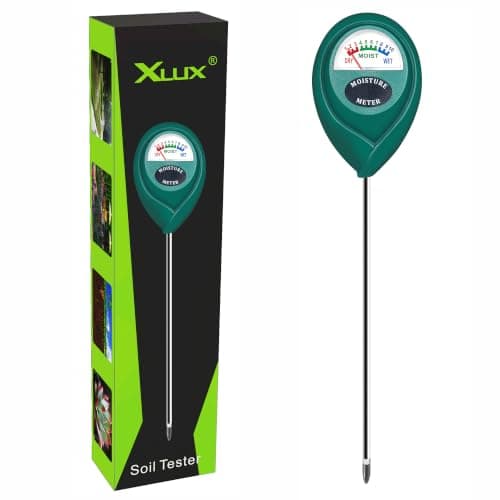
The default answer in this category, and it earns it: a single probe, no battery, a 1-to-10 dial with dry, moist and wet bands, and a probe long enough to reach the root zone of a real pot rather than the top inch.
#ad Price as of October 18, 2026, from Amazon. Prices change. How we make money.
Published specification
- Probe length
- About 7 in (17.5 cm)
- Power
- None required, since the probe generates its own signal in moist soil
- Scale
- 1 to 10, banded DRY, MOIST and WET
- Probe design
- Single probe, to limit root damage
- Weight
- About 2.5 oz (70 g)
- Probe length: XLUX published specification, via retail listing
- Power: XLUX published description
- Scale: XLUX published description
- Probe design: XLUX published description
- Weight: XLUX published specification, via retail listing
What is good about it
- No batteries means it works the day you dig it out of a drawer eighteen months later
- A 7-inch probe reaches the middle of a 6-inch pot, which is where the answer actually is
- The banded dial answers the only question you have, water or do not, without pretending to a percentage it cannot deliver
- Cheap enough to buy two and leave one in the room with the plants
What is not
- It reads conductivity, not water content, so heavily fertilized soil reads wetter than it is
- The 1-to-10 scale is relative, not calibrated to any standard, so two meters can disagree
- Single probe means one reading per insertion, and pots are not uniform
Skip this one if
Skip it if you have three plants and a finger. Virginia Tech's own guidance is to push a finger 1 to 3 inches into the mix and check, and for small pots that is genuinely as good. Buy a meter when the pots are deep enough that your finger cannot reach the root zone.
How it scored
- Published specification
- 8.5
- Probe reach
- 9.0
- Readability
- 9.0
- Value for money
- 10.0
- Measurement honesty
- 6.5
- Overall
- 8.7 / 10
Our editorial score, from published specifications and computed intervals. Not a test result. Specification source: XLUX T10 retail listing.
Lechuza Classico Color 21
A desk or shelf plant you want to stop thinking about
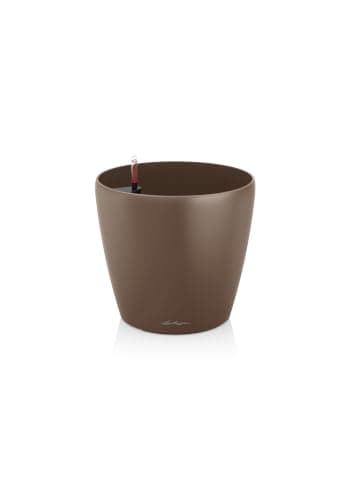
The only planter in this roundup whose maker publishes the reservoir capacity in liters, which is the single number that decides how long you can leave it. Five liters against a 6-inch tropical root ball is the longest computed interval on this page by a wide margin.
#ad Price as of October 18, 2026, from Amazon. Prices change. How we make money.
Published specification
- Reservoir capacity
- 5 liters
- External dimensions
- 9 x 9 x 8 in (21 x 21 x 20 cm)
- Water level indicator
- Yes, float gauge
- Drainage plug
- Yes, for outdoor use
- Material
- Frost and UV resistant polypropylene
- Reservoir capacity: Lechuza published specification, via retail listing
- External dimensions: Lechuza published specification, via retail listing
- Water level indicator: Lechuza published specification
- Drainage plug: Lechuza published specification
- Material: Lechuza published specification
Refill interval - computed, not tested
Roughly 7 to 14 weeks between refills
5,000 ml reservoir divided by 350 ml per thorough watering of a 6-inch pot is 14.3 waterings. At the published cadence for a tropical houseplant of once or twice a week, that is 49 to 98 days.
Assumes: 6-inch tropical root ball, indoors, average room conditions. Light, temperature, humidity, soil mix and season all change how fast a pot dries, so treat this as a planning range and not a guarantee.
What is good about it
- Publishes the reservoir capacity, which almost nothing else in this category does
- The float gauge means you never have to guess whether it needs topping up
- The drainage plug lets the same planter work outdoors without drowning the plant in a wet week
- Sub-irrigation from a granulate layer rather than a wick, so there is no wick to rot or clog
What is not
- Expensive for a 9-inch pot, and the price is most of the argument against it
- The system is built around Lechuza's own mineral granulate, so you are buying into a way of potting, not just a pot
- A 5-liter reservoir under an 8-inch or larger plant is a much shorter interval than the headline suggests
Skip this one if
Skip it if you want one pot to cover a large floor plant. The reservoir is sized for a small-to-medium root ball, and the interval collapses as the plant gets bigger. Skip it too if you like repotting into ordinary potting mix, because the granulate layer is part of the design.
How it scored
- Published capacity
- 10.0
- Computed interval
- 9.5
- Build and materials
- 9.0
- Value for money
- 6.5
- Ease of setup
- 8.5
- Overall
- 8.8 / 10
Our editorial score, from published specifications and computed intervals. Not a test result. Specification source: Lechuza Classico Color 21 retail listing.
Questions people actually ask
- How often should I water my houseplants?
Tropical foliage plants are published at sometimes once or twice a week; succulents and cacti at once or twice a month. But check rather than count days - water use changes with season, light, pot size and how root-bound the plant is.
- How much water do houseplants need?
Enough to wet the mix all the way through, with the container allowed to drain until it stops dripping. Roughly, that is about 350 ml for a 6-inch pot and 800 ml for an 8-inch one, though the correct measure is drainage rather than volume.
- Should I water houseplants on a schedule?
No. The RHS says directly to avoid a routine such as watering once a week, and to water less often but more thoroughly, letting the surface dry between times. A fixed schedule is wrong by winter and wrong in the direction of too much.
- How often should I water houseplants in winter?
Substantially less often. Lower light and slower growth can easily double or triple the interval for the same plant. Keep checking rather than adopting a new schedule.
- What time of day is best to water houseplants?
Morning, so any water on the foliage dries during the day rather than sitting overnight. It matters far less indoors than the frequency and thoroughness do.
Sources
Sources
- Criscione and Holliday-Goulart, Properly Watering Container Houseplants, Virginia Cooperative Extension SPES-804 (2026)
- Royal Horticultural Society, Watering plants wisely
- Daughtry, Watering but Not Overwatering Houseplants, NC State Extension (2022)
- Leaching Fraction: A Tool to Schedule Irrigation for Container-Grown Plants, Virginia Cooperative Extension SPES-128