Head to head
Globes vs Drip Systems vs Wicking
Three ways to move water into a pot while you are gone. They differ on volume, on whether they respond to the plant, and on how they fail.
By Scooter M. - Enthusiast. Reads the manuals, compiles the specs, does the math. | Published
Disclosure
We earn a commission if you buy through our links. It does not change what we recommend or what you pay. Full disclosure.
The short answer
The three mechanisms
Vacuum release, which is what a globe is. Water leaves the bulb only as air enters through the stem. The rate is set by how the stem sits in the soil, not by how thirsty the plant is. Seat it at an angle and you widen the air path and it can empty in hours. It is the simplest mechanism and the least controlled.
Capillary transport, which is what wicks, mats and ceramic cones are. Water moves from wet toward dry through fine pores. This is genuinely demand-driven: when the soil is wet, the gradient is small and the flow slows; when it dries, the flow picks up. Ceramic cones are the engineered version and Blumat publishes the resulting rate, about 75 ml a day for the Classic and about 150 for the XL.
Pumped delivery, which is what a drip kit is. A pump pushes a measured dose through tubing on a schedule. It is the only mechanism that can move serious volume, and the only one that is completely indifferent to whether the plant needs it.
Side by side
| Globes | Wicking and ceramic | Drip | |
|---|---|---|---|
| Typical volume | 118 to 500 ml | Whatever jug you attach | 19 L and up |
| Responds to soil moisture | No | Yes | No |
| Needs power | No | No | Yes, with battery backup |
| Setup effort | Seconds | Minutes, plus a soak for ceramic | An evening |
| Best for | Small pots, long weekend | Indoor pots, up to a month | Many pots, or a month plus |
| Typical failure | Empties in hours | Cone clogs or was not de-aerated | Emitter clogs, tube pops, pump seizes |
| Risk of drowning the plant | Real, if it dumps | Low, it self-throttles | Real, if the schedule is generous |
Why demand-driven matters more than it sounds
A timer waters on the same schedule whether the fortnight is hot and bright or cool and dark. Virginia Cooperative Extension lists temperature, humidity, light intensity and season among the things that change how much water a plant needs, and a two-week absence can easily contain both a heatwave and a cold snap.
A ceramic cone handles that automatically because the physics does the work: the drier the soil, the stronger the pull. That is a real advantage over a timer for anything longer than a few days, and it is the reason a Blumat with a jug often beats a drip kit for a single plant even though the drip kit holds ten times as much.
Choosing, in one paragraph each
Choose globes only for 4-inch pots and a long weekend, or for succulents where the published cadence is once or twice a month and even a modest volume stretches to weeks. Buy the largest capacity the listing will admit to. The honest limits are here.
Choose wicking or ceramic for indoor pots and absences up to a month. It is the best combination of volume, responsiveness and nothing-to-break in the whole category. Budget a soak and a careful setup for ceramic cones, because a badly primed one does nothing at all. For a tray of small pots specifically, a capillary mat is the simplest wicking option there is.
Choose drip when you have more pots than you want to rig individually, or you are away longer than a month, or the plants are outdoors in summer where the volumes are simply beyond everything else. The schedule setting matters as much as the kit - fewer, bigger cycles rather than a daily trickle.
What we would buy for this
The gear that fits this problem
Chosen from the same registry as our roundups, on published specifications and the computed refill interval.
Blumat Classic Watering Stakes
Set-and-forget watering of 6-inch pots, for as long as the jug lasts
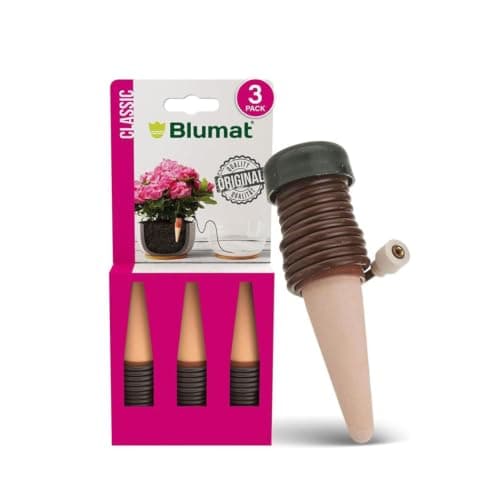
The only device in this category with a published flow rate rather than a published duration, which changes the question entirely: it is limited by how fast it can deliver, not by how much it holds. About 75 ml a day is a near-exact match for a 6-inch tropical houseplant.
#ad Price as of October 18, 2026, from Amazon. Prices change. How we make money.
Published specification
- Delivery rate
- About 75 ml per day for the Classic, about 150 ml per day for the XL
- Maximum lift
- Draws water up to 12 in (30 cm)
- Reservoir
- Any container you supply, sited no more than 12 in below the cone
- Watering method
- Ceramic cone. Soil drying creates a vacuum that pulls water from the reservoir
- Setup requirement
- Soak the cone and cap for at least 15 minutes and knock out air bubbles under water
- Delivery rate: Blumat retailer published specification
- Maximum lift: Blumat retailer published specification
- Reservoir: Blumat published description
- Watering method: Blumat published description
- Setup requirement: Blumat published instructions
Refill interval - computed, not tested
Duration is set by the jug you attach, not by the device
A 6-inch tropical houseplant draws 350 ml every 3.5 to 7 days, which is 50 to 100 ml a day. The Classic's published maximum of about 75 ml a day sits inside that band, so it can keep a 6-inch pot going but cannot keep up with a thirsty 8-inch one at 114 to 229 ml a day. That is what the XL at about 150 ml a day is for. Attach a 2 liter jug and, at a real draw of 50 ml a day, that is about 40 days.
Assumes: 6-inch tropical root ball, indoors, reservoir within 12 in below the cone. Light, temperature, humidity, soil mix and season all change how fast a pot dries, so treat this as a planning range and not a guarantee.
What is good about it
- Publishes a flow rate, which is the correct spec for a demand-driven device and which nobody else in the category gives you
- Genuinely demand-driven: when the soil is wet the flow stops, so it does not drown the plant on a cool week
- Duration is whatever reservoir you can find room for, rather than a fixed bulb
- The XL doubles the rate for larger pots, so the range actually scales with plant size
What is not
- Fiddly setup, because the cone has to be soaked and de-aerated or it simply will not siphon
- The 12-inch lift limit constrains where the reservoir can sit, and it is easy to get wrong
- More expensive per pot than a spike or a globe
- Ceramic clogs in hard water and needs periodic cleaning
Skip this one if
Skip it if you want to unbox something and push it into the soil. This rewards a careful setup and punishes a casual one, and a Blumat that was not de-aerated properly is a Blumat that does nothing at all.
How it scored
- Published specification
- 10.0
- Computed interval
- 9.0
- Honesty of claims
- 9.5
- Value for money
- 7.0
- Ease of setup
- 5.5
- Overall
- 8.9 / 10
Our editorial score, from published specifications and computed intervals. Not a test result. Specification source: Blumat Classic published specification, via Sustainable Village.
Automatic Drip Irrigation Kit with 5-Gallon Reservoir
Trips of two weeks or longer, or a whole room of plants at once
The only category here that covers a month with a straight face. A five-gallon bucket, a 22-watt pump and a programmable timer will outlast any bulb, any spike and any reservoir planter by an order of magnitude, at the cost of running hose across your floor.
#ad We do not currently hold a live price for this, so we do not show one. How we make money.
Published specification
- Reservoir capacity
- 5 gallons (about 19 liters), with 7-gallon versions also sold
- Pump
- 22 W
- Programmable interval
- 0.1 to 30 days between cycles
- Run time per cycle
- 1 to 99 seconds, model dependent
- Tubing
- 1/4 in, with individual emitters per pot
- Reservoir capacity: Published retail listing specification
- Pump: Published retail listing specification
- Programmable interval: Published retail listing specification
- Run time per cycle: Published retail listing specification
- Tubing: Published retail listing specification
Refill interval - computed, not tested
Months of water, if the pump behaves
19,000 ml divided by 350 ml per thorough watering of a 6-inch pot is 54 waterings for a single plant, which is more than half a year of capacity. Split across ten plants that is still five weeks. Capacity stops being the limiting factor entirely, and reliability becomes the thing to worry about.
Assumes: 6-inch tropical pots, indoors, 5 gallon reservoir. Light, temperature, humidity, soil mix and season all change how fast a pot dries, so treat this as a planning range and not a guarantee.
What is good about it
- Genuinely covers a long trip, which nothing passive on this site does
- One reservoir serves many pots, so cost per plant drops fast as you add plants
- Publishes real specifications, including reservoir volume, pump wattage and interval range, unlike most of the passive category
- Battery backup on many models keeps the schedule if the power blinks
What is not
- It is a pump with moving parts and a program, and any of those can fail while you are away
- Tubing to every pot, which is visible and easy to dislodge
- Fixed timing rather than demand-driven, so it waters on schedule whether the soil needs it or not
- Setup takes an evening, not five minutes
Skip this one if
Skip it for a long weekend, or for three plants. The complexity only pays back over long absences or a lot of pots. And never leave on a two-week trip having installed it the night before. Run it for a full week while you are home first.
How it scored
- Published specification
- 9.0
- Computed interval
- 10.0
- Reliability risk
- 5.5
- Value for money
- 7.5
- Ease of setup
- 4.5
- Overall
- 8.3 / 10
Our editorial score, from published specifications and computed intervals. Not a test result. Specification source: Drip irrigation kit with 5-gallon reservoir retail listing.
Capillary Matting for Plant Trays
A tray of small pots on a windowsill while you are away
The greenhouse trick, scaled down: a felt mat with one end in a water tray wicks moisture up into every pot standing on it. No mechanism, no batteries, and it works for as long as the tray holds out.
#ad We do not currently hold a live price for this, so we do not show one. How we make money.
Published specification
- Reservoir
- Whatever tray or basin you supply
- Watering method
- Capillary wicking through a felt mat into drainage holes
- Requirement
- Pots must have drainage holes and sit flat on the mat
- Reservoir: Published product descriptions
- Watering method: Published product descriptions
- Requirement: Published product descriptions
Refill interval - computed, not tested
Set by the tray, and the tray is usually the weak point
A 2 liter tray split across six 4-inch pots at 100 ml per thorough watering each is 3.3 waterings per pot, or about 12 to 23 days, if the tray does not evaporate first. In a sunny window it will.
Assumes: Six 4-inch pots on a 2 liter tray, indoors out of direct sun. Light, temperature, humidity, soil mix and season all change how fast a pot dries, so treat this as a planning range and not a guarantee.
What is good about it
- No moving parts at all, so nothing to fail while you are away
- One tray serves every pot standing on it, so cost per plant is trivial
- Bottom watering by design, which keeps the surface dry and discourages fungus gnats
What is not
- Only works with pots that have drainage holes and flat bases
- The mat has to stay in contact with the mix, so no thick layer of decorative gravel
- Evaporation from an open tray in a sunny window can beat the plants to the water
- Constant moisture at the base is a root-rot risk for succulents
Skip this one if
Skip it for succulents and cacti. Continuous bottom moisture is precisely wrong for plants whose published cadence is once or twice a month, and you will come home to rot.
How it scored
- Published specification
- 5.5
- Computed interval
- 7.0
- Reliability risk
- 9.5
- Value for money
- 9.5
- Plant compatibility
- 5.0
- Overall
- 7.4 / 10
Our editorial score, from published specifications and computed intervals. Not a test result. Specification source: Capillary matting retail listings.
Questions people actually ask
- Which is better, a watering globe or a drip system?
For anything past a long weekend on a normal-sized pot, the drip system, by a wide margin - it holds 19 liters against a globe’s 118 to 500 ml. The globe wins only on simplicity and on tiny pots, and it has nothing to break.
- What does demand-driven mean for a plant waterer?
That the delivery rate responds to how dry the soil is. Capillary devices - wicks, mats and ceramic cones - slow down when the soil is wet and speed up when it dries. Globes and timers do not, which is why they can drown a plant in a cool wet fortnight.
- Can I combine methods?
Yes, and for a long trip it is sensible. A drip system as the primary with a ceramic cone on the most valuable plant as a backup covers the main failure mode, which is that the pump stops and nothing tells you.
- Do wicking systems work for large plants?
Up to a point. A wick or a standard ceramic cone has a limited rate - Blumat publishes about 75 ml a day for the Classic - and an 8-inch tropical needs 114 to 229 ml a day. The XL at about 150 ml a day covers that; the Classic does not.
Sources