Roundup
Best Soil Moisture Meter for Gardens and Outdoor Beds
Outdoors the surface tells you almost nothing. Probe length is the specification that decides whether a reading is worth taking.
By Scooter M. - Enthusiast. Reads the manuals, compiles the specs, does the math. | Published
Disclosure
We earn a commission if you buy through our links. It does not change what we recommend or what you pay. Full disclosure.
The short answer
Why outdoor readings need depth
Sun and wind dry the top layer of a bed fast, and that layer is not where the roots are. The RHS advice is explicit about depth: use a trowel to check whether the soil is damp at 15 cm and water only if it is dry there. For containers outdoors they give a shallower check - dry 2 to 3 cm below the surface - because a container is a smaller, faster-drying system.
A long probe is the version of that trowel check you will actually do every time. That is the same argument as the indoor case: the tool wins on convenience rather than precision, and convenience is what turns a good intention into a habit.
| Situation | Depth that matters | Probe length needed |
|---|---|---|
| Patio pots | Two thirds of pot depth | 7 to 8 in |
| Raised beds and veg | About 6 in (15 cm) | 10 in or more |
| Established shrubs | 8 to 12 in | 12 in or more |
| Newly planted tree | The root ball, 12 to 18 in | 18 to 24 in |
| Lawn | 3 to 6 in | 10 in is plenty |
The case a long probe solves better than anything else
A newly planted tree or shrub. For the first year or two the plant is living off the root ball it arrived with, and that root ball can be dry while the surrounding bed is damp - the two materials have different structures and water moves poorly between them.
The result is a well-watered garden and a dying tree, which is a genuinely common and expensive failure. A probe long enough to reach into the root ball itself, pushed in close to the trunk rather than out at the drip line, is the only quick way to check the thing that matters.
What outdoor readings will not tell you
Anything absolute. These are relative conductivity readings with no published calibration, and outdoors the soil composition varies across a bed in a way potting mix does not. Compare the same spot across time, not two spots against each other.
Anything reliable in very sandy or very stony ground. Poor probe contact gives falsely dry readings, and forcing a long probe into stony soil bends it. Take three readings a hand-span apart and treat a wildly outlying one as bad contact rather than a discovery.
Anything about fertilizer. Freshly fertilized ground reads wetter, because the meter responds to dissolved salts as well as water. That is a real source of error in a vegetable bed that has just been fed.
The bigger outdoor lever
Meters diagnose. Mulch and irrigation fix. The RHS point that deep, occasional watering encourages deep roots and drought tolerance is the strategic version of everything on this page: a meter helps you water less often and more thoroughly, which over a season changes how the plants root.
For containers outdoors, where the drying is fastest, the durable answer is usually a sub-irrigated planter with a published reservoir rather than better measurement. And if the outdoor problem is specifically a trip away, that is a drip-system problem and no meter helps while you are gone.
Ranked picks
Quick picks
Ranked on published specifications and the computed refill interval, not on looks. Tap any row for the full write-up, including who should skip it.
| # | Product | Best for | Score | Price |
|---|---|---|---|---|
| 1 | Long-Probe Soil Moisture Meter for Garden BedsRaised beds, shrubs and newly planted trees | Best for beds and trees | 7.2 | Check price on Amazon |
| 2 | 3-in-1 Soil Meter for Moisture, Light and pHSomeone who wants a light reading as well and will ignore the pH scale | Best for large containers | 7.0 | Check price on Amazon |
| 3 | 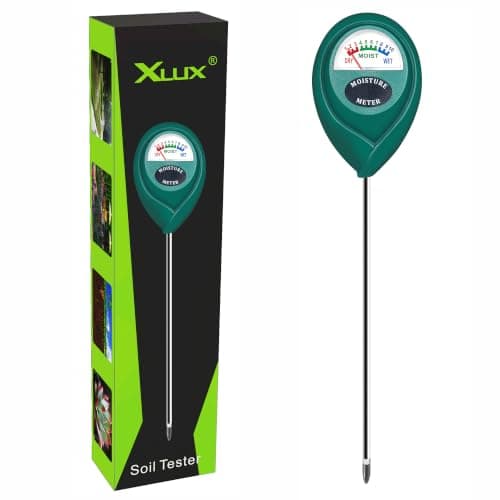 XLUX T10 Soil Moisture MeterAnyone who has killed a plant by watering on a schedule XLUX T10 Soil Moisture MeterAnyone who has killed a plant by watering on a schedule | Best for pots on a patio | 8.7 | $9.99 - View on Amazon |
| 4 | Digital Soil Moisture Meter with Backlit DisplayReading a pot in a dark corner, or wanting a number to track over time | Skip this one outdoors | 6.8 | Check price on Amazon |
Scores are our editorial judgment from published specifications. They are not test results, and they are deliberately not marked up as ratings in this page’s structured data.
Pick #1 - Best for beds and trees
Long-Probe Soil Moisture Meter for Garden Beds
Raised beds, shrubs and newly planted trees
The outdoor version, with a probe long enough to reach below the top few inches that dry out first in a bed. For garden use this is the only probe length that answers a useful question.
#ad We do not currently hold a live price for this, so we do not show one. How we make money.
Published specification
- Probe length
- Commonly 10 to 24 in, model dependent
- Power
- Usually none required
- Scale
- 1 to 10, banded dry, moist and wet
- Probe length: Published retail listing specifications
- Power: Published retail listing specification
- Scale: Published retail listing specification
What is good about it
- Long enough to read below the surface crust, which is where a bed's real moisture story is
- Answers the specific question that matters for a new tree: is the root ball still wet
- Same battery-free simplicity as the indoor meters
What is not
- Too long to use comfortably in a houseplant pot
- Longer probes bend if you force them into compacted or stony ground
- Same uncalibrated conductivity reading as any other meter, over a longer distance
Skip this one if
Skip it if all your plants are indoors. A 24-inch probe in an 8-inch pot reads the bottom of the pot and the saucer, which tells you nothing you wanted to know.
How it scored
- Published specification
- 6.0
- Probe reach
- 10.0
- Readability
- 7.5
- Value for money
- 8.0
- Measurement honesty
- 5.5
- Overall
- 7.2 / 10
Our editorial score, from published specifications and computed intervals. Not a test result. Specification source: Long-probe soil moisture meter retail listings.
Pick #2 - Best for large containers
3-in-1 Soil Meter for Moisture, Light and pH
Someone who wants a light reading as well and will ignore the pH scale
The three-dial version that shows up first in every search. The moisture needle works on the same principle as a single-function meter. The pH needle on a cheap probe of this type is the part to distrust.
#ad We do not currently hold a live price for this, so we do not show one. How we make money.
Published specification
- Functions
- Moisture, light and pH on one probe
- Power
- None required for the moisture and light functions
- Probe length
- Commonly around 7 to 8 in
- pH accuracy
- Not published by the manufacturer
- Functions: Published retail listing specification
- Power: Published retail listing specification
- Probe length: Published retail listing specification
- pH accuracy: Checked listings, no accuracy figure or calibration method published
What is good about it
- The light meter is genuinely useful for working out whether a corner is as bright as you think
- Same battery-free moisture principle as a single-function meter
- Barely more expensive than a moisture-only probe
What is not
- The pH function on a two-electrode probe of this type has no published accuracy or calibration method, and we would not make a decision on it
- Three scales on one dial is harder to read at a glance than one
- Switching functions on the cheapest units is a source of confusion and misreadings
Skip this one if
Skip it if you actually need a soil pH reading. Buy a test kit for that. Treat this as a moisture meter with a light meter attached and you will not be disappointed.
How it scored
- Published specification
- 5.0
- Probe reach
- 8.5
- Readability
- 6.5
- Value for money
- 9.0
- Measurement honesty
- 4.0
- Overall
- 7.0 / 10
Our editorial score, from published specifications and computed intervals. Not a test result. Specification source: 3-in-1 soil meter retail listings.
Pick #3 - Best for pots on a patio
XLUX T10 Soil Moisture Meter
Anyone who has killed a plant by watering on a schedule
The default answer in this category, and it earns it: a single probe, no battery, a 1-to-10 dial with dry, moist and wet bands, and a probe long enough to reach the root zone of a real pot rather than the top inch.
#ad Price as of October 18, 2026, from Amazon. Prices change. How we make money.
Published specification
- Probe length
- About 7 in (17.5 cm)
- Power
- None required, since the probe generates its own signal in moist soil
- Scale
- 1 to 10, banded DRY, MOIST and WET
- Probe design
- Single probe, to limit root damage
- Weight
- About 2.5 oz (70 g)
- Probe length: XLUX published specification, via retail listing
- Power: XLUX published description
- Scale: XLUX published description
- Probe design: XLUX published description
- Weight: XLUX published specification, via retail listing
What is good about it
- No batteries means it works the day you dig it out of a drawer eighteen months later
- A 7-inch probe reaches the middle of a 6-inch pot, which is where the answer actually is
- The banded dial answers the only question you have, water or do not, without pretending to a percentage it cannot deliver
- Cheap enough to buy two and leave one in the room with the plants
What is not
- It reads conductivity, not water content, so heavily fertilized soil reads wetter than it is
- The 1-to-10 scale is relative, not calibrated to any standard, so two meters can disagree
- Single probe means one reading per insertion, and pots are not uniform
Skip this one if
Skip it if you have three plants and a finger. Virginia Tech's own guidance is to push a finger 1 to 3 inches into the mix and check, and for small pots that is genuinely as good. Buy a meter when the pots are deep enough that your finger cannot reach the root zone.
How it scored
- Published specification
- 8.5
- Probe reach
- 9.0
- Readability
- 9.0
- Value for money
- 10.0
- Measurement honesty
- 6.5
- Overall
- 8.7 / 10
Our editorial score, from published specifications and computed intervals. Not a test result. Specification source: XLUX T10 retail listing.
Pick #4 - Skip this one outdoors
Digital Soil Moisture Meter with Backlit Display
Reading a pot in a dark corner, or wanting a number to track over time
A battery-powered probe with a numeric readout instead of a needle. The number looks more precise than the analog dial and is measuring exactly the same thing, which is worth knowing before you pay extra for it.
#ad We do not currently hold a live price for this, so we do not show one. How we make money.
Published specification
- Display
- Backlit LCD with numeric readout
- Power
- Battery required, usually AAA or a coin cell
- Calibration standard
- Not published by the manufacturer
- Display: Published retail listing specification
- Power: Published retail listing specification
- Calibration standard: Checked listings, no traceable calibration or accuracy figure published
What is good about it
- Backlit display is genuinely easier in a dim corner than squinting at a needle
- A repeatable number is easier to track across weeks than a needle position
- Often adds a temperature reading, which is a real input to how fast a pot dries
What is not
- Needs a battery, which is the failure mode for a device you use twice a month
- The extra decimal place is false precision, because the underlying measurement is the same conductivity reading
- No published calibration standard on any listing we checked, so the number is not comparable between meters
Skip this one if
Skip it if you were paying for accuracy. You are paying for a backlight and a battery compartment. The analog meter measures the same thing for less and never goes flat.
How it scored
- Published specification
- 4.5
- Probe reach
- 7.5
- Readability
- 9.0
- Value for money
- 6.0
- Measurement honesty
- 4.5
- Overall
- 6.8 / 10
Our editorial score, from published specifications and computed intervals. Not a test result. Specification source: Digital soil moisture meter retail listings.
Questions people actually ask
- How long should a garden soil moisture meter probe be?
At least 10 inches for beds, since the RHS check is whether soil is damp at about 6 inches and you want to read below that. For a newly planted tree, 18 to 24 inches so you can reach into the original root ball.
- Do soil moisture meters work in garden soil?
Yes, with the same limitation as indoors: the reading is relative conductivity, not a calibrated water content. Compare the same spot over time. In sandy or stony ground, take three readings a hand-span apart, because poor probe contact reads falsely dry.
- Why is my new tree dying when the ground is wet?
The original root ball can stay dry while the surrounding bed is damp, because the two materials have different structures and water moves poorly between them. Push a long probe in close to the trunk, into the root ball itself, rather than out at the drip line.
- Can I use an indoor moisture meter outside?
For patio pots, yes - a 7-inch probe reads a container correctly. For beds it is too short, and reading the top few inches of a bed produces confident wrong answers.
Sources