Roundup
Best Outdoor Self-Watering Planters
Outdoors, rain and sun both attack the reservoir logic. These are the ones built for it, and the honest reason we do not quote a refill interval for them.
By Scooter M. - Enthusiast. Reads the manuals, compiles the specs, does the math. | Published
Disclosure
We earn a commission if you buy through our links. It does not change what we recommend or what you pay. Full disclosure.
The short answer
Why we do not publish a refill interval for outdoor planters
Our refill number is built on a watering cadence that Virginia Cooperative Extension publishes for indoor container houseplants: once or twice a week for tropicals. There is no equivalent published band we can defend for an outdoor tomato in July, and the real figure is several times higher. Applying the indoor band outdoors would produce a number that flatters every product on this page.
So we do not. What we can tell you is the published reservoir volume, which is real, and the practical consequence: in hot weather a well-planted outdoor sub-irrigated box wants topping up daily, and the reservoir is buying you resilience against a missed day, not a vacation.
The three outdoor-specific features
| Feature | Why it matters outdoors | Which products have it |
|---|---|---|
| Drainage plug or overflow | A week of rain fills the reservoir past the air gap and drowns the roots | Lechuza Cubico, EarthBox (overflow), GroBucket (side port) |
| Mulch cover | Keeps rain out of the growing media so the reservoir stays the control | EarthBox range |
| Frost and UV resistant material | Cheap resin goes brittle and chalky in one season outdoors | Lechuza (published), EarthBox |
| Published reservoir capacity | The only way to compare two boxes at all | EarthBox, Lechuza |
The rain problem nobody mentions
A self-watering planter left outdoors in a wet week becomes a bucket with a plant in it. The air gap that keeps roots out of standing water is a designed clearance, and rain does not respect it. This is the single reason a drainage plug or overflow is not optional outdoors - and it is also why the EarthBox mulch cover, which looks like a cosmetic accessory, is doing real work: it keeps rain out of the growing media entirely so the reservoir remains the only water source.
The consequence for the rot risk is the same as indoors, just arriving by a different route. NC State Extension names the culprits - Pythium, Phytophthora, Rhizoctonia and Fusarium - and the condition they need, which is wet and poorly drained. Outdoors, the weather supplies that condition for free unless the planter is built to shed it.
Balcony versus patio
On a balcony, weight and overflow are the constraints. A 3-gallon reservoir plus two cubic feet of wet mix is heavy, and anything that drains has to drain somewhere that is not your neighbor. The square EarthBox Root and Veg or a couple of GroBucket conversions on saucers usually make more sense than one long box, and our EarthBox review sets out which of the three boxes suits which crop. If the plan is a bed at waist height rather than a box on the ground, the elevated self-watering beds are ranked separately. For the rail itself, the reservoir window boxes and the reservoir hanging baskets are ranked on their own pages.
On a patio at ground level, the constraint is heat. Dark plastic in full sun warms the reservoir, which accelerates both evaporation and root stress. Site boxes so the container itself is shaded even where the foliage is not, and expect the reservoir to drop faster than the same box in dappled light.
If what you are actually growing is food, the edible-crop roundup is the more specific page. If you want to convert containers you already have, the conversion kits are cheaper than replacing them. And if the real question is how to keep an outdoor pot alive for two weeks in August, that is a drip problem, not a planter problem.
Ranked picks
Quick picks
Ranked on published specifications and the computed refill interval, not on looks. Tap any row for the full write-up, including who should skip it.
| # | Product | Best for | Score | Price |
|---|---|---|---|---|
| 1 | 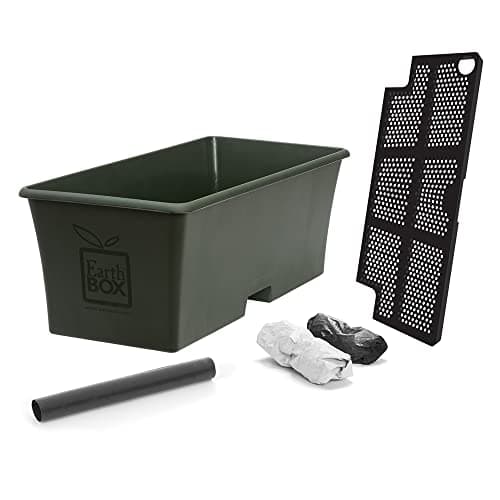 EarthBox OriginalTomatoes, peppers and herbs on a patio or balcony EarthBox OriginalTomatoes, peppers and herbs on a patio or balcony | Biggest published reservoir | 9.0 | $59.99 - View on Amazon |
| 2 |  Lechuza Cubico Color 22A floor plant in a corner you would rather not water weekly Lechuza Cubico Color 22A floor plant in a corner you would rather not water weekly | Best looking outdoors | 8.4 | Check price on Amazon |
| 3 | 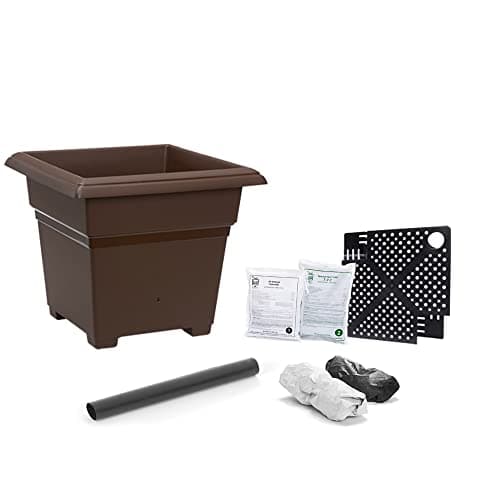 EarthBox Root and VegRoot crops and anything that needs 15 inches of depth EarthBox Root and VegRoot crops and anything that needs 15 inches of depth | Best for depth | 8.0 | $59.99 - View on Amazon |
| 4 | 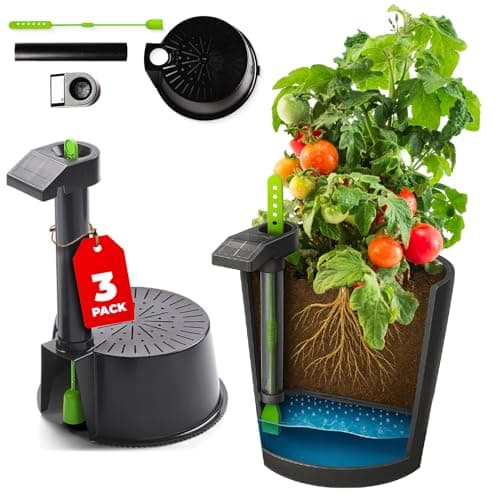 GroBucket Self-Watering Planter InsertCheap outdoor food growing in buckets you already have GroBucket Self-Watering Planter InsertCheap outdoor food growing in buckets you already have | Cheapest way in | 7.6 | $55.99 - View on Amazon |
| 5 | 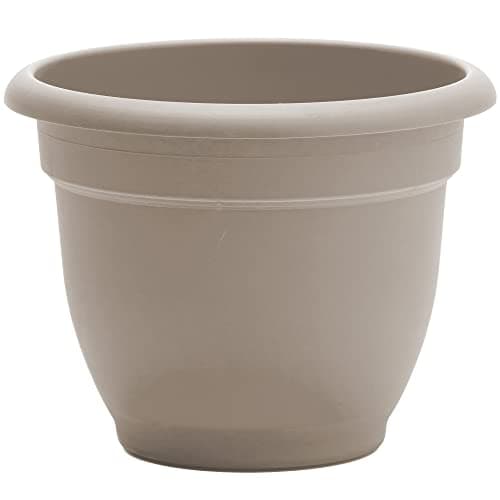 Bloem Ariana 12 in Self-Watering PlanterLooks, on a budget, when refill interval is not the deciding factor Bloem Ariana 12 in Self-Watering PlanterLooks, on a budget, when refill interval is not the deciding factor | Budget pick, undocumented | 6.4 | $12.31 - View on Amazon |
Scores are our editorial judgment from published specifications. They are not test results, and they are deliberately not marked up as ratings in this page’s structured data.
Pick #1 - Biggest published reservoir
EarthBox Original
Tomatoes, peppers and herbs on a patio or balcony
The reference sub-irrigated planter for outdoor edibles, and the only maker here that publishes reservoir capacity, soil volume and dimensions for its whole range in one comparison table. Three gallons under two cubic feet of mix is a serious buffer for tomatoes.
#ad Price as of October 18, 2026, from Amazon. Prices change. How we make money.
Published specification
- Reservoir capacity
- 3 gallons (about 11.4 liters)
- Growing media capacity
- 2.0 cubic feet
- External dimensions
- 29 x 13.5 x 11 in
- Watering method
- Sub-irrigation, capillary action from a bottom reservoir
- Kit contents
- Planter, aeration screen, fill tube, two reversible mulch covers
- Reservoir capacity: EarthBox published comparison table
- Growing media capacity: EarthBox published comparison table
- External dimensions: EarthBox published comparison table
- Watering method: EarthBox published description
- Kit contents: EarthBox published description
Refill interval - computed, not tested
We do not compute an interval for this one, on purpose
The published frequency band we use is for indoor container houseplants. An outdoor tomato in July transpires several times that, so applying the band here would produce a number that flatters the product and misleads you. In hot weather, expect to top this up daily.
Assumes: Outdoor edibles in summer, which is outside the band we can defend. Light, temperature, humidity, soil mix and season all change how fast a pot dries, so treat this as a planning range and not a guarantee.
What is good about it
- EarthBox publishes reservoir capacity, soil volume and dimensions for every model in a single table, the most transparent spec sheet in this entire roundup
- Three gallons is the largest published reservoir here, which is what a fruiting crop actually needs
- The mulch cover keeps rain out of the mix, so the reservoir stays the thing that controls watering
What is not
- It is a rectangular plastic box and it looks like one
- Two cubic feet of potting mix per box is a real cost on top of the box
- In summer it still wants topping up daily, so it is a labor saver, not a vacation solution
Skip this one if
Skip it if you want an indoor decorative planter. This is outdoor growing equipment and it will look like equipment in a living room. Skip it too if you are buying it as a two-week vacation fix for tomatoes, because it is not one.
How it scored
- Published capacity
- 10.0
- Reservoir size
- 10.0
- Build and materials
- 8.5
- Value for money
- 7.5
- Looks
- 5.0
- Overall
- 9.0 / 10
Our editorial score, from published specifications and computed intervals. Not a test result. Specification source: EarthBox published system comparison table.
Pick #2 - Best looking outdoors
Lechuza Cubico Color 22
A floor plant in a corner you would rather not water weekly
The same published-capacity honesty as the Classico in a tall floor-standing shape, with a 6-liter reservoir. It is a bigger reservoir under a bigger plant, so the interval comes out shorter than the Classico's, not longer, which is exactly the trade nobody in this category explains.
#ad We do not currently hold a live price for this, so we do not show one. How we make money.
Published specification
- Reservoir capacity
- 6 liters
- External dimensions
- 9 x 9 x 16 in (22 x 22 x 41 cm)
- Water level indicator
- Yes, float gauge
- Material
- Shockproof poly-resin, matte finish
- Indoor and outdoor
- Both, with drainage hole
- Reservoir capacity: Lechuza published specification, via retail listing
- External dimensions: Lechuza published specification, via retail listing
- Water level indicator: Lechuza published specification
- Material: Lechuza published specification
- Indoor and outdoor: Lechuza published specification
Refill interval - computed, not tested
Roughly 4 to 8 weeks between refills
6,000 ml reservoir divided by 800 ml per thorough watering of an 8-inch pot is 7.5 waterings. At once or twice a week for a tropical houseplant, that is 28 to 56 days.
Assumes: 8-inch tropical root ball, indoors, average room conditions. Light, temperature, humidity, soil mix and season all change how fast a pot dries, so treat this as a planning range and not a guarantee.
What is good about it
- One of very few floor planters with a published reservoir figure at all
- The tall body puts the reservoir under a genuinely floor-sized plant rather than under a desk pot
- Float gauge, so the fill state is visible without digging
What is not
- Bigger reservoir, bigger plant: the interval is shorter than the smaller Classico's, which is counterintuitive at the shelf
- Costs more than most people expect to pay for a plastic planter
Skip this one if
Skip it if you were buying the bigger size expecting a longer gap between refills. It does not work that way, and we would rather say so than sell you the upgrade.
How it scored
- Published capacity
- 10.0
- Computed interval
- 8.0
- Build and materials
- 9.0
- Value for money
- 6.0
- Ease of setup
- 8.5
- Overall
- 8.4 / 10
Our editorial score, from published specifications and computed intervals. Not a test result. Specification source: Lechuza Cubico Color 22 retail listing.
Pick #3 - Best for depth
EarthBox Root and Veg
Root crops and anything that needs 15 inches of depth
A deep, square sub-irrigated planter for crops that need root depth rather than surface area: carrots, beets, a bush squash. Two gallons of reservoir under two cubic feet of mix, published, as usual for this maker.
#ad Price as of October 18, 2026, from Amazon. Prices change. How we make money.
Published specification
- Reservoir capacity
- 2 gallons (about 7.6 liters)
- Growing media capacity
- 2.0 cubic feet
- External dimensions
- 17.75 x 17.75 x 15.75 in
- Watering method
- Sub-irrigation from a bottom reservoir
- Reservoir capacity: EarthBox published comparison table
- Growing media capacity: EarthBox published comparison table
- External dimensions: EarthBox published comparison table
- Watering method: EarthBox published description
What is good about it
- The deepest of the three EarthBox systems, which is the whole point of it
- Square footprint fits a balcony corner better than the long Original
- Published capacities across the range make the three genuinely comparable, which is rare
What is not
- Two gallons under two cubic feet is a lower reservoir-to-soil ratio than the Original
- Depth is wasted on leafy crops, which do just as well in the Junior
Skip this one if
Skip it if you are growing lettuce, herbs or anything shallow-rooted. You are paying for depth you will not use, and the Original has a bigger reservoir for the same soil volume.
How it scored
- Published capacity
- 10.0
- Reservoir size
- 8.0
- Build and materials
- 8.5
- Value for money
- 7.0
- Looks
- 5.5
- Overall
- 8.0 / 10
Our editorial score, from published specifications and computed intervals. Not a test result. Specification source: EarthBox published system comparison table.
Pick #4 - Cheapest way in
GroBucket Self-Watering Planter Insert
Cheap outdoor food growing in buckets you already have
Turns an ordinary 5-gallon bucket into a sub-irrigated planter: a reservoir in the base, a barrier above it and a side fill port with overflow. It is the most flexible way to own the mechanism, and worth pricing against a complete grow box before you buy - inserts are no longer automatically the cheap option.
#ad Price as of October 18, 2026, from Amazon. Prices change. How we make money.
Published specification
- Reservoir capacity
- Not published by the manufacturer
- Fits
- Standard 5-gallon bucket
- Watering method
- Sub-irrigation, reservoir formed in the bottom of the bucket
- Fill
- Side fill port with overflow
- Reservoir capacity: Checked GroBucket listings, reservoir volume not published as a figure
- Fits: GroBucket published description
- Watering method: GroBucket published description
- Fill: GroBucket published description
What is good about it
- By far the cheapest way to get a real sub-irrigated planter
- Buckets are free or nearly free, and food-safe ones are easy to find
- Scales sideways: ten buckets cost what one designer planter does
What is not
- GroBucket does not publish the reservoir volume as a number, so we cannot compute an interval for it
- It is a bucket. It looks like a bucket
- Outdoor summer use anyway, where the indoor frequency band does not apply
Skip this one if
Skip it if the planter is going indoors or anywhere it will be looked at. This is a utility solution for a back step or a community plot, not a living-room object.
How it scored
- Published capacity
- 2.0
- Computed interval
- 3.0
- Flexibility
- 8.0
- Value for money
- 10.0
- Looks
- 3.0
- Overall
- 7.6 / 10
Our editorial score, from published specifications and computed intervals. Not a test result. Specification source: GroBucket insert retail listing.
Pick #5 - Budget pick, undocumented
Bloem Ariana 12 in Self-Watering Planter
Looks, on a budget, when refill interval is not the deciding factor
A good-looking, inexpensive resin planter with a self-watering disk, and no published reservoir capacity anywhere we could find, which means nobody, including us, can tell you how long a fill lasts. It is here because it sells well and you deserve to know that gap exists before you buy.
#ad Price as of October 18, 2026, from Amazon. Prices change. How we make money.
Published specification
- Reservoir capacity
- Not published by the manufacturer
- Total planter capacity
- 3 gallons (12 quarts) of growing media
- External dimensions
- 13 x 13 x 10.25 in
- Watering method
- Self-watering grid above a hidden bottom reservoir
- Material
- Recycled plastic resin
- Reservoir capacity: Checked Bloem product listings, no figure published
- Total planter capacity: Bloem published specification, via retail listing
- External dimensions: Bloem published specification, via retail listing
- Watering method: Bloem published description
- Material: Bloem published specification
Refill interval - computed, not tested
We cannot compute one, and that is the finding
Our refill interval is reservoir capacity divided by the volume of one thorough watering. Bloem does not publish a reservoir capacity for the Ariana, so the numerator does not exist. We will not estimate it, because a made-up numerator produces a real-looking answer.
Assumes: None available. The input is missing. Light, temperature, humidity, soil mix and season all change how fast a pot dries, so treat this as a planning range and not a guarantee.
What is good about it
- Genuinely attractive for the money, in a category full of ugly plastic
- Twelve quarts of growing media is a lot of root room at this price
- Made from recycled resin, which the more expensive planters here are not
What is not
- No published reservoir capacity, so the one number that decides how long you can leave it is unavailable
- The self-watering disk sits low in a wide shallow body, so the reservoir is inherently modest relative to the soil above it
- Without a level indicator you are guessing at the fill state
Skip this one if
Skip it if you are buying specifically to extend the gap between waterings. You cannot verify that it will, and neither can we. Buy it for the way it looks and treat the reservoir as a bonus.
How it scored
- Published capacity
- 1.0
- Computed interval
- 2.0
- Build and materials
- 7.0
- Value for money
- 9.0
- Looks
- 9.0
- Overall
- 6.4 / 10
Our editorial score, from published specifications and computed intervals. Not a test result. Specification source: Bloem Ariana 12 in retail listing.
Questions people actually ask
- Do self-watering planters work outdoors in the rain?
Only if they can shed the rain. Without a drainage plug, an overflow or a mulch cover, a wet week fills the reservoir past the air gap and the roots end up sitting in water. Every planter we recommend for outdoor use has at least one of those three.
- Will an outdoor self-watering planter survive winter?
Depends on the material, and it is one of the few things brands do publish. Lechuza specifies frost and UV resistant polypropylene. Generic resin planters generally do not carry a frost claim, and a season outdoors leaves them chalky and brittle. Empty the reservoir before a hard freeze either way, because water expanding in a sealed cavity cracks the shell.
- How often do I need to fill an outdoor self-watering planter?
In hot weather with a fully grown crop, expect daily. We deliberately do not publish a computed interval for outdoor use because the watering-frequency band we rely on is published for indoor houseplants, and applying it outdoors would overstate every product here.
- Are self-watering planters good for a hot balcony?
Better than a plain pot, yes, because the reservoir buffers a missed day and sub-irrigation keeps the root zone more stable than surface watering. But the reservoir is not a vacation device in summer heat. Shade the container itself where you can - a shaded pot loses far less than a sunlit one.
Sources