Roundup
Best Houseplants for Beginners
The usual advice is to start with the plant that is hardest to kill. We think you should start with the plant that teaches you the fastest, and then buy the tough one second.
By Scooter M. - Enthusiast. Reads the manuals, compiles the specs, does the math. | Published
Disclosure
We earn a commission if you buy through our links. It does not change what we recommend or what you pay. Full disclosure.
The short answer
The criterion the usual lists get backwards
Every beginner list leads with the snake plant, on the grounds that it survives neglect. It does. Virginia Cooperative Extension publishes its watering cadence in the succulent band - once or twice a month - against once or twice a week for tropical foliage, so a missed week barely registers. That is a real advantage, and our hard-to-kill roundup ranks it first for a reader who has already killed several plants and wants one that will not die.
A beginner is a different reader. A beginner has not yet learned how to water, and the plant that tolerates everything is the plant that never teaches them. NC State Extension describes the trap that catches most new owners: a plant wilts, they read it as thirst, they add water, and the wilt was the first sign of too much. A snake plant lets that go on for months without complaint, and then it is dead. A pothos objects within a day and forgives within hours. That is a teacher.
How we ranked them
Feedback first. Does the plant show you, quickly and reversibly, that something is wrong? For a first plant this matters more than toughness.
Published watering band second. Virginia Cooperative Extension gives two bands, a factor of four apart. The wider the band, the more forgiving the plant - and the more silently it fails when overwatered.
Light tolerance third. Most first plants go where there is space, not where there is light. A plant that copes with a dim room removes one variable from a beginner’s first month.
Pet safety fourth, and stated for every pick. The ASPCA lists three of the four plants here as toxic to dogs and cats if chewed. We say which, because a beginner with a cat needs to know before buying, not after.
| Plant | Tells you? | Published cadence | Dim room? | Pets |
|---|---|---|---|---|
| Pothos | Yes, dramatic reversible wilt | Once or twice a week | Yes | Toxic to cats and dogs |
| Spider plant | Mostly - brown tips, then droop | Once or twice a week | Prefers brighter | Non-toxic |
| Snake plant | No, it suffers silently | Once or twice a month | Yes | Toxic to cats and dogs |
| ZZ plant | No, and looks fine until it is not | Once or twice a month | Best of the four | Mildly toxic if eaten |
First plant: pothos
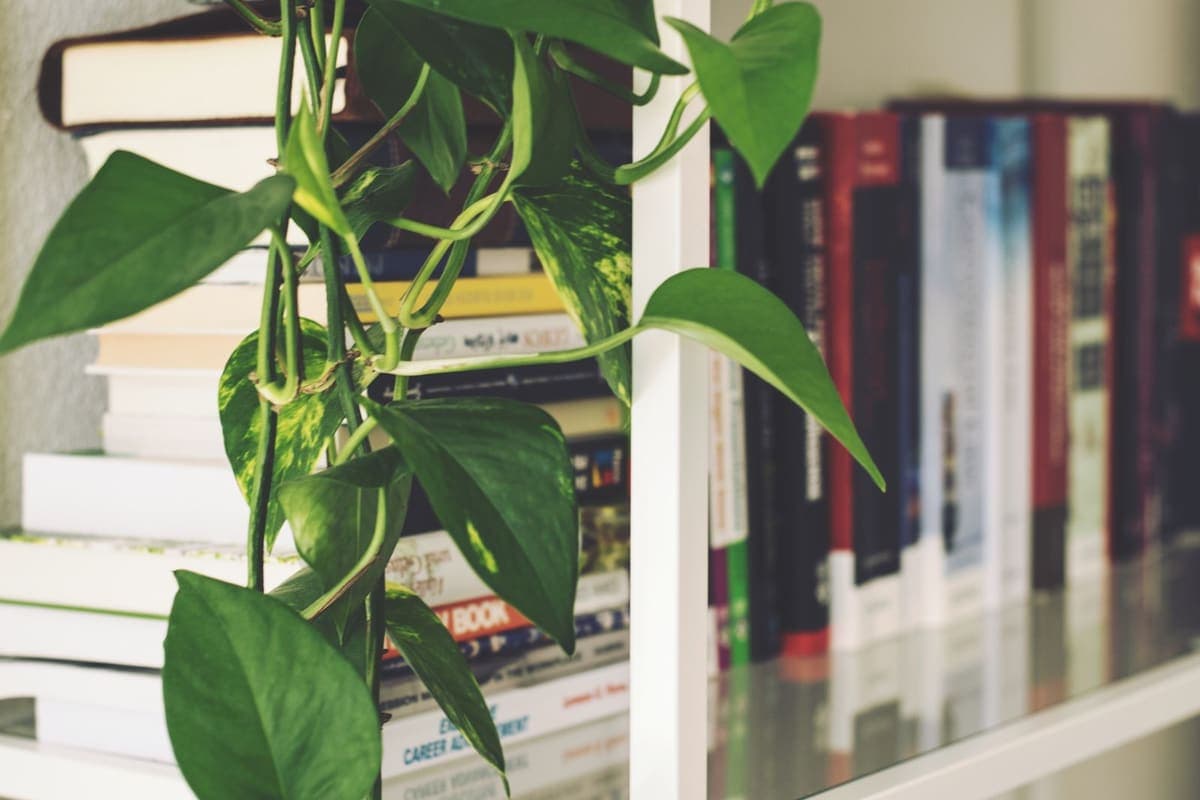
The most honest houseplant sold. When it is thirsty the leaves droop unmistakably; give it a drink and they are back up in hours. Within three or four cycles of that you will have learned what the mix feels like a day before the wilt, which is the entire skill. It handles low light, trails so it looks like something within a season, and roots in a glass of water so one plant becomes several for free.
The honest con: it is published in the tropical band, so it genuinely needs checking every week rather than every month, and it is on the ASPCA list as toxic to cats and dogs if chewed. If there is a cat in the house, start with the spider plant instead.
Second plant: spider plant
Nearly as communicative as the pothos, with two things the pothos lacks. It is on the ASPCA list as non-toxic to cats and dogs, which makes it the default first plant for any household with pets. And its tuberous roots store water, so it survives being forgotten better than its once-or-twice-a-week band suggests. It also produces plantlets on runners, so a single plant fills a shelf.
The honest con: brown leaf tips at the first sign of stress - dry air, fluoride in tap water, a missed watering - which looks worse than it is and alarms new owners. It wants brighter light than the true low-light plants, and the same tubers that buffer drought rot readily if it is kept wet.
Third plant: snake plant
Now that you have the habit, buy the survivor. The snake plant’s published cadence is once or twice a month, it tolerates a dim corner, and it grows so slowly it will not outgrow its pot or change its own water needs. It is the plant we would send with somebody moving into a first apartment - after they have killed nothing for two months.
The honest con: its one weakness is exactly the beginner’s habit. It sits in wet mix without complaint until the roots are gone, and the first visible sign is often terminal. Toxic to cats and dogs per the ASPCA. Buy it third for a reason.
Fourth plant: ZZ plant
For the room with no window. The ZZ tolerates genuinely dim conditions better than almost anything sold as a houseplant, stores water in underground rhizomes, and sits in the same once-or-twice-a-month band as the snake plant. Glossy, tidy, and almost static.
The honest con: the rhizome buffer means it looks completely normal while conditions underground go wrong; by the time a stem loosens, the rhizome has usually rotted. Published as mildly toxic if eaten. Slow, so damage stays visible for months. The snake plant versus ZZ comparison settles which of the two survivors suits your room.
The one tool to buy alongside
A moisture meter, and the cheap analog kind. The Royal Horticultural Society is direct about the mistake beginners make: watering on a routine such as once a week, instead of watering less often but thoroughly and letting the surface dry first. A probe makes the check trivial enough that you do it. For 4-inch pots your finger reaches the root zone and extension guidance says to use it; for anything 6 inches or deeper, a 7-inch battery-free probe reaches where the answer is.
The habit it builds is the same one the pothos teaches, from the other direction. Plant tells you when it is dry; meter tells you when it is still wet. Between them a beginner learns in a month what a schedule never teaches. When a finger is enough is its own page.
What not to buy first, however pretty
Ferns and calathea, which punish a single dry spell with brown edges that do not recover. Orchids in bark, which are grown on a soak-and-dry cycle nothing on this page prepares you for. Fiddle leaf figs, which drop leaves at a draft. All of them are fine third-year plants. None of them is a teacher, and a beginner who starts with one learns only that plants die.
And not a self-watering pot for the first plant. A reservoir removes the very feedback a beginner needs, and information beats automation until you know which mistake you make. Learn on a plain pot with a drainage hole. Automate later.
The verdict
Pothos first, because it teaches. Spider plant if there are pets, for the same reason plus safety. Snake plant once the habit is built, and ZZ for the dark room. Buy a plain pot with a hole, a cheap probe, and nothing else - the plants on this page cost less than the reservoir pot a beginner is usually sold, and they will teach you whether you need one.
Ranked picks
Quick picks
Ranked on published specifications and the computed refill interval, not on looks. Tap any row for the full write-up, including who should skip it.
| # | Product | Best for | Score | Price |
|---|---|---|---|---|
| 1 |  Pothos (Epipremnum aureum)Learning to read a plant, rather than guessing at it Pothos (Epipremnum aureum)Learning to read a plant, rather than guessing at it | Best first plant: it tells you | 8.6 | Check price on Amazon |
| 2 | Spider Plant (Chlorophytum comosum)Households with pets, and hanging pots | Best second plant, and safe for pets | 8.4 | Check price on Amazon |
| 3 | Snake Plant (Dracaena trifasciata)Someone who has killed everything else | Best if you know you will forget it | 9.2 | Check price on Amazon |
| 4 | ZZ Plant (Zamioculcas zamiifolia)A dark office or a hallway with no natural light | Best for a genuinely dark room | 9.0 | Check price on Amazon |
Scores are our editorial judgment from published specifications. They are not test results, and they are deliberately not marked up as ratings in this page’s structured data.
Pick #1 - Best first plant: it tells you
Pothos (Epipremnum aureum)
Learning to read a plant, rather than guessing at it
Not the most drought-tolerant plant here, but the most honest one: it wilts visibly and dramatically when it is thirsty and perks back up within hours of a drink. For a serial plant killer, a plant that tells you what is wrong is worth more than one that suffers quietly.
#ad We do not currently hold a live price for this, so we do not show one. How we make money.
Published specification
- Published watering cadence
- Tropical band, once or twice a week
- Light
- Low to bright indirect
- Thirst signal
- Pronounced, reversible wilt
- Published watering cadence: Virginia Cooperative Extension SPES-804
- Light: Published horticultural guidance
- Thirst signal: Published horticultural guidance
Refill interval - computed, not tested
A 750 ml bottle spike covers a 6-inch pothos for 8 to 15 days
The tropical band is once or twice a week, which is 3.5 to 7 days per watering. 750 ml divided by 350 ml for a 6-inch pot is 2.1 waterings, so 8 to 15 days.
Assumes: 6-inch pot, indoors, tropical frequency band. Light, temperature, humidity, soil mix and season all change how fast a pot dries, so treat this as a planning range and not a guarantee.
What is good about it
- Wilts obviously before it dies, which is the feature that actually teaches you the habit
- Recovers from a full wilt within hours, so a mistake is not fatal
- Roots in a glass of water, so one plant becomes several for free
What is not
- The tropical band means a genuinely shorter safe interval than the snake plant or ZZ
- Trails, so it needs cutting back or somewhere to hang
- Toxic to cats and dogs if chewed
Skip this one if
Skip it if you travel for more than about ten days at a time without cover. Its cadence band is four times tighter than a succulent's, and no amount of goodwill changes that.
How it scored
- Forgiveness of neglect
- 7.5
- Low-light tolerance
- 9.0
- Overwatering tolerance
- 7.0
- Availability and price
- 10.0
- Overall
- 8.6 / 10
Our editorial score, from published specifications and computed intervals. Not a test result. Specification source: Virginia Cooperative Extension, watering frequency bands.
Pick #2 - Best second plant, and safe for pets
Spider Plant (Chlorophytum comosum)
Households with pets, and hanging pots
Tuberous roots give it a real internal water buffer, and it is the one plant here that is genuinely non-toxic to cats and dogs. It is also the plant the one published globe account we found managed to waterlog, which is a useful warning.
#ad We do not currently hold a live price for this, so we do not show one. How we make money.
Published specification
- Published watering cadence
- Tropical band, once or twice a week, with a tuberous drought buffer
- Light
- Bright indirect, and it scorches in direct sun
- Pet safety
- Non-toxic to cats and dogs
- Published watering cadence: Virginia Cooperative Extension SPES-804
- Light: Published horticultural guidance
- Pet safety: Published horticultural guidance
What is good about it
- Tuberous roots store water, so it survives being forgotten better than its cadence band suggests
- Non-toxic to pets, which rules out most of this list for some households
- Produces plantlets, so one plant fills a shelf for free
What is not
- Brown leaf tips at the first sign of stress, which looks worse than it is
- The same tubers that buffer drought rot readily if it is kept wet
- Wants brighter light than the true low-light survivors
Skip this one if
Skip it if the plan is to leave a small watering globe in it and go away. That specific combination is the one published failure account we found in this whole category, and the plant ended up waterlogged.
How it scored
- Forgiveness of neglect
- 8.0
- Low-light tolerance
- 6.5
- Overwatering tolerance
- 5.5
- Availability and price
- 10.0
- Overall
- 8.4 / 10
Our editorial score, from published specifications and computed intervals. Not a test result. Specification source: The Indoor Nursery, first-hand account of a waterlogged spider plant.
Pick #3 - Best if you know you will forget it
Snake Plant (Dracaena trifasciata)
Someone who has killed everything else
The most forgiving common houseplant there is, and the reason is arithmetic rather than folklore: its published watering cadence sits in the succulent band of once or twice a month, so the interval you have to hit is four times wider than a tropical's.
#ad We do not currently hold a live price for this, so we do not show one. How we make money.
Published specification
- Published watering cadence
- Succulent band, once or twice a month
- Light
- Tolerates low light, grows faster in bright indirect
- Main failure mode
- Overwatering and root rot, not drought
- Published watering cadence: Virginia Cooperative Extension SPES-804
- Light: Published horticultural guidance
- Main failure mode: Virginia Cooperative Extension SPES-804
Refill interval - computed, not tested
A 500 ml globe covers a 6-inch snake plant for 3 to 6 weeks
The succulent band is once or twice a month, which is 15 to 30 days per watering. 500 ml divided by 350 ml for a 6-inch pot is 1.4 waterings, so 21 to 42 days. The same globe on a tropical in the same pot is 5 to 10 days.
Assumes: 6-inch pot, indoors, succulent frequency band. Light, temperature, humidity, soil mix and season all change how fast a pot dries, so treat this as a planning range and not a guarantee.
What is good about it
- The wide published cadence is what makes it forgiving, because a week late matters far less than it does for a fern
- Genuinely tolerates low light, so it survives the corner where nothing else does
- Slow growing, so it does not outgrow its pot and change its own water needs
What is not
- The same tolerance means it will sit in wet soil without complaining until the roots are already gone
- Slow growth means slow recovery from any damage
Skip this one if
Skip it if you are the kind of plant killer who overwaters rather than forgets. This plant's one weakness is exactly your habit, and a pothos would be more honest with you about being wet.
How it scored
- Forgiveness of neglect
- 10.0
- Low-light tolerance
- 9.5
- Overwatering tolerance
- 5.0
- Availability and price
- 9.5
- Overall
- 9.2 / 10
Our editorial score, from published specifications and computed intervals. Not a test result. Specification source: Virginia Cooperative Extension, watering frequency bands.
Pick #4 - Best for a genuinely dark room
ZZ Plant (Zamioculcas zamiifolia)
A dark office or a hallway with no natural light
Stores water in thick underground rhizomes, which is why it survives the month you forget it exists. Same wide watering band as a snake plant, with a glossier look and a slightly higher tolerance for gloom.
#ad We do not currently hold a live price for this, so we do not show one. How we make money.
Published specification
- Published watering cadence
- Succulent band, once or twice a month
- Light
- Very low to bright indirect
- Water storage
- Rhizomes store water below soil level
- Published watering cadence: Virginia Cooperative Extension SPES-804
- Light: Published horticultural guidance
- Water storage: Published horticultural guidance
What is good about it
- The rhizomes are a built-in reservoir, so it has its own buffer before you even add one
- Handles genuinely dim rooms better than almost anything else sold as a houseplant
- Glossy foliage that does not look like a survival plant
What is not
- Slow, so a damaged plant stays damaged-looking for months
- Same rot risk as any drought-adapted plant kept wet
- Mildly toxic if eaten, which matters with pets
Skip this one if
Skip it if you want visible growth. It is a plant that rewards being left alone by doing almost nothing, which is either the point or the problem depending on what you wanted.
How it scored
- Forgiveness of neglect
- 10.0
- Low-light tolerance
- 10.0
- Overwatering tolerance
- 4.5
- Availability and price
- 8.5
- Overall
- 9.0 / 10
Our editorial score, from published specifications and computed intervals. Not a test result. Specification source: Virginia Cooperative Extension, watering frequency bands.
Questions people actually ask
- What is the best houseplant for a complete beginner?
A pothos. It wilts visibly when thirsty and recovers within hours of a drink, which teaches the one habit that keeps plants alive - checking the soil rather than watering on a schedule. It is published in the tropical band, once or twice a week, and it handles low light. Note it is toxic to cats and dogs if chewed; a spider plant is the pet-safe alternative.
- Is a snake plant good for beginners?
It is the toughest plant on this page and a poor teacher. Published at once or twice a month, it survives neglect - and it also sits in wet soil without complaint until the roots are gone, which is the mistake beginners make most. Buy it after a pothos has taught you the habit, not before.
- Which beginner houseplants are safe for cats and dogs?
Of the four here, only the spider plant is on the ASPCA non-toxic list. Pothos and snake plant are listed as toxic to both cats and dogs, and the ZZ plant is published as mildly toxic if eaten. Our pet-safe roundup covers three more non-toxic plants that tolerate neglect.
- How often should a beginner water houseplants?
Do not water on a schedule at all. Check the mix - a finger for small pots, a probe for deep ones - and water thoroughly when it has dried in the upper root zone. Published cadence is once or twice a week for tropical foliage and once or twice a month for succulents, but light, season and pot size all move it.
- Should a beginner buy a self-watering pot?
Not for the first plant. A reservoir removes the feedback a beginner needs to learn from, and it hides the overwatering mistake rather than correcting it. Learn on a plain pot with a drainage hole and a cheap moisture meter, then buy the reservoir once you know whether your problem is forgetting or overdoing it.
Sources
Sources
- Criscione and Holliday-Goulart, Properly Watering Container Houseplants, Virginia Cooperative Extension SPES-804 (2026)
- Royal Horticultural Society, Watering plants wisely
- Daughtry, Watering but Not Overwatering Houseplants, NC State Extension (2022)
- ASPCA Animal Poison Control, Toxic and Non-Toxic Plants list