Roundup
Best Self-Watering Hanging Baskets
A hanging basket is the thirstiest container in the house: more air around it, more sun on it, and no way to see into it. A reservoir helps more here than almost anywhere, and it is claimed to do more than it can.
By Scooter M. - Enthusiast. Reads the manuals, compiles the specs, does the math. | Published
Disclosure
We earn a commission if you buy through our links. It does not change what we recommend or what you pay. Full disclosure.
The short answer
Why hanging baskets are the hardest case
Three things work against a basket at once. It is surrounded by moving air on every side, so it loses water to evaporation faster than a pot on a floor. It is usually hung where the light is, which means sun and heat. And it is above eye level, so you cannot see the mix, cannot easily feel it, and find out it is dry when the plant tells you.
NC State Extension’s container chapter is plain that small containers with a high surface-to-volume ratio dry out fastest and need the most attention. A basket is the extreme of that. So a reservoir underneath the mix - a buffer the plant can draw on between your visits - is worth more here than in a floor planter. It is also why the duration claims on these products need checking more carefully than usual.
How we ranked them
Published capacity first. A basket that tells you how much water it holds lets you do the arithmetic before you buy. One that does not is asking you to trust a claim.
Published soil volume second. This one is unusual, and only one maker here provides it. The refill interval depends on both numbers - how much the tank holds and how much the plant draws per watering - and the second is set by the volume of mix. Without it we have to assume a pot size, and we say so where we do.
Seeing the level third. An indicator you can read from below is the feature a hanging basket most needs, because the basket is the one container you cannot check by looking.
| Basket | Reservoir | Soil volume | Maker's claim | Our computed range |
|---|---|---|---|---|
| Lechuza Nido Cottage 35 | 0.9 gal (3.4 L) | 2.9 dry gal | None stated | 5 to 9 days |
| UOUZ 13 in, 2 pack | 50 oz (1.5 L) | Not published | 7 to 14 days | 3 to 6 days |
| Lechuza Nido Cottage 28 | 0.5 gal (1.9 L) | 1.6 dry gal | None stated | 5 to 9 days |
The arithmetic, shown
For the Lechuza baskets, both numbers are published, so the interval is straightforward. One thorough watering is 20 percent of the soil volume in our method - the derivation is on the methodology page - so 2.9 dry gallons, about 12.8 liters of mix, takes roughly 2,560 ml. The published 3.4 liter reservoir is 1.3 waterings. At Virginia Cooperative Extension’s published tropical cadence of once or twice a week, that is 4.7 to 9.3 days.
The Nido 28 computes to the same range, because Lechuza scales the reservoir with the soil volume. That is worth noticing: the bigger basket does not buy you more days, it buys you a bigger plant for the same days. It is the same counterintuitive fact as the Classico and the Cubico, and it holds across this whole category.
For the UOUZ basket, the reservoir is published - 50 oz, about 1.5 liters - but the soil volume is not. A 13-inch basket is wide and shallow, so we treat it as the 10-inch row of our pot table, about 1,600 ml per thorough watering, and we say so. That makes the reservoir 0.9 of a watering, or 3 to 6 days. The maker claims 7 to 14. The claim sits above our range, and the gap is not small.
Sun changes everything, and the makers do not say so
Every figure above is for a basket out of direct afternoon sun, because the published cadence bands we use are for houseplants indoors. A basket of petunias on a south-facing porch in July is a different plant in a different climate, and it can draw several times the indoor figure on a hot day. The reservoir is still a buffer, and a valuable one - it is the difference between a missed day being a non-event and a missed day being a crisis - but it is not a week.
If the basket is the thing you are trying to keep alive during a trip, adding a globe or a spike to a reservoir basket stacks two buffers, and moving it into shade before you go does more than either.
Weight, and the hook it hangs from
The number nobody prints is what the basket weighs full. A Nido 35 holds about 3.4 liters of water plus roughly 12 liters of wet mix, which is a real load on a ceiling fixing - and a reservoir basket is full more of the time than a plain one, by design. The 28 is the honest answer for a plasterboard ceiling or a bracket you are not sure of. The budget baskets are lighter and hang on thinner chains, which is the trade.
The honest cons on every pick
Lechuza Nido Cottage 35. Expensive for a hanging basket, and heavy when full. Built around Lechuza’s own substrate layer, like the rest of the range. The published numbers are the reason to pay for it, and if you will not use them, you are paying for a plastic basket.
UOUZ 13-inch pair. The 7-to-14-day claim does not survive the arithmetic. Thin plastic, chains that are the likeliest failure point, and no level indicator - you are checking by weight. As two budget baskets you top up twice a week, it is a good buy; as a two-week basket, it is not.
Lechuza Nido Cottage 28. A 9.5-inch liner is a small basket, and a trailing plant outgrows it in a season. Same premium price bracket as the 35 for less plant.
What to plant in one
Trailing tropicals and shade annuals, which are published in the once-or-twice-a- week band and want the steady moisture a reservoir provides. Pothos, spider plants, Boston ferns and trailing philodendron all suit a reservoir basket indoors; the full compatibility list applies unchanged. What does not suit one is a string of pearls or any other trailing succulent - published at once or twice a month, and a permanently charged reservoir is how those rot.
Ranked picks
Quick picks
Ranked on published specifications and the computed refill interval, not on looks. Tap any row for the full write-up, including who should skip it.
| # | Product | Best for | Score | Price |
|---|---|---|---|---|
| 1 |  Lechuza Nido Cottage 35 Self-Watering Hanging PlanterA porch or balcony basket you want to fill once a week and forget Lechuza Nido Cottage 35 Self-Watering Hanging PlanterA porch or balcony basket you want to fill once a week and forget | Best overall, published capacity | 8.6 | Check price on Amazon |
| 2 | 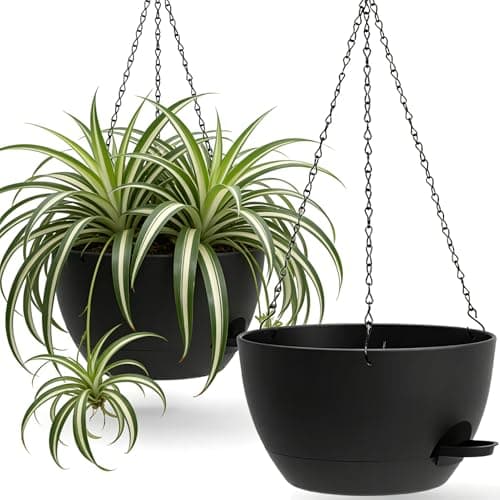 UOUZ 13-Inch Self-Watering Hanging Planters, 2 PackCovering several porch baskets cheaply, with the interval understood UOUZ 13-Inch Self-Watering Hanging Planters, 2 PackCovering several porch baskets cheaply, with the interval understood | Best budget pair | 6.9 | $26.99 - View on Amazon |
| 3 | 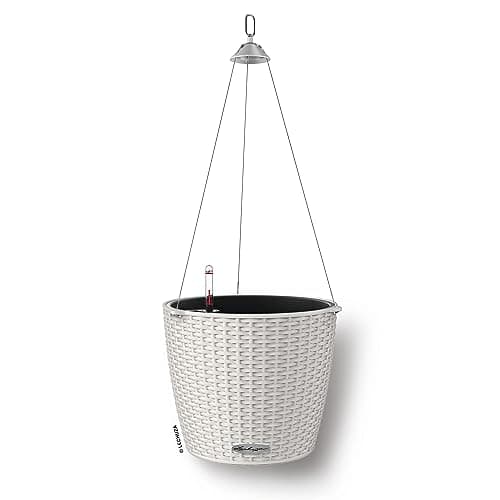 Lechuza Nido Cottage 28 Self-Watering Hanging PlanterA lighter fixing, or a basket that lives indoors Lechuza Nido Cottage 28 Self-Watering Hanging PlanterA lighter fixing, or a basket that lives indoors | Best for a light hook or indoors | 8.2 | $81.85 - View on Amazon |
Scores are our editorial judgment from published specifications. They are not test results, and they are deliberately not marked up as ratings in this page’s structured data.
Pick #1 - Best overall, published capacity
Lechuza Nido Cottage 35 Self-Watering Hanging Planter
A porch or balcony basket you want to fill once a week and forget
The only hanging basket in this roundup whose maker publishes both the reservoir and the soil volume, which means the refill interval here is arithmetic rather than a claim. 0.9 gallons under 2.9 dry gallons of mix, with a water-level indicator you can read from below.
#ad We do not currently hold a live price for this, so we do not show one. How we make money.
Published specification
- Reservoir capacity
- 0.9 liquid gallons (about 3.4 liters)
- Plant volume
- 2.9 dry gallons
- Dimensions
- 13.8 in wide x 9.1 in high, liner 12.6 in across, planting depth 5.9 in
- Water level indicator
- Yes
- Material
- Frost and UV resistant polypropylene, made in Germany; cables removable for tabletop use
- Reservoir capacity: Lechuza published specification table
- Plant volume: Lechuza published specification table
- Dimensions: Lechuza published specification table
- Water level indicator: Lechuza published description
- Material: Lechuza published description
Refill interval - computed, not tested
About 5 to 9 days for a tropical basket in shade
2.9 dry gallons is about 12.8 liters of mix, and one thorough watering is 20 percent of that, roughly 2,560 ml. The published 3,407 ml reservoir is 1.3 waterings. At once or twice a week, that is 4.7 to 9.3 days. A basket in full sun on a hot week will be shorter, and Lechuza does not claim otherwise.
Assumes: Tropical annuals or trailing foliage, basket out of direct afternoon sun. Light, temperature, humidity, soil mix and season all change how fast a pot dries, so treat this as a planning range and not a guarantee.
What is good about it
- Reservoir and soil volume are both published, so the interval can be checked
- The water-level indicator is the feature a hanging basket most needs, because you cannot see into one
- Removable cables turn it into a table planter, which is more useful than it sounds
- Drain screw for outdoor use, so a wet week does not flood the reservoir
What is not
- Expensive for a hanging basket, and the price is most of the argument against it
- Nearly 14 inches across and full of wet mix is heavy for a ceiling hook
- Built around Lechuza's own mineral substrate layer, like the rest of the range
Skip this one if
Skip it if the hook is a plasterboard ceiling. A 3.4 liter reservoir plus 12 liters of wet mix is a real load, and the smaller Nido 28 is the honest answer for a light fixing.
How it scored
- Published capacity
- 10.0
- Computed interval
- 7.5
- Build and materials
- 9.0
- Value for money
- 6.0
- Ease of setup
- 8.0
- Overall
- 8.6 / 10
Our editorial score, from published specifications and computed intervals. Not a test result. Specification source: Lechuza Nido Cottage published specification table.
Pick #2 - Best budget pair
UOUZ 13-Inch Self-Watering Hanging Planters, 2 Pack
Covering several porch baskets cheaply, with the interval understood
A budget plastic basket that does something most budget baskets do not: it publishes the reservoir, a removable 50-ounce tray under a wick. That number is what lets us check the maker's 7-to-14-day claim, and the claim does not survive the check on a basket this size.
#ad Price as of September 21, 2026, from Amazon. Prices change. How we make money.
Published specification
- Reservoir capacity
- 50 oz (about 1.5 liters), removable tray
- Basket diameter
- 13 in
- Soil volume
- Not published by the manufacturer
- Watering method
- Wick from the tray up into the mix, mesh base for drainage
- Manufacturer duration claim
- 7 to 14 days
- Material
- UV-resistant plastic, two 23.5 in chains per basket
- Reservoir capacity: UOUZ published listing
- Basket diameter: UOUZ published listing
- Soil volume: Checked the listing, no figure given
- Watering method: UOUZ published listing
- Manufacturer duration claim: UOUZ published listing
- Material: UOUZ published listing
Refill interval - computed, not tested
About 3 to 6 days on our arithmetic, against a claim of 7 to 14
Soil volume is not published, so we treat a wide, shallow 13-inch basket as the 10-inch row of our pot table, about 1,600 ml per thorough watering. The published 1,479 ml reservoir is 0.9 of a watering, which at once or twice a week is 3.2 to 6.5 days. The maker's 7-to-14-day claim sits above that range.
Assumes: Tropical trailing plant, basket treated as a 10-inch pot because the soil volume is not published. Light, temperature, humidity, soil mix and season all change how fast a pot dries, so treat this as a planning range and not a guarantee.
What is good about it
- Publishes the reservoir volume, which almost nothing at this price does
- Removable tray makes cleaning and refilling straightforward
- Two baskets for less than a single branded one
What is not
- The 7-to-14-day claim does not survive the arithmetic on a basket this wide
- Thin plastic, and the chains are the part most likely to fail
- No water-level indicator, so you are checking by weight
Skip this one if
Skip it if you were buying it for the two-week claim. Fifty ounces under a 13-inch basket is a long weekend, and the honest use is a budget basket you top up twice a week.
How it scored
- Published capacity
- 8.0
- Computed interval
- 5.0
- Build and materials
- 5.5
- Value for money
- 9.0
- Honesty of claims
- 4.0
- Overall
- 6.9 / 10
Our editorial score, from published specifications and computed intervals. Not a test result. Specification source: UOUZ 13-inch self-watering hanging planter retail listing.
Pick #3 - Best for a light hook or indoors
Lechuza Nido Cottage 28 Self-Watering Hanging Planter
A lighter fixing, or a basket that lives indoors
The smaller Nido, with the same published-spec discipline: half a gallon of reservoir under 1.6 dry gallons of mix. The reservoir-to-soil ratio is the same as the 35, so the interval comes out the same - it just carries a smaller plant.
#ad Price as of September 21, 2026, from Amazon. Prices change. How we make money.
Published specification
- Reservoir capacity
- 0.5 liquid gallons (about 1.9 liters)
- Plant volume
- 1.6 dry gallons
- Dimensions
- 10.6 in wide x 9.1 in high, liner 9.5 in across, planting depth 5.9 in
- Water level indicator
- Yes
- Reservoir capacity: Lechuza published specification table
- Plant volume: Lechuza published specification table
- Dimensions: Lechuza published specification table
- Water level indicator: Lechuza published description
Refill interval - computed, not tested
About 5 to 9 days, the same as the larger model
1.6 dry gallons is about 7.0 liters of mix, so one thorough watering is roughly 1,410 ml. The published 1,893 ml reservoir is 1.3 waterings, and at once or twice a week that is 4.7 to 9.4 days. Lechuza scales the reservoir with the soil, which is why the two sizes compute to the same interval.
Assumes: Tropical foliage, basket out of direct afternoon sun. Light, temperature, humidity, soil mix and season all change how fast a pot dries, so treat this as a planning range and not a guarantee.
What is good about it
- Published reservoir and soil volume, like the rest of the range
- Light enough full to hang from an ordinary hook
- Indoor-friendly: the drain screw stays in and the indicator does the work
What is not
- A 9.5-inch liner is a small basket, and a trailing plant outgrows it in a season
- Still a premium price for the size
Skip this one if
Skip it if you want a full, cascading porch basket. The liner is under ten inches across, and the 35 is the right size for that.
How it scored
- Published capacity
- 10.0
- Computed interval
- 7.5
- Build and materials
- 9.0
- Value for money
- 5.5
- Ease of setup
- 8.5
- Overall
- 8.2 / 10
Our editorial score, from published specifications and computed intervals. Not a test result. Specification source: Lechuza Nido Cottage published specification table.
Questions people actually ask
- How long does a self-watering hanging basket last between refills?
About 5 to 9 days for the Lechuza Nido baskets on our arithmetic - a published 0.9 or 0.5 gallon reservoir against 20 percent of the published soil volume, at the tropical cadence of once or twice a week. A budget basket with a 50 oz reservoir computes to 3 to 6 days. In full sun on a hot week, all of these are shorter.
- Are self-watering hanging baskets worth it?
For the container that dries out fastest and is hardest to check, yes - a reservoir turns a missed day into a non-event. They are not a two-week vacation solution whatever the packaging says, and the honest use is a basket you fill once or twice a week instead of every day.
- Do bigger self-watering baskets last longer?
Not usually. Makers that scale the reservoir with the soil volume - Lechuza does - end up with the same interval in every size, because the bigger basket also carries a bigger plant. The bigger basket buys you more plant, not more days.
- Can I use a self-watering hanging basket outdoors in the rain?
Only if it has a way to drain. The Lechuza baskets publish a removable drain screw for outdoor use, so a wet week does not flood the reservoir and close the air gap. A budget basket with a sealed tray needs the tray emptied after heavy rain.
- What plants are best in a self-watering hanging basket?
Trailing plants published in the tropical band: pothos, spider plant, Boston fern, trailing philodendron, and shade annuals outdoors. Avoid trailing succulents like string of pearls, which are published at once or twice a month and rot on a constant reservoir.
Sources
Sources
- Lechuza Nido Cottage published specification table
- UOUZ 13-inch self-watering hanging planter retail listing
- Criscione and Holliday-Goulart, Properly Watering Container Houseplants, Virginia Cooperative Extension SPES-804 (2026)
- Plants Grown in Containers, NC State Extension Gardener Handbook chapter 18