Roundup
Best Self-Watering Planters for Vegetables and Herbs
Edible crops drink far more than houseplants, so the reservoir stops being a convenience and starts being the thing that decides your yield.
By Scooter M. - Enthusiast. Reads the manuals, compiles the specs, does the math. | Published
Disclosure
We earn a commission if you buy through our links. It does not change what we recommend or what you pay. Full disclosure.
The short answer
Why edibles change the calculation
A houseplant is grown to sit still. A tomato is grown to convert water into fruit as fast as it can, and it will take everything you give it. The consequence is that the reservoir in an edible planter is not really about convenience - it is about avoiding the wet-dry swing that causes blossom-end rot and split fruit.
That is also why we do not publish a computed refill interval for the boxes on this page. Our arithmetic rests on a watering cadence Virginia Cooperative Extension publishes for indoor container houseplants, and there is no equivalent published band for an outdoor crop in July that we could apply honestly. What we can give you is the published reservoir and media volumes, which are real numbers and genuinely comparable between boxes.
Reservoir per cubic foot of mix - the useful comparison
| Box | Reservoir | Growing media | Reservoir per cu ft |
|---|---|---|---|
| EarthBox Original | 3.0 gal | 2.0 cu ft | 1.50 gal |
| EarthBox Junior | 1.15 gal | 1.0 cu ft | 1.15 gal |
| EarthBox Root and Veg | 2.0 gal | 2.0 cu ft | 1.00 gal |
That last column is the one to read. The Original carries fifty percent more water per unit of soil than the Root and Veg does, which is why it is the fruiting-crop box and the Root and Veg is the depth box. Both are correct designs for different jobs, and it takes a published table to see it - which is exactly why we rank EarthBox highly regardless of aesthetics. Our full review of the EarthBox Original works through the rest of that table, including the two claims we will not repeat. The same ratio turns up again at bed scale: the self-watering raised beds that publish both numbers land at 1.49 gallons per cubic foot, within a hundredth of the EarthBox Original.
What to grow in which
Tomatoes, peppers, eggplant. The Original. Fruiting crops have the highest and least forgiving water demand, and they need the reservoir-to-soil ratio. Two plants per Original is the practical maximum for tomatoes.
Carrots, beets, radishes, bush squash. The Root and Veg. Depth is what these need and surface area is not.
Basil, parsley, cilantro, mint. The Junior. Herbs bolt when they dry out and stall when they sit wet, so consistency matters more than volume, and a cubic foot is enough root room. This is also the one that fits a real windowsill, which matters if you want to actually use the herbs.
Anything, on a budget. GroBucket inserts in 5-gallon buckets. Not attractive, genuinely effective, and cheap enough that you can run ten of them for what one designer planter costs.
Starting any of them from seed. None of these boxes is a seed tray. Start seedlings in cells and plant them out once they are big enough - the self-watering seed starter trays are ranked here, on cell size by crop.
The one mistake that ruins an edible sub-irrigated planter
Using garden soil or a heavy topsoil-based mix. Sub-irrigation depends on capillary rise, and a dense mix does not wick. The result is a full reservoir and a dry root zone, which looks exactly like the system failing. Use a light peat or coir based potting mix - the NC State Extension container chapter covers why the components matter, with perlite and bark there specifically to keep the structure open.
The second mistake is fertilizing into the reservoir. These boxes are designed to take a fertilizer strip on the surface, under the cover, where it dissolves gradually as water moves up. Dumping soluble feed into the reservoir raises the salt concentration in the water column and burns roots. It also, as a side effect, makes any moisture meter reading in that pot read wetter than it is, since these meters respond to conductivity.
One thing a sub-irrigated box does not do is cover a trip. In hot weather it still wants topping up daily, so watering a vegetable garden while you are away is a separate problem with a different set of answers.
Ranked picks
Quick picks
Ranked on published specifications and the computed refill interval, not on looks. Tap any row for the full write-up, including who should skip it.
| # | Product | Best for | Score | Price |
|---|---|---|---|---|
| 1 | 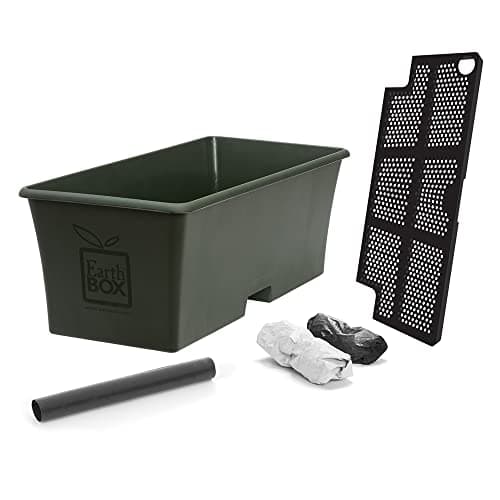 EarthBox OriginalTomatoes, peppers and herbs on a patio or balcony EarthBox OriginalTomatoes, peppers and herbs on a patio or balcony | Best for tomatoes | 9.0 | $59.99 - View on Amazon |
| 2 | 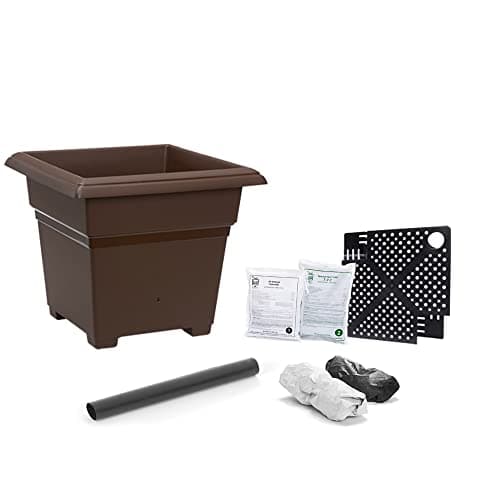 EarthBox Root and VegRoot crops and anything that needs 15 inches of depth EarthBox Root and VegRoot crops and anything that needs 15 inches of depth | Best for root crops | 8.0 | $59.99 - View on Amazon |
| 3 |  EarthBox JuniorHerbs on a sunny windowsill or a narrow balcony rail EarthBox JuniorHerbs on a sunny windowsill or a narrow balcony rail | Best for herbs | 8.2 | Check price on Amazon |
| 4 | 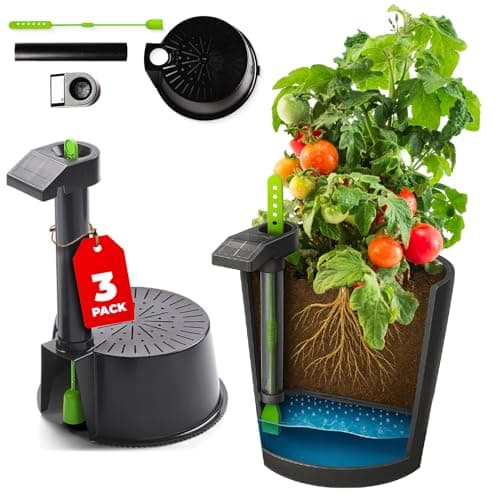 GroBucket Self-Watering Planter InsertCheap outdoor food growing in buckets you already have GroBucket Self-Watering Planter InsertCheap outdoor food growing in buckets you already have | Cheapest per plant | 7.6 | $55.99 - View on Amazon |
Scores are our editorial judgment from published specifications. They are not test results, and they are deliberately not marked up as ratings in this page’s structured data.
Pick #1 - Best for tomatoes
EarthBox Original
Tomatoes, peppers and herbs on a patio or balcony
The reference sub-irrigated planter for outdoor edibles, and the only maker here that publishes reservoir capacity, soil volume and dimensions for its whole range in one comparison table. Three gallons under two cubic feet of mix is a serious buffer for tomatoes.
#ad Price as of October 18, 2026, from Amazon. Prices change. How we make money.
Published specification
- Reservoir capacity
- 3 gallons (about 11.4 liters)
- Growing media capacity
- 2.0 cubic feet
- External dimensions
- 29 x 13.5 x 11 in
- Watering method
- Sub-irrigation, capillary action from a bottom reservoir
- Kit contents
- Planter, aeration screen, fill tube, two reversible mulch covers
- Reservoir capacity: EarthBox published comparison table
- Growing media capacity: EarthBox published comparison table
- External dimensions: EarthBox published comparison table
- Watering method: EarthBox published description
- Kit contents: EarthBox published description
Refill interval - computed, not tested
We do not compute an interval for this one, on purpose
The published frequency band we use is for indoor container houseplants. An outdoor tomato in July transpires several times that, so applying the band here would produce a number that flatters the product and misleads you. In hot weather, expect to top this up daily.
Assumes: Outdoor edibles in summer, which is outside the band we can defend. Light, temperature, humidity, soil mix and season all change how fast a pot dries, so treat this as a planning range and not a guarantee.
What is good about it
- EarthBox publishes reservoir capacity, soil volume and dimensions for every model in a single table, the most transparent spec sheet in this entire roundup
- Three gallons is the largest published reservoir here, which is what a fruiting crop actually needs
- The mulch cover keeps rain out of the mix, so the reservoir stays the thing that controls watering
What is not
- It is a rectangular plastic box and it looks like one
- Two cubic feet of potting mix per box is a real cost on top of the box
- In summer it still wants topping up daily, so it is a labor saver, not a vacation solution
Skip this one if
Skip it if you want an indoor decorative planter. This is outdoor growing equipment and it will look like equipment in a living room. Skip it too if you are buying it as a two-week vacation fix for tomatoes, because it is not one.
How it scored
- Published capacity
- 10.0
- Reservoir size
- 10.0
- Build and materials
- 8.5
- Value for money
- 7.5
- Looks
- 5.0
- Overall
- 9.0 / 10
Our editorial score, from published specifications and computed intervals. Not a test result. Specification source: EarthBox published system comparison table.
Pick #2 - Best for root crops
EarthBox Root and Veg
Root crops and anything that needs 15 inches of depth
A deep, square sub-irrigated planter for crops that need root depth rather than surface area: carrots, beets, a bush squash. Two gallons of reservoir under two cubic feet of mix, published, as usual for this maker.
#ad Price as of October 18, 2026, from Amazon. Prices change. How we make money.
Published specification
- Reservoir capacity
- 2 gallons (about 7.6 liters)
- Growing media capacity
- 2.0 cubic feet
- External dimensions
- 17.75 x 17.75 x 15.75 in
- Watering method
- Sub-irrigation from a bottom reservoir
- Reservoir capacity: EarthBox published comparison table
- Growing media capacity: EarthBox published comparison table
- External dimensions: EarthBox published comparison table
- Watering method: EarthBox published description
What is good about it
- The deepest of the three EarthBox systems, which is the whole point of it
- Square footprint fits a balcony corner better than the long Original
- Published capacities across the range make the three genuinely comparable, which is rare
What is not
- Two gallons under two cubic feet is a lower reservoir-to-soil ratio than the Original
- Depth is wasted on leafy crops, which do just as well in the Junior
Skip this one if
Skip it if you are growing lettuce, herbs or anything shallow-rooted. You are paying for depth you will not use, and the Original has a bigger reservoir for the same soil volume.
How it scored
- Published capacity
- 10.0
- Reservoir size
- 8.0
- Build and materials
- 8.5
- Value for money
- 7.0
- Looks
- 5.5
- Overall
- 8.0 / 10
Our editorial score, from published specifications and computed intervals. Not a test result. Specification source: EarthBox published system comparison table.
Pick #3 - Best for herbs
EarthBox Junior
Herbs on a sunny windowsill or a narrow balcony rail
The small EarthBox: 1.15 gallons of reservoir under a cubic foot of mix, in a windowsill-friendly footprint. Published numbers again, which is why it is here instead of one of the dozens of unlabeled boxes at the same price.
#ad We do not currently hold a live price for this, so we do not show one. How we make money.
Published specification
- Reservoir capacity
- 1.15 gallons (about 4.4 liters)
- Growing media capacity
- 1.0 cubic foot
- External dimensions
- 23 x 9.5 x 7.25 in
- Watering method
- Sub-irrigation from a bottom reservoir
- Reservoir capacity: EarthBox published comparison table
- Growing media capacity: EarthBox published comparison table
- External dimensions: EarthBox published comparison table
- Watering method: EarthBox published description
Refill interval - computed, not tested
About 3 to 5 weeks for indoor herbs
4,353 ml reservoir divided by 800 ml per thorough watering of the equivalent 8-inch root volume is 5.4 waterings. At once or twice a week indoors, that is 19 to 35 days.
Assumes: Indoor herbs in moderate light. Outdoors in summer, far shorter. Light, temperature, humidity, soil mix and season all change how fast a pot dries, so treat this as a planning range and not a guarantee.
What is good about it
- Narrow enough to sit on a real windowsill, which the Original is not
- Same published-spec discipline as the rest of the EarthBox range
- A cubic foot of mix is enough root room for basil and parsley to stop bolting the moment you forget them
What is not
- 1.15 gallons is a modest reservoir once the plants fill in
- Still a plastic box, aesthetically
Skip this one if
Skip it if you want to grow anything fruiting. A cubic foot of mix and a gallon of reservoir will not carry a tomato through a hot week. Buy the Original for that.
How it scored
- Published capacity
- 10.0
- Reservoir size
- 6.5
- Build and materials
- 8.5
- Value for money
- 8.0
- Looks
- 5.5
- Overall
- 8.2 / 10
Our editorial score, from published specifications and computed intervals. Not a test result. Specification source: EarthBox published system comparison table.
Pick #4 - Cheapest per plant
GroBucket Self-Watering Planter Insert
Cheap outdoor food growing in buckets you already have
Turns an ordinary 5-gallon bucket into a sub-irrigated planter: a reservoir in the base, a barrier above it and a side fill port with overflow. It is the most flexible way to own the mechanism, and worth pricing against a complete grow box before you buy - inserts are no longer automatically the cheap option.
#ad Price as of October 18, 2026, from Amazon. Prices change. How we make money.
Published specification
- Reservoir capacity
- Not published by the manufacturer
- Fits
- Standard 5-gallon bucket
- Watering method
- Sub-irrigation, reservoir formed in the bottom of the bucket
- Fill
- Side fill port with overflow
- Reservoir capacity: Checked GroBucket listings, reservoir volume not published as a figure
- Fits: GroBucket published description
- Watering method: GroBucket published description
- Fill: GroBucket published description
What is good about it
- By far the cheapest way to get a real sub-irrigated planter
- Buckets are free or nearly free, and food-safe ones are easy to find
- Scales sideways: ten buckets cost what one designer planter does
What is not
- GroBucket does not publish the reservoir volume as a number, so we cannot compute an interval for it
- It is a bucket. It looks like a bucket
- Outdoor summer use anyway, where the indoor frequency band does not apply
Skip this one if
Skip it if the planter is going indoors or anywhere it will be looked at. This is a utility solution for a back step or a community plot, not a living-room object.
How it scored
- Published capacity
- 2.0
- Computed interval
- 3.0
- Flexibility
- 8.0
- Value for money
- 10.0
- Looks
- 3.0
- Overall
- 7.6 / 10
Our editorial score, from published specifications and computed intervals. Not a test result. Specification source: GroBucket insert retail listing.
Questions people actually ask
- How many tomato plants fit in an EarthBox Original?
Two is the practical maximum. The published 3-gallon reservoir and two cubic feet of media are sized for that, and a third plant means all three compete for water at the exact point in the season when the demand peaks.
- Can I use garden soil in a self-watering planter?
No. Sub-irrigation relies on capillary rise, and a dense soil-based mix will not wick. You get a full reservoir and a dry root zone. Use a light potting mix with perlite or bark to keep the structure open.
- Do I still need to water a self-watering vegetable planter every day?
In hot weather with mature plants, generally yes - you are topping up the reservoir rather than watering the soil, but the frequency is similar. The benefit is consistency, not absence.
- Why do you not publish a refill interval for these?
Because the watering-frequency band we compute from is published for indoor container houseplants, and an outdoor summer crop uses several times that. Applying the indoor band here would produce a flattering number we could not defend.
Sources