Roundup
Best Self-Watering Raised Garden Beds
Every bed on this page is sold as self-watering. Exactly one of them tells you how much water the reservoir holds. That single fact decides the ranking, because it is the only one you can check before you buy.
By Scooter M. - Enthusiast. Reads the manuals, compiles the specs, does the math. | Published
Disclosure
We earn a commission if you buy through our links. It does not change what we recommend or what you pay. Full disclosure.
The short answer
The number this category refuses to print
A self-watering raised bed is a large box with a water tank underneath it. The tank is the entire proposition - it is why the bed costs more than a plain one and why the listing says you will water less often. So the obvious question is how much water the tank holds.
We put that question to every bed in this roundup, using the makers’ own published listings. Two of the five answer it. The rest describe the reservoir in words - “full watering system includes a reservoir to prevent root decay and over watering” is Keter’s, repeated verbatim across its range - and leave the volume out.
That is not a small omission, and it has a specific consequence for a buyer: without the number, no claim about watering less often can be checked before purchase or after it. It is the same gap we found in watering globes and in African violet pots, and it is the reason this site ranks on published specifications rather than on marketing copy.
How we ranked them
Published reservoir capacity first. A bed that prints the figure can be compared with every other reservoir product on this site. One that does not is asking for trust instead of evidence, and it goes below the ones that do however good the bed itself is.
Published soil capacity second. The reservoir only means something relative to how much soil - and therefore how much plant - sits on top of it. Most makers do publish this one, usually as the headline gallon figure in the product name.
The ratio between them third. Where both numbers exist, gallons of reservoir per cubic foot of soil is the single figure that lets you compare a four-foot bed with an eight-foot one, or a bed with a planter box.
Outdoor drainage fourth. A reservoir bed lives outside. Without a way to let rain out, a wet week fills it from above, the air gap between the water and the roots closes, and you get the waterlogged condition NC State Extension names for root rot - Pythium, Phytophthora, Rhizoctonia and Fusarium all thrive in wet, poorly drained soil. The full mechanism is here.
Planting depth last, but it is a hard limit. Ten inches grows most things and does not grow some things, and no reservoir changes that.
| Bed | Published reservoir | Published soil | Gal per cu ft |
|---|---|---|---|
| Gardener's Supply 2 x 8 | 20 gal (4 x 5 gal) | 13.4 cu ft (342 qt) | 1.49 |
| CedarCraft 21 x 47 in | 6 gal | 4.8 cu ft | 1.25 |
| Keter Splendor | Not published | 31.7 gal (4.24 cu ft) | Cannot be computed |
| Keter Urban Bloomer | Not published | 12.7 gal (1.70 cu ft) | Cannot be computed |
| Glowpear Cafe 29.5 in | Not published | 16 gal (2.14 cu ft), 11 in deep | Cannot be computed |
The ratio, and what it tells you
Twenty gallons over 13.4 cubic feet is 1.49 gallons of reservoir per cubic foot of soil. Six gallons over 4.8 cubic feet is 1.25. The two beds that publish their numbers are not offering the same thing, and the ratio is how you see it: the CedarCraft carries about a sixth less water per unit of soil than the Gardener’s Supply bed does.
Now put those next to the one sub-irrigated box in our registry that publishes everything. The EarthBox Original holds a published 3 gallons under 2.0 cubic feet of mix - 1.50 gallons per cubic foot. The big cedar bed lands within a hundredth of the box we already call the most transparent product on the site, which is a useful sanity check in both directions: it suggests Gardener’s Supply has sized the reservoir sensibly, and it suggests the EarthBox ratio is close to what this design actually needs. Our EarthBox review works through that spec sheet in detail.
The figure also gives you a way to read the beds that publish nothing. If the Keter Splendor held the same 1.49 gallons per cubic foot across its 4.24 cubic feet of soil, its reservoir would be about 6.3 gallons. We want to be explicit that this is our arithmetic applied to someone else’s product, not a Keter figure, and we do not put it on the product card or treat it as a specification. It is an illustration of what the missing number would have to be for the claim to work, nothing more.
Why we do not publish a refill interval for a bed
Everywhere else on this site we divide a published reservoir by the volume of one thorough watering and multiply by the watering cadence Virginia Cooperative Extension publishes. The method is set out here, including its assumptions.
Those cadence bands are for container houseplants indoors. A raised bed of vegetables in July transpires several times as much and varies with the weather from one day to the next, so running our arithmetic on a bed would produce a confident-looking number that flatters the product and misleads you. We refuse it on the EarthBox for the same reason, and we refuse it on every product on our vegetable garden page.
What a reservoir genuinely buys an outdoor bed is a buffer against a missed day and steadier moisture through a hot one - not a week away. Gardener’s Supply describes it as extending time between waterings and creating more even moisture throughout the bed, which is a careful claim and a true one. Read it that way and the product delivers; read it as a vacation solution and it will not.
What ten inches of planting depth rules in and out
Gardener’s Supply publishes a 10-inch planting depth and CedarCraft publishes 9.3 inches, which is deeper than a window box and shallower than open ground. Either comfortably grows salad greens, spinach, chard, bush beans, radishes, herbs, peppers and determinate tomatoes. Both are tight for carrots and parsnips beyond the short varieties, and tight for a full indeterminate tomato that wants to put a taproot down.
NC State Extension’s container chapter makes the general point: the smaller the soil volume relative to the plant, the more often it needs water and the less forgiving it is. A reservoir offsets that, and it does not abolish it. If the plan is deep-rooted crops, a bed on the ground with no reservoir and unlimited depth beats an elevated bed with one.
Drainage, which is the outdoor feature that matters
The Keter Splendor publishes a drainage plug and it is the best thing about it. An elevated reservoir bed with no way to drain fills from above in a wet week - rain lands on the soil surface, saturates the mix, closes the air gap over the reservoir and leaves roots sitting in water. That is the condition that rots them, and it arrives without anybody doing anything wrong.
The Gardener’s Supply bed uses a fill tube and a rising level indicator rather than a plug, which tells you when the reservoirs are full but does not let you empty them. CedarCraft publishes no drainage plug either. In a genuinely wet climate that is the thing to check before buying any bed on this page.
Elevated or on the ground?
Every bed here is elevated, and that is mostly an ergonomic decision rather than a horticultural one - 29 inches of height means no bending, which is the reason Gardener’s Supply and Keter both lead with it. It has two real side effects worth knowing.
An elevated bed is a container, not a piece of ground. It dries faster on every side, it has a fixed soil volume, and nothing can root below it. That is exactly why a reservoir is more useful here than in a ground bed, and it is why we treat these as very large containers rather than as garden beds.
Second, weight. Thirteen cubic feet of wet mix plus twenty gallons of water is a serious load on legs and on a deck, and even the CedarCraft’s 4.8 cubic feet plus 6 gallons is more than its published 38.7 lb empty weight suggests. Site the bed before you fill it, and check what it is standing on - casters included.
The one that works differently: Vegepod
Vegepod turns up in every search for this category and is worth naming, because it is not a reservoir bed in the same sense. Its published description is a wicking system - the soil draws water upward - rather than a tank with a stated capacity, and the maker publishes container size, growing depth and required soil volume but no reservoir figure at all.
It is also the one product here sold with a protective mesh cover as standard, which is a genuine advantage against pests and harsh sun and has nothing to do with watering. We have not featured it as a pick because there is no capacity to rank it on, and the difference between a wicking pot and a reservoir pot matters more here than the marketing suggests. If the cover is what you want, buy it for the cover.
The honest cons on every pick
Gardener’s Supply 2 x 8. The most expensive way to buy this much growing area here, and eight feet of filled bed is not moving again. Ten inches of depth is a hard limit.
CedarCraft. The thinnest ratio of the two beds that publish one, at 1.25 gallons per cubic foot. Just over nine inches of depth and 4.8 cubic feet of soil make it a large planter rather than a garden. No drainage plug is published, and the cedar is published as untreated.
Keter Splendor. The reservoir capacity is not published, so the central claim cannot be checked. Resin looks like resin. No published planting depth either.
Keter Urban Bloomer. Same unpublished reservoir. And the 12.7 gallons in the name is the soil, not the water - the most misread number in this category. At 1.7 cubic feet it is a planter, not a bed.
Glowpear Cafe. Several times the price of a bed that tells you more about itself, with the reservoir still unpublished. Sixteen gallons of soil is a large planter. Oak outdoors needs maintenance. We rank it last on published numbers and say so plainly, because the alternative is pretending the oak is a specification.
What we would buy
The Gardener’s Supply 2 x 8 if you already know you will keep up with sixteen square feet of vegetables, because it is the bed where you can check every claim before you spend the money. The CedarCraft for a patio or a first self-watering bed: both numbers published, a thinner ratio, and a good deal less money. The Keter Splendor if soil volume per dollar is the deciding factor and you accept that the reservoir is an unquantified bonus.
And if what you actually want is a reservoir under edibles rather than a bed at waist height, the sub-irrigated vegetable boxes publish more about themselves and cost a great deal less. For a bed already in the ground, a buried olla adds a reservoir to soil you already have.
Ranked picks
Quick picks
Ranked on published specifications and the computed refill interval, not on looks. Tap any row for the full write-up, including who should skip it.
| # | Product | Best for | Score | Price |
|---|---|---|---|---|
| 1 | 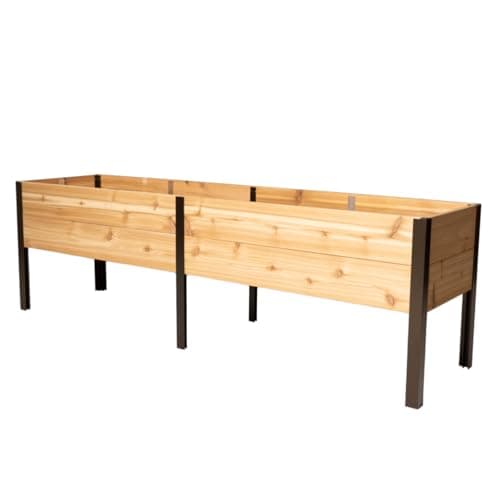 Gardener's Supply Elevated Cedar Raised Bed, 2 ft x 8 ft Self-WateringSixteen square feet of growing area at waist height Gardener's Supply Elevated Cedar Raised Bed, 2 ft x 8 ft Self-WateringSixteen square feet of growing area at waist height | Best overall, both numbers published | 8.7 | $479.99 - View on Amazon |
| 2 | 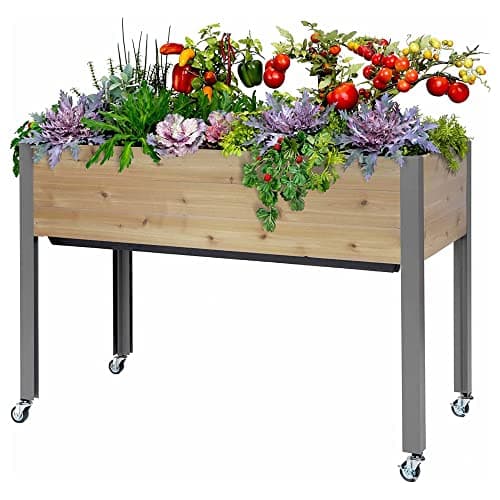 CedarCraft Self-Watering Elevated Cedar Planter, 21 x 47 inA patio or balcony bed you can roll, with both numbers published CedarCraft Self-Watering Elevated Cedar Planter, 21 x 47 inA patio or balcony bed you can roll, with both numbers published | Best both-numbers bed for a patio | 8.5 | $259.99 - View on Amazon |
| 3 | 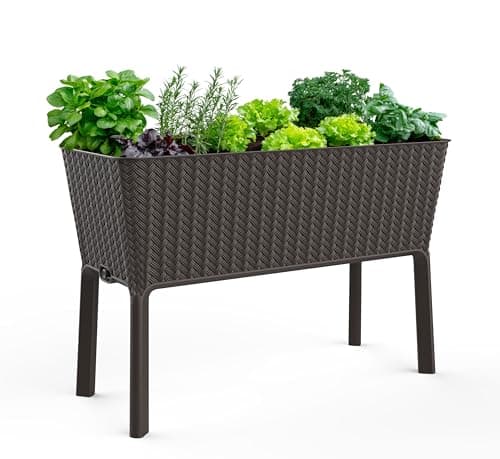 Keter Splendor 31.7 Gallon Raised Garden BedThe most soil volume for the money, if you accept an unpublished reservoir Keter Splendor 31.7 Gallon Raised Garden BedThe most soil volume for the money, if you accept an unpublished reservoir | Best soil volume per dollar | 7.4 | $127.49 - View on Amazon |
| 4 | 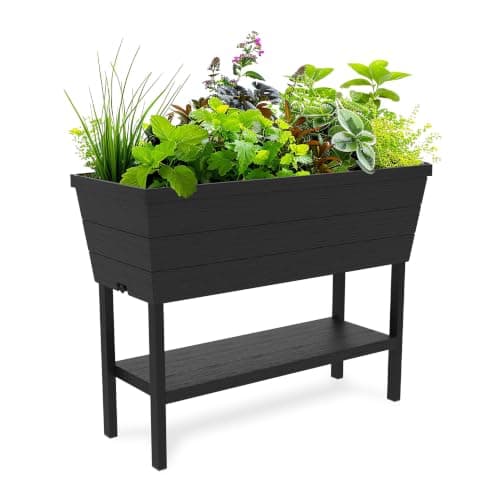 Keter Urban Bloomer 12.7 Gallon Raised Garden BedA narrow balcony or a deck rail run where a full bed will not fit Keter Urban Bloomer 12.7 Gallon Raised Garden BedA narrow balcony or a deck rail run where a full bed will not fit | Best for a narrow balcony | 7.2 | $91.79 - View on Amazon |
| 5 | 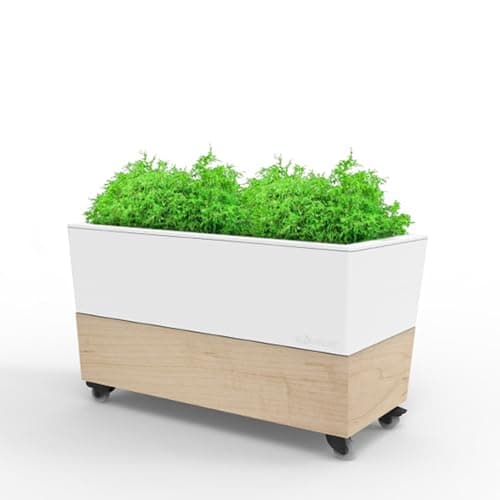 Glowpear Cafe Self-Watering Planter Box, 29.5 inA planter you want in a room, not just on a patio Glowpear Cafe Self-Watering Planter Box, 29.5 inA planter you want in a room, not just on a patio | Skip unless the look is the point | 6.8 | $699.00 - View on Amazon |
Scores are our editorial judgment from published specifications. They are not test results, and they are deliberately not marked up as ratings in this page’s structured data.
Pick #1 - Best overall, both numbers published
Gardener's Supply Elevated Cedar Raised Bed, 2 ft x 8 ft Self-Watering
Sixteen square feet of growing area at waist height
The most transparent bed in this category: 20 gallons of reservoir under 13.4 cubic feet of mix, both figures published by the maker. That is 1.49 gallons per cubic foot, within a hundredth of the EarthBox Original's 1.50 - and the EarthBox is the most transparent spec sheet in the rest of our registry.
#ad Price as of September 21, 2026, from Amazon. Prices change. How we make money.
Published specification
- Reservoir capacity
- 20 gallons, from 4 connected reservoirs of 5 gallons each
- Soil capacity
- 342 quarts (13.4 cubic feet) of potting mix
- Reservoir per cubic foot of soil
- 1.49 gallons
- Overall dimensions
- 96 x 24 x 29 in, 16 square feet of growing space
- Planting depth
- 10 in
- Refill and level
- Fill tube and a rising water level indicator
- Reservoir capacity: Gardener's Supply published listing specification
- Soil capacity: Gardener's Supply published listing specification
- Reservoir per cubic foot of soil: Our arithmetic: the two published figures above, divided
- Overall dimensions: Gardener's Supply published listing specification
- Planting depth: Gardener's Supply published listing specification
- Refill and level: Gardener's Supply published description
Refill interval - computed, not tested
Not computed for an outdoor bed, on purpose
The published cadence bands we use are for indoor container houseplants, not an outdoor bed in summer, so we do not run the arithmetic here. The checkable figure is the ratio - 20 gallons over 13.4 cubic feet is 1.49 gallons per cubic foot.
Assumes: Outdoor edibles in summer, which is outside the band we can defend. Light, temperature, humidity, soil mix and season all change how fast a pot dries, so treat this as a planning range and not a guarantee.
What is good about it
- Both capacities published, and the reservoir scales with the soil instead of lagging it
- Sixteen square feet is a real vegetable garden rather than a planter
- Four connected reservoirs spread the water along the whole length
What is not
- The single most expensive way to buy this much growing area on this page
- Eight feet of filled cedar bed is not something you move once it is planted
- Ten inches of planting depth, which is a hard limit on what will grow in it
Skip this one if
Skip it if you have not grown in a raised bed before. Start with something the size of the CedarCraft, find out whether you keep up with it, and scale up to sixteen square feet next season.
How it scored
- Published capacity
- 10.0
- Reservoir-to-soil ratio
- 9.5
- Build and materials
- 9.0
- Value for money
- 5.0
- Ease of setup
- 6.5
- Overall
- 8.7 / 10
Our editorial score, from published specifications and computed intervals. Not a test result. Specification source: Gardener's Supply 2 x 8 elevated bed retail listing.
Pick #2 - Best both-numbers bed for a patio
CedarCraft Self-Watering Elevated Cedar Planter, 21 x 47 in
A patio or balcony bed you can roll, with both numbers published
The other bed on this page whose maker publishes both numbers: a 6-gallon irrigation system under 4.8 cubic feet of mix, which works out to 1.25 gallons per cubic foot. That is below the 1.49 Gardener's Supply builds into its beds, and it is still a figure you can check before you spend the money - which is more than the rest of this category offers.
#ad Price as of September 21, 2026, from Amazon. Prices change. How we make money.
Published specification
- Reservoir capacity
- 6 gallons
- Soil capacity
- 4.8 cubic feet
- Reservoir per cubic foot of soil
- 1.25 gallons
- Planting area
- 20 x 45 in, 9.3 in deep
- Overall dimensions
- 21 x 47 x 32 in high, with casters
- Mobility
- Four casters, two of which lock
- Material
- Untreated Western Red Cedar with rustproof powder-coated aluminum legs, made in Canada
- Weight and assembly
- 38.7 lb empty; assembly required
- Reservoir capacity: CedarCraft published listing specification
- Soil capacity: CedarCraft published listing specification
- Reservoir per cubic foot of soil: Our arithmetic: the two published figures above, divided
- Planting area: CedarCraft published listing specification
- Overall dimensions: CedarCraft published listing specification
- Mobility: CedarCraft published description
- Material: CedarCraft published description
- Weight and assembly: CedarCraft published listing specification
Refill interval - computed, not tested
Not computed for an outdoor bed, on purpose
Our refill interval multiplies a reservoir by the watering cadence Virginia Cooperative Extension publishes, and that cadence is for container houseplants indoors. An outdoor bed of vegetables in July draws several times as much and varies with the weather, so a computed number here would flatter the product. What we can check is the ratio: 6 gallons over 4.8 cubic feet is 1.25 gallons of water per cubic foot of soil.
Assumes: Outdoor edibles in summer, which is outside the band we can defend. Light, temperature, humidity, soil mix and season all change how fast a pot dries, so treat this as a planning range and not a guarantee.
What is good about it
- Publishes reservoir capacity AND soil capacity, which most of this category does not
- Cedar and powder-coated aluminum rather than resin, and made in Canada
- Four casters, two locking, so a filled planter can still be repositioned
- Costs a good deal less than either Gardener's Supply bed
What is not
- 1.25 gallons per cubic foot is the lowest ratio of the beds here that publish one
- 9.3 in of planting depth, shallower than the 10 in Gardener's Supply publishes
- 4.8 cubic feet is about a third of the soil in the 2 x 8, so it is a large planter rather than a garden
- No drainage plug is published, which matters for an outdoor reservoir in a wet week
- The cedar is published as untreated, with no finish claimed
Skip this one if
Skip it if you want depth or volume. Under ten inches of mix and 4.8 cubic feet is fine for greens, herbs and determinate tomatoes, and it is not the bed for long carrots, parsnips or a full indeterminate tomato.
How it scored
- Published capacity
- 10.0
- Reservoir-to-soil ratio
- 7.5
- Build and materials
- 8.5
- Value for money
- 7.5
- Ease of setup
- 7.0
- Overall
- 8.5 / 10
Our editorial score, from published specifications and computed intervals. Not a test result. Specification source: CedarCraft self-watering elevated cedar planter retail listing.
Pick #3 - Best soil volume per dollar
Keter Splendor 31.7 Gallon Raised Garden Bed
The most soil volume for the money, if you accept an unpublished reservoir
The most growing capacity per dollar on this page by a wide margin - 31.7 gallons of soil in a resin bed with a drainage plug. The catch is the one that runs through this whole category: Keter says there is a reservoir and never says how big it is.
#ad Price as of September 21, 2026, from Amazon. Prices change. How we make money.
Published specification
- Soil capacity
- 31.7 gallons (about 4.2 cubic feet)
- Reservoir capacity
- Not published by the manufacturer
- Overall dimensions
- 44.8 x 19.4 x 29.8 in
- Watering system
- Reservoir plus a drainage plug, described as preventing root decay and overwatering
- Material
- Weather-resistant resin
- Soil capacity: Keter published listing specification
- Reservoir capacity: Checked the listing; a reservoir is described, its volume is not given
- Overall dimensions: Keter published listing specification
- Watering system: Keter published description
- Material: Keter published description
Refill interval - computed, not tested
Cannot be computed, and we will not estimate it
The refill interval is reservoir capacity divided by what the planting draws. Keter publishes the soil volume but not the reservoir, so the numerator does not exist and we will not invent one. For scale, if it held the same 1.49 gallons per cubic foot as the Gardener's Supply beds it would be about 6.3 gallons - but that is our arithmetic on someone else's product, not a Keter figure, and we are not treating it as one.
Assumes: None possible without a published reservoir volume. Light, temperature, humidity, soil mix and season all change how fast a pot dries, so treat this as a planning range and not a guarantee.
What is good about it
- By far the most soil volume per dollar here
- A drainage plug, which is the feature that matters when a reservoir bed lives outdoors in a wet week
- Resin does not rot, split or need treating
What is not
- The reservoir capacity is not published, so the duration claim cannot be checked at all
- Resin looks like resin next to cedar
- Shallower than the cedar beds, and the listing does not publish a planting depth
Skip this one if
Skip it if the reservoir is the reason you are buying. You are buying a large, well-drained resin bed that happens to have one, and that is a fair purchase - just not a measurable one.
How it scored
- Published capacity
- 4.0
- Reservoir-to-soil ratio
- 3.0
- Build and materials
- 7.5
- Value for money
- 9.5
- Ease of setup
- 8.0
- Overall
- 7.4 / 10
Our editorial score, from published specifications and computed intervals. Not a test result. Specification source: Keter Splendor raised garden bed retail listing.
Pick #4 - Best for a narrow balcony
Keter Urban Bloomer 12.7 Gallon Raised Garden Bed
A narrow balcony or a deck rail run where a full bed will not fit
The balcony-sized version: a narrow 14.7-inch footprint holding 12.7 gallons of soil, with a watering gauge on the front. It is the cheapest entry to a reservoir bed on this page, and like its bigger sibling it does not tell you how much water the reservoir holds.
#ad Price as of September 21, 2026, from Amazon. Prices change. How we make money.
Published specification
- Soil capacity
- 12.7 gallons (about 1.7 cubic feet)
- Reservoir capacity
- Not published by the manufacturer
- Overall dimensions
- 32.3 x 14.7 x 30.7 in
- Watering system
- Reservoir with a watering gauge
- Soil capacity: Keter published listing specification
- Reservoir capacity: Checked the listing; a reservoir is described, its volume is not given
- Overall dimensions: Keter published listing specification
- Watering system: Keter published description
Refill interval - computed, not tested
Cannot be computed, and we will not estimate it
No reservoir volume is published, so there is no numerator. The 12.7 gallons in the product name is the soil, not the water, and that distinction is the single most misread number in this category.
Assumes: None possible without a published reservoir volume. Light, temperature, humidity, soil mix and season all change how fast a pot dries, so treat this as a planning range and not a guarantee.
What is good about it
- Fits a genuinely narrow balcony at under 15 inches deep
- A watering gauge, which is the thing you actually read
- The cheapest way onto this page
What is not
- Reservoir capacity is not published
- 12.7 gallons of soil is a planter's worth, not a bed's worth
- The headline gallon figure describes the soil and reads like a water capacity
Skip this one if
Skip it if you want to grow more than herbs and salad. One and seven tenths cubic feet of mix is less than a single EarthBox, and a tomato will outgrow it.
How it scored
- Published capacity
- 4.0
- Reservoir-to-soil ratio
- 3.0
- Build and materials
- 7.0
- Value for money
- 8.5
- Ease of setup
- 8.5
- Overall
- 7.2 / 10
Our editorial score, from published specifications and computed intervals. Not a test result. Specification source: Keter Urban Bloomer retail listing.
Pick #5 - Skip unless the look is the point
Glowpear Cafe Self-Watering Planter Box, 29.5 in
A planter you want in a room, not just on a patio
The design-led end of the category: American oak frame, water gauge, clip-on drip tray so it works indoors, and a published 16 gallon soil volume at 11 inches deep. It is also several times the price of a bed that publishes more about itself.
#ad Price as of September 21, 2026, from Amazon. Prices change. How we make money.
Published specification
- Soil volume
- 16 gallons (about 2.1 cubic feet), 11 in soil depth
- Reservoir capacity
- Not published by the manufacturer
- Overall dimensions
- 29.5 x 18.9 x 19.7 in
- Watering system
- Integrated self-watering reservoir with a water level indicator
- Indoor use
- Clip-on drip tray; UV and corrosion resistant, BPA free and food safe
- Frame
- American oak base, on castors
- Soil volume: Glowpear published listing specification
- Reservoir capacity: Checked the listing; the reservoir and gauge are described, the volume is not
- Overall dimensions: Glowpear published listing specification
- Watering system: Glowpear published description
- Indoor use: Glowpear published description
- Frame: Glowpear published description
Refill interval - computed, not tested
Cannot be computed, and we will not estimate it
Glowpear publishes the soil volume and the soil depth but not the reservoir capacity, so the refill interval has no numerator. The drip tray does mean this is one of the few beds here that can honestly live indoors, where our published cadence bands would actually apply if we had the reservoir figure.
Assumes: None possible without a published reservoir volume. Light, temperature, humidity, soil mix and season all change how fast a pot dries, so treat this as a planning range and not a guarantee.
What is good about it
- The only bed here designed to be used indoors, with a drip tray to make that work
- Publishes both soil volume and soil depth, which most of this category skips
- Water gauge, castors, and a finish that does not look like garden equipment
What is not
- By a distance the most expensive thing on this page, and the reservoir is still unpublished
- Sixteen gallons of soil is a large planter, not a garden bed
- Oak outdoors needs looking after in a way resin and cedar-with-aluminum do not
Skip this one if
Skip it unless the look is a real part of the purchase. On published numbers alone it is beaten by beds costing a fraction as much, and we would rather say that than pretend the oak is a specification.
How it scored
- Published capacity
- 4.5
- Reservoir-to-soil ratio
- 3.0
- Build and materials
- 9.0
- Value for money
- 3.5
- Ease of setup
- 8.0
- Overall
- 6.8 / 10
Our editorial score, from published specifications and computed intervals. Not a test result. Specification source: Glowpear Cafe planter box retail listing.
Questions people actually ask
- How much water does a self-watering raised bed hold?
Usually the maker does not say. Of the beds here, two publish it: 20 gallons in the Gardener’s Supply 2 x 8, from four 5-gallon reservoirs, and 6 gallons in the CedarCraft. Keter and Glowpear describe a reservoir without giving a capacity, so their duration claims cannot be checked. Be careful with headline gallon figures in product names: they usually describe the soil, not the water.
- How long can a self-watering raised bed go without watering?
We will not give you a number, because we do not have a defensible one. The published watering cadences we use across this site are for container houseplants indoors, and an outdoor bed of vegetables in summer transpires several times as much and changes with the weather. Treat the reservoir as a buffer against a missed day and steadier moisture in heat, not as a week away.
- Are self-watering raised beds worth it?
For an elevated bed, yes - an elevated bed is a container, it dries out from every side, and a reservoir under it genuinely evens out the moisture. Whether a particular bed is worth it is harder to answer, because most makers do not publish the reservoir capacity you are paying for. Buy the one that prints the number.
- What can you grow in a 10-inch deep raised bed?
Salad greens, spinach, chard, bush beans, radishes, herbs, peppers and determinate tomatoes all do well at that depth. Long carrots, parsnips and a full indeterminate tomato want more room than an elevated bed gives them - for those, ground with unlimited depth beats a reservoir.
- Do self-watering raised beds cause root rot?
Not when the air gap between the reservoir and the root zone is intact. The outdoor risk is rain: it lands on the surface, saturates the mix and closes that gap, which is the wet, poorly drained condition root-rot organisms need. A drainage plug is the feature that protects against it, and not every bed here has one.
- What happened to the Gardener's Supply 2 x 4 self-watering bed?
It was our top pick until September 2026, when its listing went to “Currently unavailable” with no purchasable offer, so we removed it rather than send you to a dead page. One warning if you go looking: the 2 x 4 Gardener’s Supply bed still on sale is the plain version, whose listing describes a cedar-slat false floor that drains rather than a reservoir. For a reservoir you can check, the 2 x 8 and the CedarCraft are the two beds here that publish their numbers.
Sources
Sources
- Gardener's Supply elevated cedar raised bed published specification, via retail listing
- CedarCraft self-watering elevated cedar planter published specification, via retail listing
- Keter Splendor raised garden bed published specification, via retail listing
- Glowpear Cafe self-watering planter box published specification, via retail listing
- EarthBox published system comparison table
- Criscione and Holliday-Goulart, Properly Watering Container Houseplants, Virginia Cooperative Extension SPES-804 (2026)
- Plants Grown in Containers, NC State Extension Gardener Handbook chapter 18
- Daughtry, Watering but Not Overwatering Houseplants, NC State Extension (2022)