Roundup
Best Seed Starting Mix
Most seed mixes are sold on the word premium. These are ranked on what the bag actually says it contains - and on whether the mix will still take up water after it has dried out once.
By Scooter M. - Enthusiast. Reads the manuals, compiles the specs, does the math. | Published
Disclosure
We earn a commission if you buy through our links. It does not change what we recommend or what you pay. Full disclosure.
The short answer
Seed mix is not potting soil, and the difference is particle size
A seed starting mix is finer, lighter and lower in nutrients than a general potting mix. Fine particles hold moisture in continuous contact with a seed, which is what germination needs - as we covered with the trays themselves, University of Maryland Extension puts it as an adequate and continuous supply of moisture.
The low nutrient level is deliberate too. Clemson Extension notes that seeds should be started in a well-drained, well-aerated, sterile soilless medium, and that soilless mixtures reduce soil-borne diseases such as damping-off. A seed does not need feeding: it carries its own supply until the first true leaves, which is why extension guidance puts the first fertilizer at that point and not before.
How we ranked them
We have not run germination trials. There is no sown flat here with five mixes side by side. What follows is each maker’s published listing, judged on four things that decide whether a mix works in a tray that waters from below.
Does it publish a recipe? First, because it is the only way to tell a peat-and-perlite mix from a bag of unnamed brown material. Two of these five name every component; two name none.
Will it re-wet after drying? This is the one that matters for this site’s readers, and it is the difference between peat and coir. A dried-out peat mix is water-repellent and sheds water; coir takes it back up. On a capillary mat that is the whole ballgame.
Volume per dollar, on the published quarts. Compressed blocks win this by a distance, and one bag here loses it spectacularly.
Ready to use, or a brick to hydrate? Not a quality judgment, just a real difference in how your afternoon goes.
| Mix | Published components | Base material | Volume | Ready to use |
|---|---|---|---|---|
| Espoma Organic Seed Starter | Peat, perlite, yucca extract, lime, mycorrhizae | Peat | 16 qt | Yes |
| Burpee Coconut Coir | Coir only | Coir, peat-free | 16 qt (2 bricks) | No - hydrate |
| Miracle-Gro Seed Starting | Not published; states no compost or bark | Not published | 16 qt (2 bags) | Yes |
| Back to the Roots block | Not published; peat-free, OMRI | Not published | 12 qt | No - hydrate |
| Midwest Hearth | Peat, perlite, vermiculite | Peat | 4 qt | Yes |
Peat or coir, if your tray waters from below
This is the decision that actually matters, and most seed-mix roundups do not make it, because most of them are not written by people thinking about capillary mats.
Peat is the traditional base and it holds water superbly - until it dries out. Dry peat becomes hydrophobic: water runs off it, or channels down the side of the cell and out of the bottom without wetting the middle. Top-watering can force the issue with patience. A capillary mat cannot, because it only offers water at the base and relies on the medium pulling it upward.
Coir re-wets readily, which is why it is the better base for a self-watering seed tray and for a capillary mat setup. It also holds a great deal of water, which cuts the other way: coir plus a permanently full reservoir is how you drown seedlings, and it is worth reading the root rot mechanism before you leave a tray standing in water for a fortnight.
If you are set on peat, the practical answer is to wet the mix before you fill the cells. UMD’s instruction is to moisten dry media thoroughly first, until it is as moist as a wrung-out sponge and not sopping wet. That one step removes most of the re-wetting problem for the season, because the mix never gets a chance to go properly dry.
Fungus gnats start in the bag
Miracle-Gro’s listing makes a claim none of the others do: no compost and no bark, which it names as the ingredients that shelter fungus gnats. That is a more useful sentence than anything else on any of these five listings.
Fungus gnats breed in moist organic matter, and a warm tray under a humidity dome is close to ideal for them. If you have fought them before, our guide to getting rid of fungus gnats goes through the controls that work - but choosing a mix without the bulky organic fraction they shelter in is a cheaper first move.
What about sterility?
Every one of these is a soilless mix, which is the property Clemson names as reducing damping-off. None of them publishes a sterilization method, and we are not going to pretend otherwise: “soilless” is a statement about ingredients, not a guarantee that a bag is pathogen-free.
What you can control is what happens after you open it. Clean trays between sowings - the dishwasher-safe kits on the tray page earn their keep here - take the humidity dome off once seedlings germinate, and do not let the surface sit saturated under a dome for weeks.
How much do you actually need?
Miracle-Gro is the only maker here that answers this: each 8 quart bag fills three 72-cell trays. That gives you a usable rule of thumb for the others, since a quart fills roughly 27 standard cells.
For most home sowings, 12 to 16 quarts is a season. That is why the 4 quart bag is the odd one out - the recipe is good, and you would need four of them to fill what one bag of the others fills, at several times the price per quart.
The honest cons on every pick
Espoma. Peat-based, so it is the least sustainable here and the hardest to re-wet once dry. Mycorrhizae do little for a seedling that moves on in three weeks. Bulky to store.
Burpee coir. Twenty minutes of hydrating and crumbling before you sow. No perlite in the recipe, so aeration depends on you. Holds so much water that a full reservoir underneath becomes a risk.
Miracle-Gro. No ingredient list at all, fed rather than inert, and not organic-certified. The gnat claim is the reason to buy it; the rest is trust.
Back to the Roots. Peat-free and OMRI listed tell you what is not in it and what it is certified as, but not what is in it. Balanced pH with no figure.
Midwest Hearth. The best recipe on the page in the smallest bag at the highest price per quart. Four dry quarts is roughly one tray.
What we would buy
Coir bricks for anything sitting on a mat or in a self-watering tray, because re-wetting is the failure mode that ends seasons. Espoma if you top-water by hand and want the recipe printed on the bag. Miracle-Gro if gnats have beaten you before.
Whichever you choose, moisten it before filling the cells, sow into a tray with cells sized for the crop, and pot on when the first true leaves appear rather than waiting for the seedling to tell you it has run out of room.
Ranked picks
Quick picks
Ranked on published specifications and the computed refill interval, not on looks. Tap any row for the full write-up, including who should skip it.
| # | Product | Best for | Score | Price |
|---|---|---|---|---|
| 1 | 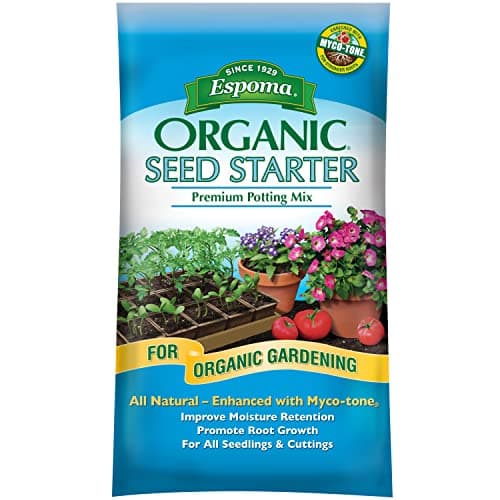 Espoma Organic Seed Starter Mix, 16 qtA gardener who wants to know what is in the bag and why Espoma Organic Seed Starter Mix, 16 qtA gardener who wants to know what is in the bag and why | Best overall, publishes its recipe | 8.8 | $15.82 - View on Amazon |
| 2 | 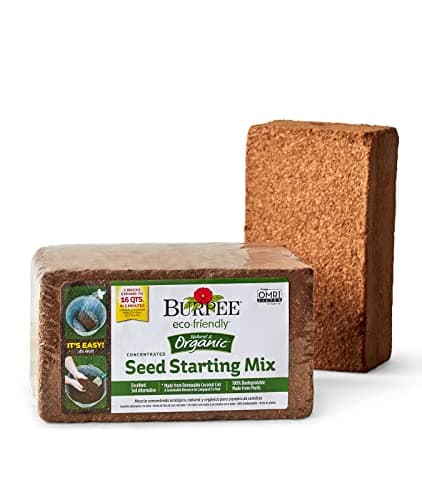 Burpee Organic Coconut Coir Seed Starting Mix, 16 qtSelf-watering trays, capillary mats, and anyone avoiding peat Burpee Organic Coconut Coir Seed Starting Mix, 16 qtSelf-watering trays, capillary mats, and anyone avoiding peat | Best for capillary mats | 8.6 | $12.99 - View on Amazon |
| 3 | 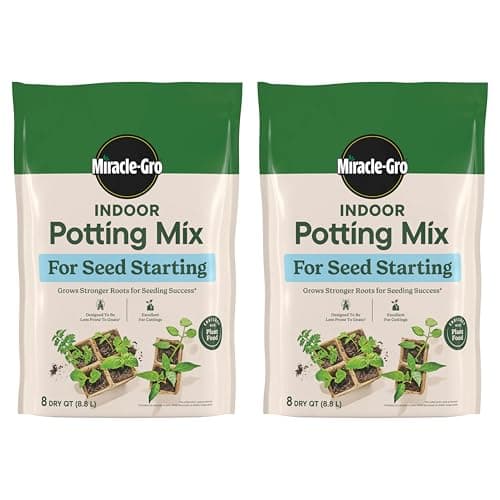 Miracle-Gro Indoor Potting Mix for Seed Starting, 8 qt (2-Pack)Anyone who has had fungus gnats and does not want them again Miracle-Gro Indoor Potting Mix for Seed Starting, 8 qt (2-Pack)Anyone who has had fungus gnats and does not want them again | Best against fungus gnats | 8.2 | $10.38 - View on Amazon |
| 4 | 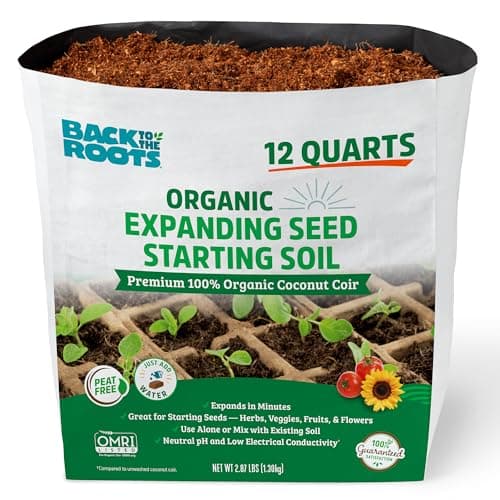 Back to the Roots Organic Seed Starting Block, 12 qtThe most mix for the least money, if you do not mind hydrating it Back to the Roots Organic Seed Starting Block, 12 qtThe most mix for the least money, if you do not mind hydrating it | Most mix per dollar | 8.0 | $8.80 - View on Amazon |
| 5 | 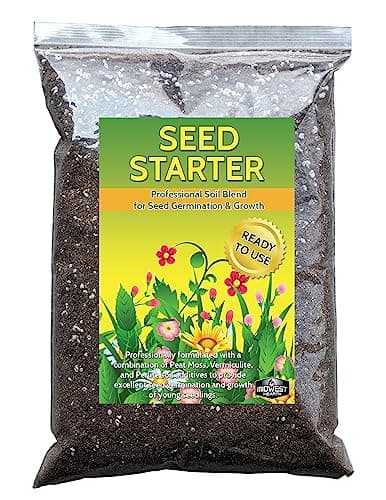 Midwest Hearth Seed Starter Soil Mix, 4 Dry QuartsA windowsill tray or two where you want a classic three-part mix Midwest Hearth Seed Starter Soil Mix, 4 Dry QuartsA windowsill tray or two where you want a classic three-part mix | Good recipe, wrong size | 6.9 | $15.95 - View on Amazon |
Scores are our editorial judgment from published specifications. They are not test results, and they are deliberately not marked up as ratings in this page’s structured data.
Pick #1 - Best overall, publishes its recipe
Espoma Organic Seed Starter Mix, 16 qt
A gardener who wants to know what is in the bag and why
The only mix here that publishes its full recipe and the reason for each part: sphagnum peat and perlite for moisture and air, lime to correct the pH of the peat, yucca extract, and mycorrhizae. When a maker names lime for pH control, it is telling you it knows peat is acidic - which is the detail the unlabeled bags leave out.
#ad Price as of September 21, 2026, from Amazon. Prices change. How we make money.
Published specification
- Published ingredients
- Sphagnum peat moss and perlite, with yucca extract and lime
- Biology added
- Myco-tone blend of endo and ecto mycorrhizae
- pH handling
- Lime included to ensure correct pH
- Volume
- 16 quarts, ready to use
- Fertilizer
- No synthetic plant foods or chemicals, per the maker
- Published ingredients: Espoma published description
- Biology added: Espoma published description
- pH handling: Espoma published description
- Volume: Espoma published listing specification
- Fertilizer: Espoma published description
What is good about it
- Publishes the actual components rather than the word premium
- Lime for pH is named, which is the correct treatment for a peat-based mix
- Ready to use - no water, no waiting, no mixing bowl
- Perlite is in the recipe, so it is aerated out of the bag
What is not
- Peat-based, which is the least sustainable option here and dries to a crust that resists re-wetting
- Ready-to-use bags take up a lot of shelf space compared with a compressed block
- Mycorrhizae are of limited value to a seedling that will be potted on in three weeks
- Mid-priced per quart - the coir bricks beat it
Skip this one if
Skip it if your trays sit on a capillary mat all season. Peat that has once dried out is the hardest medium here to re-wet from below, and a self-watering tray works by wetting from below.
How it scored
- Published recipe
- 10.0
- Wicks from below
- 7.0
- Volume per dollar
- 7.0
- Sustainability
- 4.0
- Ready to use
- 10.0
- Overall
- 8.8 / 10
Our editorial score, from published specifications and computed intervals. Not a test result. Specification source: Espoma Organic Seed Starter 16 qt retail listing.
Pick #2 - Best for capillary mats
Burpee Organic Coconut Coir Seed Starting Mix, 16 qt
Self-watering trays, capillary mats, and anyone avoiding peat
Two compressed coir bricks that expand to 8 quarts each, OMRI listed, peat-free. Coir is the medium to want if your seedlings sit on a capillary mat: it re-wets readily after drying, which is exactly where peat fails.
#ad Price as of September 21, 2026, from Amazon. Prices change. How we make money.
Published specification
- Material
- Coconut coir from recycled coconut husks, peat-free
- Volume
- Two bricks, each expanding to 8 quarts - 16 quarts total
- Certification
- OMRI listed and certified organic
- Preparation
- Add water to expand the dehydrated brick
- Maker's claim
- Better air circulation and moisture retention than peat
- Material: Burpee published description
- Volume: Burpee published listing specification
- Certification: Burpee published description
- Preparation: Burpee published description
- Maker's claim: Burpee published description
What is good about it
- Coir re-wets far more willingly than peat, which suits bottom watering
- OMRI listed, and the certification is published rather than implied
- Two bricks store in a drawer until you need them
- Peat-free, with the environmental argument that goes with it
What is not
- You have to hydrate and crumble it before sowing - about twenty minutes of work
- No perlite in the mix, so aeration depends on how coarsely you break it up
- Coir holds a lot of water, which is a risk if you also keep a reservoir full
- No published pH figure, only the implication that coir sits near neutral
Skip this one if
Skip it if you want to open a bag and sow immediately. Hydrating bricks is genuinely more work, and on a Saturday morning that matters more than the sustainability argument.
How it scored
- Published recipe
- 7.5
- Wicks from below
- 9.5
- Volume per dollar
- 8.5
- Sustainability
- 9.0
- Ready to use
- 5.0
- Overall
- 8.6 / 10
Our editorial score, from published specifications and computed intervals. Not a test result. Specification source: Burpee Organic Coconut Coir Seed Starting Mix retail listing.
Pick #3 - Best against fungus gnats
Miracle-Gro Indoor Potting Mix for Seed Starting, 8 qt (2-Pack)
Anyone who has had fungus gnats and does not want them again
The only mix here that addresses fungus gnats in its own specification: it contains no compost or bark, the two ingredients that shelter them. It is also fed rather than inert, which makes it the least suitable choice for germination purists and the most convenient for everyone else.
#ad Price as of September 21, 2026, from Amazon. Prices change. How we make money.
Published specification
- Gnat resistance
- Contains no compost or bark, which the maker names as fungus gnat shelter
- Fertilizer
- Enriched with plant food
- Volume
- Two 8 quart bags - 16 quarts total
- Published coverage
- Each 8 quart bag fills three 72-cell seeding trays
- Full ingredient list
- Not published
- Gnat resistance: Miracle-Gro published description
- Fertilizer: Miracle-Gro published description
- Volume: Miracle-Gro published listing specification
- Published coverage: Miracle-Gro published description
- Full ingredient list: Checked on the Miracle-Gro listing
What is good about it
- Publishes a coverage figure in trays, which no other mix here does
- The no-compost, no-bark formulation is a real answer to a real problem
- Ready to use, in two manageable bags rather than one large one
- Cheapest ready-to-use option per quart here
What is not
- Fed mixes can push soft growth in seedlings that do not need feeding yet
- No ingredient list, so you are trusting the brand rather than reading a recipe
- Not organic-certified, unlike three of the four others
- Plant food in a germination mix is a preference, not an upgrade
Skip this one if
Skip it if you sow and then pot on within two or three weeks. Seedlings do not need fertilizer until their first true leaves, so the feed is doing nothing for you in that window.
How it scored
- Published recipe
- 5.5
- Wicks from below
- 8.0
- Volume per dollar
- 9.5
- Sustainability
- 5.0
- Ready to use
- 10.0
- Overall
- 8.2 / 10
Our editorial score, from published specifications and computed intervals. Not a test result. Specification source: Miracle-Gro Indoor Potting Mix for Seed Starting retail listing.
Pick #4 - Most mix per dollar
Back to the Roots Organic Seed Starting Block, 12 qt
The most mix for the least money, if you do not mind hydrating it
A single compressed, peat-free, OMRI-listed block that expands to 12 quarts, at the lowest cost per quart on this page. It publishes a balanced pH and not much else, which is the trade you are making for the price.
#ad Price as of September 21, 2026, from Amazon. Prices change. How we make money.
Published specification
- Volume
- Compressed block expanding to 12 quarts
- Material
- Peat free
- Certification
- OMRI listed
- pH
- Published as balanced; no figure given
- Full ingredient list
- Not published
- Volume: Back to the Roots published listing specification
- Material: Back to the Roots published description
- Certification: Back to the Roots published description
- pH: Back to the Roots published description
- Full ingredient list: Checked on the Back to the Roots listing
What is good about it
- Cheapest per quart on this page once expanded
- Peat-free and OMRI listed, both stated on the listing
- One block stores flat and expands when you need it
- Published as all-purpose, so leftovers are useful for potting on
What is not
- No ingredient list published - peat-free tells you what is absent, not what is present
- No perlite named, so aeration is unknown until you open it
- Balanced pH is a claim without a number behind it
- Needs hydrating like any compressed block
Skip this one if
Skip it if you are sowing something fussy and want to know exactly what the seeds are sitting in. For that, buy the mix that prints its recipe.
How it scored
- Published recipe
- 5.0
- Wicks from below
- 8.5
- Volume per dollar
- 10.0
- Sustainability
- 9.0
- Ready to use
- 5.0
- Overall
- 8.0 / 10
Our editorial score, from published specifications and computed intervals. Not a test result. Specification source: Back to the Roots compressed seed starting block retail listing.
Pick #5 - Good recipe, wrong size
Midwest Hearth Seed Starter Soil Mix, 4 Dry Quarts
A windowsill tray or two where you want a classic three-part mix
A three-part peat, perlite and vermiculite mix with a published pH claim - a proper professional-style recipe in a very small bag. The recipe is the best thing about it and the quantity is the worst: four dry quarts is by far the most expensive way to buy seed mix here.
#ad Price as of September 21, 2026, from Amazon. Prices change. How we make money.
Published specification
- Published ingredients
- Peat moss, perlite and vermiculite
- pH
- Published as pH controlled and balanced; no figure given
- Volume
- 4 dry quarts
- Origin
- Made in USA
- Formulation claim
- The same formulation used by professional growers
- Published ingredients: Midwest Hearth published description
- pH: Midwest Hearth published description
- Volume: Midwest Hearth published listing specification
- Origin: Midwest Hearth published listing specification
- Formulation claim: Midwest Hearth published description
What is good about it
- Names all three components, including vermiculite, which the others leave out
- Vermiculite holds moisture at the surface where germinating seed needs it
- A pH claim is published, even without a number
- Small bag suits someone sowing a single tray
What is not
- By far the highest price per quart on this page
- Four quarts fills roughly one standard tray, so a real sowing needs several bags
- Peat-based, with the same re-wetting problem as the Espoma
- Professional formulation is a claim with nothing published behind it
Skip this one if
Skip it for any serious sowing. Buy it for one tray of something precious; buy a coir brick or a 16 quart bag for everything else, because the price per quart here is several times the alternatives.
How it scored
- Published recipe
- 9.0
- Wicks from below
- 7.0
- Volume per dollar
- 2.0
- Sustainability
- 4.0
- Ready to use
- 10.0
- Overall
- 6.9 / 10
Our editorial score, from published specifications and computed intervals. Not a test result. Specification source: Midwest Hearth seed starter soil mix retail listing.
Questions people actually ask
- Can you use potting soil instead of seed starting mix?
You can, and germination is usually poorer. General potting soil is coarser, holds more nutrient than a seed needs and often contains compost or bark, which hold water unevenly around a small seed and shelter fungus gnats. Clemson Extension recommends a well-drained, well-aerated soilless medium for starting seed, specifically because soilless mixes reduce damping-off.
- Is coco coir better than peat for seed starting?
For a tray that waters from below, yes - coir takes water back up after it has dried, and peat becomes water-repellent when it dries and sheds it. For hand watering from the top, the difference is much smaller and peat-based mixes with perlite and lime are excellent. Coir is also peat-free, which matters to some buyers on its own terms.
- Do you need to fertilize seed starting mix?
Not at sowing. Seeds carry their own food until the first true leaves, and extension guidance puts the first feed at that point. That is why most seed mixes are inert. A mix sold as enriched with plant food is not wrong, it is simply doing something your seedlings do not need in their first two or three weeks.
- How much seed starting mix do I need?
Miracle-Gro is the only maker here that publishes a figure: one 8 quart bag fills three 72-cell trays. Twelve to sixteen quarts covers a normal home sowing season. Compressed blocks and bricks are the cheapest way to buy that volume, at the cost of hydrating them first.
- Does seed starting mix go bad?
Unopened and dry, it keeps for years. The thing that ruins it is storing an opened bag damp, which grows fungi and gives fungus gnats somewhere to breed before the mix ever reaches a tray. Keep opened bags closed and dry, and hydrate compressed blocks only when you are ready to sow.
Sources
Sources
- Espoma Organic Seed Starter published specification, via retail listing
- Burpee Organic Coconut Coir Seed Starting Mix published specification, via retail listing
- Miracle-Gro Indoor Potting Mix for Seed Starting published specification, via retail listing
- Back to the Roots compressed seed starting block published specification, via retail listing
- Midwest Hearth seed starter soil mix published specification, via retail listing
- Polomski and Shaughnessy, Starting Seeds Indoors, Clemson Cooperative Extension HGIC 1259 (revised 2020)
- Traunfeld, Starting Vegetable Seeds Indoors, University of Maryland Extension (2026)