Roundup
Best Self-Watering Seed Starter Trays
A capillary mat is a genuinely good way to water seedlings. Whether a tray is a good tray comes down to cell size, which extension services publish crop by crop and most tray makers never mention.
By Scooter M. - Enthusiast. Reads the manuals, compiles the specs, does the math. | Published
Disclosure
We earn a commission if you buy through our links. It does not change what we recommend or what you pay. Full disclosure.
The short answer
Why seedlings are where self-watering makes the most sense
Elsewhere on this site we tell you that a reservoir pot is the wrong tool for a seedling, and we stand by it: a reservoir delivers water to a zone, and a seed tray is not a zone. A self-watering seed starter is a different design. There is no deep tank and no wick into a single pot. It is a shallow reservoir, a felt capillary mat, and a tray of small cells standing on the mat, each cell drawing water up through its drainage hole.
That design suits the job. University of Maryland Extension puts it plainly: seed germination begins with water absorption, and an adequate and continuous supply of moisture is essential. Clemson Extension adds that seeds are extremely sensitive to drying out. And a seedling cell holds very little mix - the GrowEase’s published 3 quarts is shared across 24 cells, half a cup each. NC State Extension’s container chapter notes that larger containers do not dry out as quickly and need less frequent watering, which is the same point from the other end.
Bottom watering is also one of the two methods UMD describes for seedlings, and Clemson Extension gives the manual version - stand the tray in 1 to 2 inches of water for 3 to 10 minutes, then lift it back out. A capillary mat does the same thing continuously, which is the greenhouse technique the mat was invented for. The page on bottom watering covers the manual method for houseplants in more detail.
The risk it introduces: mix that never gets a chance to dry
Continuous is also the problem. UMD says the common problems in seedling care come down to root moisture - a lack of uniform watering, overwatering, and letting the containers dry out - and warns that the water molds Pythium, Phytophthora and Rhizoctonia cause root rot and damping-off that can quickly kill a whole container of seedlings if the mix is kept too wet. A mat is designed to fix the first and the third. Left brim-full with a dome on top, it can create the second.
It is the same mechanism we set out for root rot in self-watering pots, at a smaller scale and with less margin. Three habits keep it under control, and each rests on published guidance - two from extension services, one from a maker - rather than on our say-so.
Take the dome off on time. Clemson says to keep a germination dome on until all the seeds have germinated; University of Minnesota Extension says to remove it once seedlings are tall enough to touch it. Either way, a dome is for germination, not for growing on.
Do not fill past the maker’s line. SOLIGT is the only maker here that publishes a fill level - about 3/4 inch - and it is a useful habit with any tray. The reservoir is there to keep the mat wet, not to flood the cells.
Use a seed-starting mix, not garden soil. Clemson notes that soilless mixes reduce soil-borne diseases such as damping-off. The mixes are ranked here, including which ones re-wet properly on a capillary mat.
How we ranked them
We have not grown seedlings in any of these kits. There is no germination trial here and no side-by-side shelf. What follows is each maker’s published specification, checked against published extension guidance, with our arithmetic shown where we did any.
Published cell size first. Cell size decides what a tray can grow and for how long, and UMD publishes a recommended range for each group of crops. A tray whose maker prints the cell dimensions can be checked against it before you buy.
Published reservoir capacity second. It is the one number that makes the self-watering claim checkable, and only one maker here prints it.
Moisture control third. A published fill level, a visible water line, a platform that keeps cells out of the water - design features that make the overwatering risk above easier to manage.
Light, where a kit includes one. Measured against the hours three extension services recommend, because a light that cannot run long enough is a light you still have to supplement.
Cells per kit and value last. A cheap cell that is too small for your crop is not good value.
| Kit | Cell area | Cell depth | Published reservoir | Cells |
|---|---|---|---|---|
| Gardener's Supply GrowEase 24 | 4 sq in (2 x 2 in) | 2 1/4 in | 10 cups | 24 |
| Gardener's Supply Best XL | 5 sq in (2 1/2 x 2 in) | 3 1/4 in | 5 cups | 12 |
| Burpee XL | 5.06 sq in (2 1/4 x 2 1/4 in) | 2 in | Not published | 32 |
| SOLIGT 6 pack | 2.25 sq in (1 1/2 x 1 1/2 in) | 2.17 in | Not published (fill to 3/4 in) | 144 |
| BlumWay 5 pack | Not published | 1.97 in | Not published | 60 |
Cell size, crop by crop
University of Maryland Extension publishes recommended individual cell sizes by crop group. Put the trays against them and the picture is clearer than any listing makes it.
| Crop group | UMD recommended cell | Trays here that fit |
|---|---|---|
| Lettuce, beets, spinach, kale and other greens | 3 to 6 sq in | GrowEase, Best XL, Burpee XL |
| Squash, cucumber, broccoli, cabbage | 4 to 9 sq in | GrowEase (at the floor), Best XL, Burpee XL |
| Tomato, eggplant, pepper | 9 to 16 sq in | None - pot up |
Two things follow. The SOLIGT’s 2.25 square inch cells are below the smallest range UMD gives for anything, and the BlumWay does not publish a cell width at all, so neither can be placed on this table.
And no self-watering kit we found reaches the tomato range. That is not a reason to avoid them, because the extension guidance does not expect a tomato to finish in its first cell. UMD says tomatoes, peppers and eggplant are often started singly and moved into larger containers 2 to 3 weeks after germination. Clemson gives one or two sets of true leaves as the moment to transplant into larger containers, and UMN recommends a new container 1 to 2 inches wider than the cell. A small cell is a schedule, not a failure - as long as you know it is coming.
It is also worth knowing what not to start in a tray at all. Clemson lists beans, corn and carrots as crops that do not do well as transplants and should be sown directly in the garden.
Depth is not area
Burpee’s listing describes its cells as ideal for deep-rooted plants like tomatoes, peppers and eggplants. Its published cell is 2 1/4 inches square and 2 inches deep. That is 5.06 square inches - the largest cell area on this page, and still only a little over half of the 9 square inch minimum UMD recommends for exactly those crops. The depth, meanwhile, is precisely the 2-inch minimum UMD gives for any seed-starting container.
The Gardener’s Best XL is the genuinely deep one, at 3 1/4 inches, with vents for air pruning and a pop-out hole in each cell base. Its cell area is 5 square inches, the same as the Burpee in practice. So the XL buys you a longer stay in the tray before roots run out of room downward; it does not buy you the width UMD recommends for fruiting crops. At the other end, the BlumWay’s published 1.97-inch depth is a hair under UMD’s 2-inch minimum.
The one number most makers leave out
Every kit here is sold as self-watering. Gardener’s Supply is the only maker that tells you how much water its reservoir holds: 10 cups on the 24-cell GrowEase, 5 cups on the 12-cell GrowEase, and 5 cups on the Best XL. Burpee, SOLIGT and BlumWay describe a water tray and a mat and stop there.
The GrowEase also publishes its mix capacity, which lets you check the ratio. Ten cups of water under 3 quarts - 12 cups - of mix is 0.83 cups of reservoir per cup of mix. The 12-cell version holds 5 cups under 1 1/2 quarts, which is the same 0.83. Gardener’s Supply scales the reservoir with the tray, the same pattern we found on its elevated raised beds.
BlumWay goes further than anyone in the other direction. Its listing says one watering is enough to take seeds from germination to strong seedlings, and it publishes no reservoir volume to back that up. We cannot check the claim, so we do not repeat it as a feature.
Why there is no refill interval on this page
Everywhere else on this site we divide a published reservoir by the volume of one thorough watering and multiply by the watering cadence Virginia Cooperative Extension publishes for container houseplants. The method is set out here.
Seedlings are outside that method. None of the extension guidance we rely on publishes a watering cadence for seedlings on a capillary mat, and a tray’s draw changes as the seedlings grow. Clemson recommends a fan once seedlings have two true leaves, and notes that it raises transpiration and dries them out, so moisture management matters more from that point. A number here would look precise and mean nothing, so we check the reservoir the way you should: look at it every day.
Light, which no tray solves on its own
A self-watering tray takes care of water. It does nothing for the other thing seedlings indoors most often lack. University of Minnesota Extension calls artificial light essential for healthy seedlings and gives 12 to 16 hours a day, with the light no more than 4 inches above the seedlings. UMD recommends 14 to 16 hours with the tops 1 to 2 inches from the lights. Clemson recommends 16 to 18 hours and warns that windowsill transplants reach for the light and become tall and leggy.
That is the problem with the BlumWay, the one kit here sold with a light. Its longest timer setting is 12 hours - the floor of Minnesota’s range and short of the other two - and BlumWay publishes no light output figure, so there is no way to judge whether eight LEDs over a tray are enough at any duration. Treat it as a supplement to a bright window, not as the light.
Converting a tray you already own
If you already have ordinary cell trays and a flat, you do not need a kit. A sheet of capillary matting in a flat without holes, with the cells standing on it, is the same system. UMD describes the standard 10 x 20 inch flat, notes that flats without holes act as a saucer, and warns that care must be taken to avoid overwatering undrained flats - which is the same fill-level discipline as above.
The one requirement you cannot skip: UMN says every seed-starting container must have drainage holes in the bottom. For a mat, those holes are also the only way water gets in.
Also considered
Jiffy Self-Watering Seed Starter Tray Kit, 4 pack. Four 34-cell trays, 136 peat pellets and a wicking mat. Jiffy publishes a pellet diameter rather than a cell size, and no reservoir figure, so there is nothing on it to rank.
Gardener’s Supply Galvanized Steel Seed Starting Tray, 24 cell. A steel tray with a wire grid over the water and a compostable jute mat. It publishes its soil capacity, about 19 cups, but not the reservoir, and it costs considerably more than the plastic GrowEase for the same cell count.
Hanaoyo Self-Watering Seed Starter Tray, 2 packs. 96 cells with 4.1-inch domes, at a low price, but no published cell dimensions at all.
Burpee 72-Cell Self-Watering Seed Starter Kit. Listed as out of stock when we checked, so we have not linked it.
The honest cons on every pick
GrowEase 24-cell. Twenty-four cells is a small sowing. Its cells are under half the area UMD recommends for tomatoes and peppers. The dome is a low 2 3/4 inches. It costs more per cell than the Burpee or the SOLIGT.
Gardener’s Best XL. Twelve cells, by a distance the most expensive per cell here, and the humidity domes are sold separately. Deep cells, but not wide ones, and no published mix capacity.
Burpee XL. No published reservoir figure. The tomato claim in the listing outruns the cell size. The 32 coir pellets cover one sowing of 32 cells, so the next one needs pellets or loose mix.
SOLIGT 6 pack. The smallest cells here, below every UMD range, so everything moves on early. Reservoir volume is not published. Six of everything to fill, check and wash, and the highest total price on the page.
BlumWay 5 pack. A 12-hour timer, an unrated light, no published cell width, a depth a hair under UMD’s minimum, and a one-watering claim with no reservoir figure behind it. Cheap, and priced accordingly.
What we would buy
The GrowEase 24-cell for a first self-watering tray, because it is the only kit where the self-watering claim comes with numbers attached and its cells suit the greens, herbs and brassicas most people start first. The Burpee XL if you want more cell area for less money and can live without a reservoir figure. The Gardener’s Best XL only for a handful of tomatoes or peppers you want to keep in the tray a little longer.
And once they are big enough to plant out, the sub-irrigated vegetable and herb planters are where the reservoir arithmetic starts to apply again.
Ranked picks
Quick picks
Ranked on published specifications and the computed refill interval, not on looks. Tap any row for the full write-up, including who should skip it.
| # | Product | Best for | Score | Price |
|---|---|---|---|---|
| 1 | 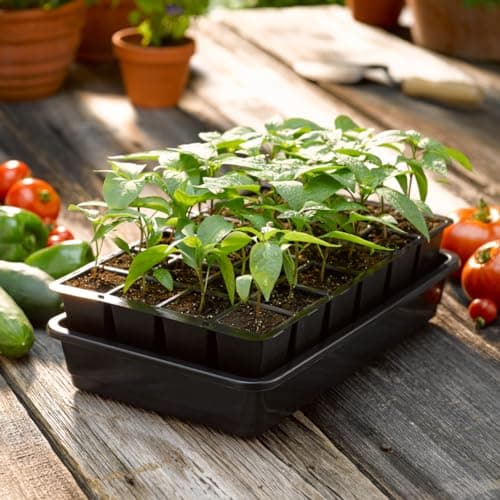 Gardener's Supply GrowEase Self-Watering Seed Starting Kit, 24-CellA first self-watering tray for greens, herbs, flowers and brassicas Gardener's Supply GrowEase Self-Watering Seed Starting Kit, 24-CellA first self-watering tray for greens, herbs, flowers and brassicas | Best overall, the only one that publishes the water | 8.8 | $29.99 - View on Amazon |
| 2 | 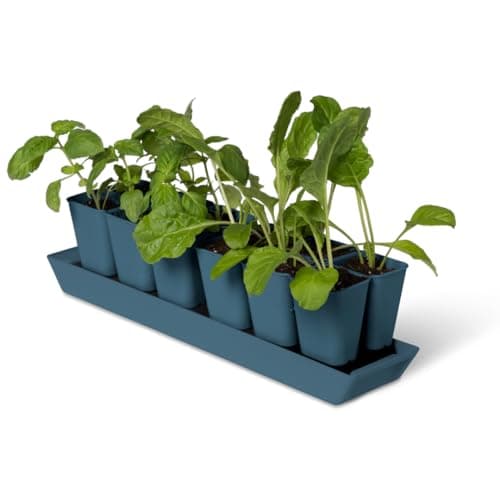 Gardener's Supply Gardener's Best XL Self-Watering Seed Starting KitA few tomatoes, peppers or squash you want to keep in the tray longer Gardener's Supply Gardener's Best XL Self-Watering Seed Starting KitA few tomatoes, peppers or squash you want to keep in the tray longer | Deepest cells, for a few big starts | 8.3 | $37.99 - View on Amazon |
| 3 | 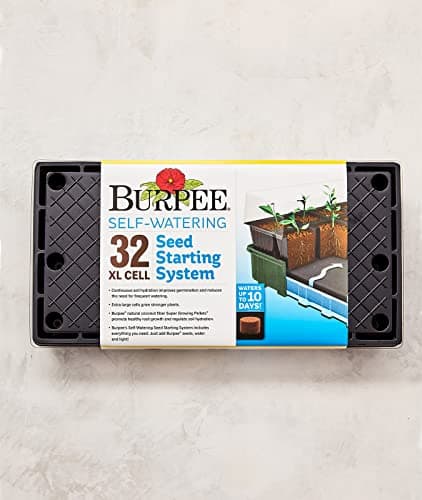 Burpee XL Self-Watering Growing System, 32 CellsThe most cell area for the money, on a standard shelf or heat mat Burpee XL Self-Watering Growing System, 32 CellsThe most cell area for the money, on a standard shelf or heat mat | Best value, largest cell area | 8.0 | $20.95 - View on Amazon |
| 4 | 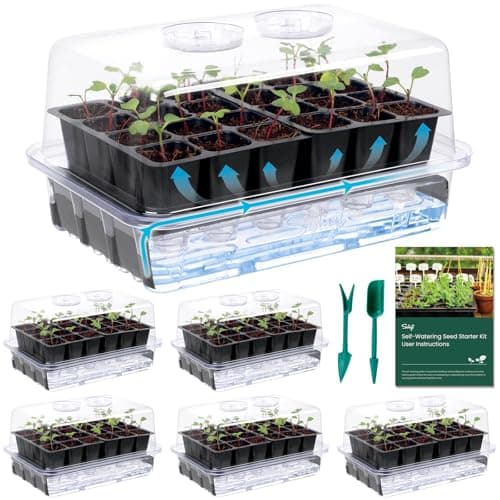 SOLIGT Self-Watering Seed Starter Trays with Humidity Domes, 6 Pack, 144 CellsSowing a lot at once and potting up as soon as true leaves appear SOLIGT Self-Watering Seed Starter Trays with Humidity Domes, 6 Pack, 144 CellsSowing a lot at once and potting up as soon as true leaves appear | Most cells, if you pot up early | 7.4 | $49.99 - View on Amazon |
| 5 | 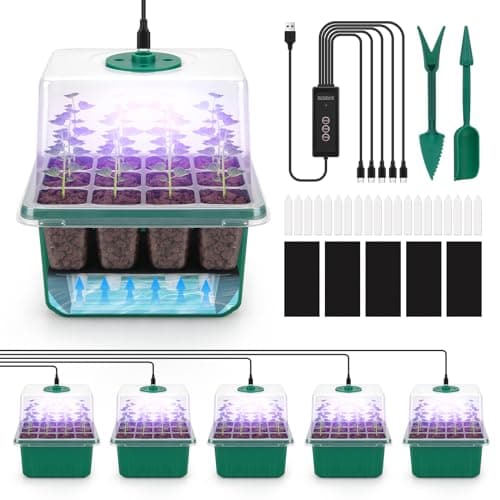 BlumWay Self-Watering Seed Starter Tray with Grow Light, 5 Pack, 60 CellsA windowsill starter where the light only supplements daylight BlumWay Self-Watering Seed Starter Tray with Grow Light, 5 Pack, 60 CellsA windowsill starter where the light only supplements daylight | Skip if the kit light is your only light | 6.2 | $19.99 - View on Amazon |
Scores are our editorial judgment from published specifications. They are not test results, and they are deliberately not marked up as ratings in this page’s structured data.
Pick #1 - Best overall, the only one that publishes the water
Gardener's Supply GrowEase Self-Watering Seed Starting Kit, 24-Cell
A first self-watering tray for greens, herbs, flowers and brassicas
The only seed starter we found whose maker publishes both how much water the reservoir holds and how much mix the cells hold: 10 cups under 3 quarts. That is the whole promise of a self-watering tray, put in numbers you can check, and the 2-inch cells land inside the size University of Maryland Extension recommends for lettuce, greens and brassicas.
#ad Price as of September 21, 2026, from Amazon. Prices change. How we make money.
Published specification
- Reservoir capacity
- 10 cups of water
- Mix capacity
- 3 quarts of seed starting mix
- Reservoir per cup of mix
- 0.83 cups (10 cups over 12 cups of mix)
- Cell size
- 2 in square x 2 1/4 in deep (4 sq in), 24 cells
- Overall footprint
- 14 3/4 x 9 1/4 in; germination dome 2 3/4 in high
- What is in the kit
- Reservoir, platform, 24-cell tray, reusable capillary mat, germination dome
- Material
- BPA-free recycled plastic; reservoir, platform and cell tray dishwasher-safe
- Reservoir capacity: Gardener's Supply published listing specification
- Mix capacity: Gardener's Supply published listing specification
- Reservoir per cup of mix: Our arithmetic: the two published figures above, divided
- Cell size: Gardener's Supply published listing specification
- Overall footprint: Gardener's Supply published listing specification
- What is in the kit: Gardener's Supply published listing specification
- Material: Gardener's Supply published description
Refill interval - computed, not tested
Not computed for seedlings, on purpose
Our refill interval multiplies a reservoir by the watering cadence Virginia Cooperative Extension publishes for container houseplants. None of the extension guidance we rely on publishes a watering cadence for seedlings on a capillary mat, and a tray's draw changes week by week as the seedlings grow, so a computed number would be invented. What we can check is the ratio: 10 cups of water under 12 cups of mix is 0.83 cups of reservoir per cup of mix.
Assumes: Seedlings from sowing to true leaves, which is outside the band we can defend. Light, temperature, humidity, soil mix and season all change how fast a pot dries, so treat this as a planning range and not a guarantee.
What is good about it
- Publishes reservoir capacity AND mix capacity, which no other tray here does
- 4 sq in cells sit inside University of Maryland Extension's recommended range for greens
- Leak-proof reservoir, platform, reusable capillary mat and dome all in the box
- Reservoir, platform and cell tray are dishwasher-safe, so they can be cleaned between sowings
What is not
- 24 cells is a small sowing - one tray will not start a whole vegetable garden
- 4 sq in is under half the 9 to 16 sq in UMD recommends for tomatoes, peppers and eggplant, so those need potting up
- The published dome height is 2 3/4 in against 3.9 in on the BlumWay, and UMN says a dome comes off once seedlings touch it
- Costs more per cell than the Burpee or the SOLIGT
Skip this one if
Skip it if you are starting dozens of tomatoes and peppers to grow on in the same cells. The cells are sized for greens and brassicas, and University of Maryland Extension's guidance is to move tomatoes, peppers and eggplant into larger containers 2 to 3 weeks after germination.
How it scored
- Published specs
- 10.0
- Cell size
- 7.0
- Moisture control
- 8.5
- Value for money
- 7.0
- Ease of setup
- 9.0
- Overall
- 8.8 / 10
Our editorial score, from published specifications and computed intervals. Not a test result. Specification source: Gardener's Supply GrowEase 24-cell retail listing.
Pick #2 - Deepest cells, for a few big starts
Gardener's Supply Gardener's Best XL Self-Watering Seed Starting Kit
A few tomatoes, peppers or squash you want to keep in the tray longer
The deepest published cells on this page at 3 1/4 inches, with air-pruning vents and a published 5-cup reservoir. It is built to hold a seedling longer before it has to move, and it charges for that: 12 cells in total, and the humidity domes are sold separately.
#ad Price as of September 21, 2026, from Amazon. Prices change. How we make money.
Published specification
- Reservoir capacity
- 5 cups of water
- Cell size
- 2 1/2 x 2 in x 3 1/4 in deep (5 sq in), 12 cells across 2 trays
- Mix capacity
- Not published
- Overall footprint
- 16 1/2 x 4 x 5 1/2 in
- What is in the kit
- 2 XL cell trays, reservoir, platform, capillary mat; humidity domes sold separately
- Cell design
- Vents for air pruning and a pop-out hole in the bottom of each cell
- Material
- Reusable, dishwasher-safe plastic
- Reservoir capacity: Gardener's Supply published listing specification
- Cell size: Gardener's Supply published listing specification
- Mix capacity: Checked on the Gardener's Supply listing
- Overall footprint: Gardener's Supply published listing specification
- What is in the kit: Gardener's Supply published listing specification
- Cell design: Gardener's Supply published description
- Material: Gardener's Supply published description
Refill interval - computed, not tested
Not computed for seedlings, on purpose
None of the extension guidance we rely on publishes a watering cadence for seedlings on a capillary mat, and a tray's draw changes week by week as the seedlings grow, so we do not run our refill arithmetic here. The reservoir figure itself is published - 5 cups - but the mix capacity is not, so unlike the 24-cell GrowEase there is no ratio to check either.
Assumes: Seedlings from sowing to transplant, which is outside the band we can defend. Light, temperature, humidity, soil mix and season all change how fast a pot dries, so treat this as a planning range and not a guarantee.
What is good about it
- Deepest published cells on this page, at 3 1/4 in
- Published reservoir capacity, from the same maker as our top pick
- Pop-out holes in each cell base to ease seedlings out, plus vents for air pruning
- Dishwasher-safe and reusable
What is not
- Only 12 cells, and by a distance the most expensive per cell here
- Humidity domes are sold separately, so germination needs an extra purchase or a cover of your own
- 5 sq in of cell area is still under UMD's 9 to 16 sq in for tomatoes, peppers and eggplant - depth is not area
- Mix capacity is not published, so the reservoir cannot be compared with the soil it feeds
Skip this one if
Skip it if you want to start more than a dozen plants, or if you are sowing lettuce and flowers. Those crops are well served by the smaller, cheaper cells elsewhere on this page, and here you would be paying a large premium per cell for depth.
How it scored
- Published specs
- 8.5
- Cell size
- 8.5
- Moisture control
- 8.5
- Value for money
- 5.0
- Ease of setup
- 7.5
- Overall
- 8.3 / 10
Our editorial score, from published specifications and computed intervals. Not a test result. Specification source: Gardener's Supply Gardener's Best XL seed starting kit retail listing.
Pick #3 - Best value, largest cell area
Burpee XL Self-Watering Growing System, 32 Cells
The most cell area for the money, on a standard shelf or heat mat
The largest published cell area on this page - 2 1/4 in square, just over 5 sq in - in a standard 10 x 20 in flat footprint, at a budget price. What Burpee does not publish is how much water the tray holds, so the self-watering half of the product is a description rather than a number.
#ad Price as of September 21, 2026, from Amazon. Prices change. How we make money.
Published specification
- Reservoir capacity
- Not published
- Cell size
- 2 1/4 x 2 1/4 in x 2 in deep (5.06 sq in), 32 cells across 2 trays
- Overall footprint
- 10 x 20 x 5 in
- What is in the kit
- Two 16-cell trays, 2 plant stands, self-watering mat, water tray, dome, 32 coir pellets
- Growing medium
- 32 compressed coconut coir pellets included
- Maker's note
- Recommended for use with a heat mat
- Reservoir capacity: Checked on the Burpee listing
- Cell size: Burpee published listing specification
- Overall footprint: Burpee published listing specification
- What is in the kit: Burpee published listing specification
- Growing medium: Burpee published description
- Maker's note: Burpee published description
Refill interval - computed, not tested
Not computed, and the reservoir is not published
Burpee describes a water tray and a self-watering mat but does not publish how much water the tray holds. Without that figure there is nothing to divide, and even with it, none of the extension guidance we rely on publishes a watering cadence for seedlings on a mat.
Assumes: Seedlings from sowing to transplant, which is outside the band we can defend. Light, temperature, humidity, soil mix and season all change how fast a pot dries, so treat this as a planning range and not a guarantee.
What is good about it
- Largest published cell area here, at 5.06 sq in per cell
- The standard 10 x 20 in flat size UMD describes, so it fits accessories made for flats
- Coir pellets included, so the first sowing needs nothing else
- Budget price for 32 cells of this size
What is not
- Reservoir capacity is not published, so the self-watering claim cannot be checked
- The listing calls the cells ideal for tomatoes and peppers; at 5.06 sq in they are only a little over half UMD's 9 sq in minimum for those crops
- 2 in deep is exactly UMD's minimum container depth for seed starting, not a deep cell
- 32 pellets for 32 cells, so a second sowing needs more pellets or loose mix
Skip this one if
Skip it if a published reservoir figure matters to you. It is the best value on this page per square inch of cell, but it asks you to trust the water tray rather than showing you what it holds.
How it scored
- Published specs
- 6.0
- Cell size
- 8.0
- Moisture control
- 7.0
- Value for money
- 9.0
- Ease of setup
- 8.5
- Overall
- 8.0 / 10
Our editorial score, from published specifications and computed intervals. Not a test result. Specification source: Burpee XL Self-Watering Growing System retail listing.
Pick #4 - Most cells, if you pot up early
SOLIGT Self-Watering Seed Starter Trays with Humidity Domes, 6 Pack, 144 Cells
Sowing a lot at once and potting up as soon as true leaves appear
The most cells on this page and the only maker that tells you how deep to fill the reservoir - about 3/4 inch. The catch is cell size: 1 1/2 in square is 2.25 sq in, below the smallest range University of Maryland Extension recommends for any crop, so this is a germination station you pot up from, not a tray you grow on in.
#ad Price as of September 21, 2026, from Amazon. Prices change. How we make money.
Published specification
- Reservoir capacity
- Not published; fill to about 3/4 in deep
- Cell size
- 1 1/2 x 1 1/2 in x 2.17 in deep (2.25 sq in), 144 cells
- Pack layout
- 6 units, each with a clear base tray, dome, 2 x 12-cell trays, 2 stands and a capillary mat
- Unit footprint
- 11.9 x 8.2 x 4.25 in
- Dome
- Adjustable vents
- Maker's setup note
- One side of the capillary mat must touch the bottom of the reservoir
- Reservoir capacity: SOLIGT published listing instructions
- Cell size: SOLIGT published listing specification
- Pack layout: SOLIGT published listing specification
- Unit footprint: SOLIGT published listing specification
- Dome: SOLIGT published description
- Maker's setup note: SOLIGT published listing instructions
Refill interval - computed, not tested
Not computed for seedlings, on purpose
SOLIGT publishes a fill depth rather than a volume, which is genuinely useful for setup but cannot be divided by anything. None of the extension guidance we rely on publishes a watering cadence for seedlings on a capillary mat, so we would not compute an interval even with a volume.
Assumes: Seedlings from sowing to true leaves, which is outside the band we can defend. Light, temperature, humidity, soil mix and season all change how fast a pot dries, so treat this as a planning range and not a guarantee.
What is good about it
- 144 cells, the most here, and the cheapest per cell alongside the BlumWay
- The only maker here that publishes how deep to fill the reservoir
- Clear base tray, so the water level is visible without lifting anything
- Six separate units let you run different crops on different schedules
What is not
- 2.25 sq in cells are below UMD's smallest recommended range (3 to 6 sq in, for greens), so every crop needs potting up early
- Reservoir volume is not published, only a fill depth
- Six domes, six reservoirs and twelve cell trays to fill, check and wash
- The highest total price on this page, because you are buying six kits
Skip this one if
Skip it if you want to sow once and transplant straight to the garden. The cells are too small to hold anything past its first true leaves, which UMD and Clemson both give as the time to move a seedling on - fine if you plan for it, a problem if you do not.
How it scored
- Published specs
- 7.0
- Cell size
- 4.0
- Moisture control
- 8.0
- Value for money
- 7.5
- Ease of setup
- 6.5
- Overall
- 7.4 / 10
Our editorial score, from published specifications and computed intervals. Not a test result. Specification source: SOLIGT 6 pack 144-cell self-watering seed starter retail listing.
Pick #5 - Skip if the kit light is your only light
BlumWay Self-Watering Seed Starter Tray with Grow Light, 5 Pack, 60 Cells
A windowsill starter where the light only supplements daylight
The cheapest way on this page to get a light with your tray, and the light is the problem. Its longest timer setting is 12 hours - the bottom of the 12 to 16 hours University of Minnesota Extension gives, and short of the 14 to 16 University of Maryland recommends and the 16 to 18 Clemson recommends - and BlumWay publishes no light output figure at all.
#ad Price as of September 21, 2026, from Amazon. Prices change. How we make money.
Published specification
- Reservoir capacity
- Not published
- Cell size
- 1.97 in deep; cell width not published; 60 cells across 5 trays
- Grow light
- 40 LED beads (8 per tray), red, blue and white
- Light controls
- 5 brightness levels (20 to 100%); timer settings of 3, 6 or 12 hours
- Light output
- Not published
- Dome
- 3.9 in high, adjustable vents
- Material
- ABS plastic, clear trays
- Reservoir capacity: Checked on the BlumWay listing
- Cell size: BlumWay published listing specification
- Grow light: BlumWay published listing specification
- Light controls: BlumWay published listing specification
- Light output: Checked on the BlumWay listing
- Dome: BlumWay published listing specification
- Material: BlumWay published description
Refill interval - computed, not tested
Not computed, and the reservoir is not published
The listing says one watering is enough to take seeds from germination to strong seedlings, but publishes no reservoir volume to support it. There is nothing to divide, and none of the extension guidance we rely on publishes a watering cadence for seedlings on a mat.
Assumes: Seedlings from sowing to true leaves, which is outside the band we can defend. Light, temperature, humidity, soil mix and season all change how fast a pot dries, so treat this as a planning range and not a guarantee.
What is good about it
- A grow light and timer included at a budget price
- Five separate small trays rather than one full flat
- 3.9 in dome gives seedlings room before it has to come off
- Clear trays show roots and moisture at a glance
What is not
- Longest timer setting is 12 hours: the floor of UMN's 12 to 16 hour range, and short of UMD's 14 to 16 and Clemson's 16 to 18
- No light output figure published, so there is no way to judge whether 8 LEDs per tray is enough
- Cell width not published, and 1.97 in deep is a hair under UMD's 2 in minimum container depth
- The one-watering claim comes with no published reservoir volume behind it
Skip this one if
Skip it if the kit's light is the only light your seedlings will get. Twelve hours from an unrated light is the minimum of one extension range and below two others, and seedlings short of light stretch toward it - Clemson's word for the result is leggy.
How it scored
- Published specs
- 4.0
- Cell size
- 5.0
- Moisture control
- 6.0
- Value for money
- 8.0
- Ease of setup
- 7.0
- Overall
- 6.2 / 10
Our editorial score, from published specifications and computed intervals. Not a test result. Specification source: BlumWay 5 pack self-watering seed starter with grow light retail listing.
Questions people actually ask
- Do self-watering seed trays cause damping-off?
They can make it more likely if the mix is kept too wet. University of Maryland Extension names water molds - Pythium, Phytophthora and Rhizoctonia - as the cause of damping-off in seedlings grown in overly wet mix. Fill the reservoir only to the maker’s line, take the dome off once seedlings have germinated or touch it, and use a soilless seed-starting mix, which Clemson Extension notes reduces soil-borne disease.
- How long can a self-watering seed tray go without refilling?
We will not give a number, because there is no defensible one. None of the extension guidance we rely on publishes a watering cadence for seedlings on a capillary mat, and a tray’s draw rises sharply as seedlings grow. Only Gardener’s Supply publishes a reservoir capacity - 10 cups on the 24-cell GrowEase - and even that is best treated as a buffer you check daily.
- What size seed starting cells do tomatoes need?
University of Maryland Extension recommends 9 to 16 square inches for tomato, eggplant and pepper. None of the self-watering kits we found reaches that; the largest published cell is about 5 square inches. UMD says those crops are often started singly and moved into larger containers 2 to 3 weeks after germination, so a smaller cell works if you plan to pot up.
- When should you take the dome off a seed tray?
Clemson Extension says to keep the dome on until all the seeds have germinated. University of Minnesota Extension says to remove it once seedlings are tall enough to touch it. Both treat the dome as a germination tool, not something to grow seedlings under.
- Can you bottom water seedlings without a self-watering tray?
Yes. Clemson Extension’s method is to fill a container or lid with 1 to 2 inches of water, stand the seedling tray in it for 3 to 10 minutes, then put it back under the lights. A capillary mat in a flat without holes does the same job continuously.
Sources
Sources
- Traunfeld, Starting Vegetable Seeds Indoors, University of Maryland Extension (2026)
- Starting seeds indoors, University of Minnesota Extension (reviewed 2026)
- Polomski and Shaughnessy, Starting Seeds Indoors, Clemson Cooperative Extension HGIC 1259 (revised 2020)
- Plants Grown in Containers, NC State Extension Gardener Handbook chapter 18
- Gardener's Supply GrowEase 24-cell seed starting kit published specification, via retail listing
- Gardener's Supply Gardener's Best XL seed starting kit published specification, via retail listing
- Burpee XL Self-Watering Growing System published specification, via retail listing
- SOLIGT self-watering seed starter trays published specification and fill instructions, via retail listing
- BlumWay self-watering seed starter tray with grow light published specification, via retail listing
- Criscione and Holliday-Goulart, Properly Watering Container Houseplants, Virginia Cooperative Extension SPES-804 (2026)