Head to head
Wicking Pots vs Sub-Irrigated Reservoir Pots
Both get called self-watering. They move water in different ways, fail in different ways, and suit different pots.
By Scooter M. - Enthusiast. Reads the manuals, compiles the specs, does the math. | Published
Disclosure
We earn a commission if you buy through our links. It does not change what we recommend or what you pay. Full disclosure.
The short answer
What each one actually does
Wicking. A physical wick bridges the reservoir and the soil. Water climbs the wick by capillary action and moves into the mix where the mix is drier than the wick. The reservoir and the root zone are physically separated, so there is no route for roots to grow down into standing water. The rate is limited by the wick, which is a feature: it is nearly impossible to over-supply a plant this way.
Sub-irrigation. The media sits on a perforated platform, or on a layer of inert granulate, directly above the water. Capillary rise happens through the media itself. This moves considerably more water than a wick, which is why the large edible boxes all use it, and it depends entirely on the mix being open enough to wick.
| Wicking | Sub-irrigation | |
|---|---|---|
| Water delivery rate | Limited by the wick | Higher, limited by the mix |
| Suits | Small and medium houseplants | Large plants and edible crops |
| Clogging risk | Real. Wicks mineralize and root in | Lower, but the mix compacts |
| If the mix is dense | Still works, slowly | Stops working entirely |
| Risk of roots in water | Very low, physically separated | Real if the air gap is lost |
| Silent failure | Wick stops, reservoir stays full | Mix compacts, reservoir stays full |
| Typical products | Inserts, conversion kits, small pots | EarthBox, Lechuza, large planters |
How to tell which one you bought
Lift the plant out, or look down the fill tube. If you can see a rope, a felt tail or a fabric tab hanging into the water, it is a wick. If you see a perforated plastic platform, an aeration screen or a layer of coarse mineral granulate sitting directly over the reservoir, it is sub-irrigation. Some designs use both - a granulate layer with a wick to start the column - and those behave like sub-irrigation once running.
Which fails, and how you would know
Both fail silently, which is the genuine argument against this whole category and one nobody makes. A wick that has mineralized in hard water or been colonized by fine roots stops moving water while the reservoir stays visibly full. A compacted mix in a sub-irrigated box does the same. In both cases the water-level indicator says everything is fine and the plant is drying out.
The practical defense is to check the soil, not the gauge. Push a finger or a probe into the upper half of the mix once a month. If the reservoir is full and the mix is dry, the transport path has failed - lift the plant, rinse the wick or loosen the mix, and prime it again from the top.
Which to choose
For a houseplant on a shelf, a wick is more forgiving and harder to get wrong. For anything with real water demand - a floor plant, a tomato box - the wick becomes the bottleneck and sub-irrigation is the right mechanism. And if your mix is heavy, or you are inclined to use garden soil, choose the wick, because sub-irrigation simply will not work with it.
Either way, the mechanism matters less than the reservoir size. The published-capacity table is a better basis for a decision than the plumbing, and the full mechanism explainer covers the physics if you want it.
Ceramic adds a third mechanism to these two - a porous clay wall that draws water through itself - and it is the one case where the plumbing genuinely decides the purchase, because no ceramic maker publishes a reservoir capacity to compare instead.
What we would buy for this
The gear that fits this problem
Chosen from the same registry as our roundups, on published specifications and the computed refill interval.
Lechuza Classico Color 21
A desk or shelf plant you want to stop thinking about
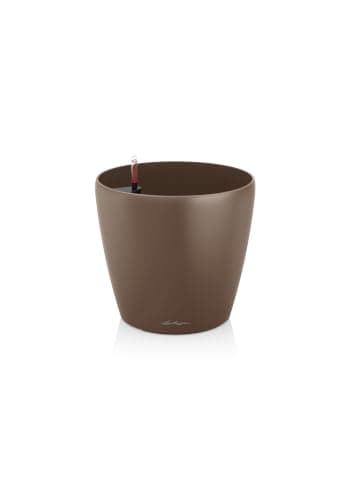
The only planter in this roundup whose maker publishes the reservoir capacity in liters, which is the single number that decides how long you can leave it. Five liters against a 6-inch tropical root ball is the longest computed interval on this page by a wide margin.
#ad Price as of October 18, 2026, from Amazon. Prices change. How we make money.
Published specification
- Reservoir capacity
- 5 liters
- External dimensions
- 9 x 9 x 8 in (21 x 21 x 20 cm)
- Water level indicator
- Yes, float gauge
- Drainage plug
- Yes, for outdoor use
- Material
- Frost and UV resistant polypropylene
- Reservoir capacity: Lechuza published specification, via retail listing
- External dimensions: Lechuza published specification, via retail listing
- Water level indicator: Lechuza published specification
- Drainage plug: Lechuza published specification
- Material: Lechuza published specification
Refill interval - computed, not tested
Roughly 7 to 14 weeks between refills
5,000 ml reservoir divided by 350 ml per thorough watering of a 6-inch pot is 14.3 waterings. At the published cadence for a tropical houseplant of once or twice a week, that is 49 to 98 days.
Assumes: 6-inch tropical root ball, indoors, average room conditions. Light, temperature, humidity, soil mix and season all change how fast a pot dries, so treat this as a planning range and not a guarantee.
What is good about it
- Publishes the reservoir capacity, which almost nothing else in this category does
- The float gauge means you never have to guess whether it needs topping up
- The drainage plug lets the same planter work outdoors without drowning the plant in a wet week
- Sub-irrigation from a granulate layer rather than a wick, so there is no wick to rot or clog
What is not
- Expensive for a 9-inch pot, and the price is most of the argument against it
- The system is built around Lechuza's own mineral granulate, so you are buying into a way of potting, not just a pot
- A 5-liter reservoir under an 8-inch or larger plant is a much shorter interval than the headline suggests
Skip this one if
Skip it if you want one pot to cover a large floor plant. The reservoir is sized for a small-to-medium root ball, and the interval collapses as the plant gets bigger. Skip it too if you like repotting into ordinary potting mix, because the granulate layer is part of the design.
How it scored
- Published capacity
- 10.0
- Computed interval
- 9.5
- Build and materials
- 9.0
- Value for money
- 6.5
- Ease of setup
- 8.5
- Overall
- 8.8 / 10
Our editorial score, from published specifications and computed intervals. Not a test result. Specification source: Lechuza Classico Color 21 retail listing.
GroBucket GroBuddy Self-Watering Pot Insert
A medium floor plant in a pot deep enough to hide the insert

A one-gallon reservoir with a refill indicator, dropped into a pot you already own. The published gallon figure is the reason it makes this list ahead of the unlabeled inserts sitting next to it in the search results.
#ad We do not currently hold a live price for this, so we do not show one. How we make money.
Published specification
- Reservoir capacity
- 1 gallon (about 3.8 liters)
- Refill indicator
- Yes
- Watering method
- Below-soil reservoir with wicking to the root zone
- Reservoir capacity: GroBucket published specification, via retail listing
- Refill indicator: GroBucket published description
- Watering method: GroBucket published description
Refill interval - computed, not tested
About 2.5 to 5 weeks
3,785 ml divided by 800 ml per thorough watering of an 8-inch pot is 4.7 waterings. At once or twice a week, that is 17 to 35 days.
Assumes: 8-inch tropical root ball, indoors. Light, temperature, humidity, soil mix and season all change how fast a pot dries, so treat this as a planning range and not a guarantee.
What is good about it
- A published gallon of reservoir is genuinely large for an insert
- The refill indicator removes the guesswork that sinks most conversion kits
- Cheaper than replacing a pot you already like
What is not
- Needs real depth to disappear. In a shallow pot the insert eats the root zone
- One fixed size, so it fits the pots it fits
Skip this one if
Skip it if your pot is under about 10 inches deep. The insert takes up the bottom of the container, and in a shallow pot you are trading root room for reservoir at a bad exchange rate.
How it scored
- Published capacity
- 9.0
- Computed interval
- 8.5
- Flexibility
- 6.5
- Value for money
- 8.5
- Ease of setup
- 8.0
- Overall
- 8.1 / 10
Our editorial score, from published specifications and computed intervals. Not a test result. Specification source: GroBuddy insert retail listing.
Questions people actually ask
- Is a wicking pot the same as a self-watering pot?
It is one kind of self-watering pot. The other kind is sub-irrigation, where the growing media sits directly above the reservoir on a perforated platform. Both are sold under the same label and they behave differently.
- Which is better for a large plant?
Sub-irrigation. A wick has a limited delivery rate, and a large plant will out-drink it. That is why every large edible box on the market uses direct capillary rise rather than a rope.
- My reservoir is full but the soil is dry. What happened?
The transport path has failed. On a wicking system the wick has probably mineralized or rooted in. On a sub-irrigated one the mix has compacted or is too dense to wick. Lift the plant, clean or replace the wick, loosen the mix, and prime it by watering thoroughly from the top once.
- Can I make a wicking pot myself?
Yes, and people do - a cotton or nylon rope through a drainage hole into a reservoir below works. It is genuinely functional. What it lacks is a controlled air gap and an overflow, so it needs a bit more attention than a designed system.
Sources
Sources
- Plants Grown in Containers, NC State Extension Gardener Handbook chapter 18
- Criscione and Holliday-Goulart, Properly Watering Container Houseplants, Virginia Cooperative Extension SPES-804 (2026)
- Leaching Fraction: A Tool to Schedule Irrigation for Container-Grown Plants, Virginia Cooperative Extension SPES-128