Roundup
Best Self-Watering Ceramic Pots and Planters
Every pot on this page is sold on a water reservoir, and not one maker says how much water it holds. So we ranked them on the things a listing does tell you - and on whether you can see the level at all.
By Scooter M. - Enthusiast. Reads the manuals, compiles the specs, does the math. | Published
Disclosure
We earn a commission if you buy through our links. It does not change what we recommend or what you pay. Full disclosure.
The short answer
The number nobody in ceramic prints
This site ranks self-watering pots on published reservoir capacity, because that is the figure that decides how long you can leave one alone. The method is here. Plastic brands mostly play along: Lechuza publishes capacity for every size in its range, EarthBox publishes it, and the numbers can be checked against each other.
Ceramic does not. We went through every ceramic and terracotta self-watering pot we could find in stock - fifty-one distinct listings across ten catalog searches - and not one published a reservoir volume in milliliters, ounces or cups. What they publish instead falls into three groups: pot dimensions, which are not a capacity; saucer dimensions, which are closer but still not one, because the pot stands in the saucer and displaces an unpublished part of it; and duration claims in days, which depend on the plant rather than the pot.
That is not a reason to avoid ceramic. It is a reason to rank ceramic on different evidence, which is what this page does.
How we ranked them
We have not tested these pots. There is no bench here, no timed drawdown and no unit on a shelf. What follows is each maker’s published listing, our judgment about the mechanism, and the horticultural sources we cite everywhere else.
Can you see the water level? This is first precisely because capacity is unpublished. A reservoir you can see is a reservoir you can manage; an opaque glazed saucer means lifting the pot or poking a finger in to find out. Exactly one pot here has a transparent reservoir.
How does the water actually move? Three mechanisms turn up in ceramic, and they behave differently. The wicking-versus-reservoir distinction matters more here than the marketing does.
Can you flush it? Fertilizer salts build up in any container that is watered from below, and the standard fix is to water generously from the top so a fraction drains away - the leaching fraction Virginia Cooperative Extension publishes guidance on. A pot with no drainage hole cannot do that at all.
What size is it really? Most self-watering ceramic stops at 6 inches. If your plant needs 8, the field narrows fast.
Price last, and only against what the listing actually tells you.
| Pot | Reservoir you can see | Mechanism | Drainage hole | Published size figure |
|---|---|---|---|---|
| D'vine Dev terracotta 6 in | Yes, clear glass | Porous clay wall | No | 6.2 in dia x 5.9 in pot |
| Nihow ceramic 6 in | No, glazed saucer | Cotton wick | Two, with plugs | Saucer 6 x 2.5 in |
| Chubacoo ceramic 8 in | No, glazed saucer | Absorbent upper pot | Yes | 8 x 8 x 8 in |
| Nihow ceramic 4.5 in | No, glazed saucer | Cotton wick | Two, with plugs | Saucer 4.5 x 1.75 in |
| Teagas ceramic 8 in | No, glazed outer pot | Absorbent clay inner pot | Not published | Outer 8.1 x 6.7 in |
The three mechanisms, and which one to want
Porous clay wall. The plant sits in unglazed terracotta, the terracotta sits in water, and water moves through the clay into the mix as the mix dries. This is the same physics as a buried olla and as the ceramic cone on a Blumat: it is demand-driven, so it slows down when the soil is already wet. It is the best mechanism on this page and the one with the worst side effect, because the pots built this way have no drainage hole.
Cotton wick. A piece of rope runs from the mix, through a drainage hole, into a saucer. It is the cheapest arrangement, it keeps the pot a normal pot with normal drainage, and its weakness is contact: the wick has to stay buried in the mix at one end and under water at the other. Wicks also work best over short lifts, which is why the saucer sits directly underneath.
Absorbent inner pot. An unglazed clay inner pot stands inside a glazed outer pot holding the water - the African violet design, which we cover in detail for violets. Mechanically it is the porous-wall method with the water on the outside, and it scales up to 8 inches on two of the pots here.
Unglazed clay breathes, glazed clay does not
The difference between terracotta and a glazed finish is not decoration; it changes how the pot handles water. NC State Extension’s container chapter puts it plainly: porous and semi-porous containers lose moisture more quickly and need watering more often than nonporous ones.
In an ordinary pot that is a drawback. In a self-watering pot it is the working principle - the same porosity that dries a terracotta pot out on a windowsill is what lets it draw water in from a reservoir. It also means an unglazed pot loses water through its exposed sides to the room, so some of what you pour in leaves without ever reaching the plant.
The drainage hole is the real trade-off
Every pot here does one of two things well and the other badly.
A sealed terracotta pot in a glass cup gives you the best delivery mechanism and a visible water level, and it takes away your ability to flush. Salts from tap water and fertilizer concentrate in the mix, and Virginia Cooperative Extension’s leaching-fraction guidance is built on applying enough water that some drains away and carries them out. With no hole, that option is gone, and the practical answer is to repot into fresh mix rather than to keep correcting the old mix.
A wicking pot with two drainage holes keeps that option open. Once or twice a season you take it off the saucer, water it heavily in the sink until it runs out of the bottom, let it drain, and put it back. That is a real, checkable advantage, and it is the reason the Nihow ranks directly behind a pot with a better mechanism.
The same argument runs through our page on root rot in self-watering pots: the danger is not the reservoir, it is a root zone that never gets to dry or drain.
What the duration claims are worth
Two makers on this page put a number of days on the listing. Chubacoo says the soil stays moist for up to 5 to 8 days; elsewhere in its range the 6-inch version says 4 to 7. Neither figure comes with a capacity, a plant size, a light level or a season.
Compare that with how the rest of this site handles the same question. Where a maker publishes a reservoir - Lechuza, EarthBox, the Gardener’s Supply beds - we divide that volume by the volume of one thorough watering for the pot size and multiply by the cadence Virginia Cooperative Extension publishes for container houseplants. The result is arithmetic you can check line by line. A bare “5 to 8 days” is not that, and we do not repeat it on the product card as though it were a specification.
What you can rely on is the direction of travel. A 4.5-inch saucer holds less than a 6-inch one. A pot in a bright window in July empties its reservoir faster than the same pot in February. NC State Extension’s container guidance is blunt about the first point: larger containers do not dry out as quickly and need watering less often.
Setting one up so it does not rot the plant
Use a light potting mix, never garden soil. Every mechanism here depends on capillary rise, and a dense soil-based mix does not wick. The failure looks like the pot not working - full reservoir, dry root zone - and it is actually the mix. A peat or coir based mix with perlite in it is what these pots are designed around, and NC State Extension’s container chapter explains why the components matter.
Do not keep the reservoir permanently topped up. This is the single most common way to kill a plant in a self-watering pot, and it is the same warning we give on the African violet page: a reservoir that is never allowed to empty keeps the mix saturated, and saturated mix is the wet, poorly drained condition that root-rot organisms need. Let it run down, let the mix breathe for a day, then refill.
Check the wick, if it has one. A cotton wick has to be buried in the mix at the top and sitting in water at the bottom. When one of those two things stops being true - the wick shifts during repotting, or the saucer runs dry and the wick dries out - delivery stops without any visible sign until the plant wilts.
Flush it if you can. On any pot with drainage holes, take it to the sink once or twice a season and water it from the top until water runs freely out of the bottom. That is the leaching fraction Virginia Cooperative Extension describes, and it carries out the fertilizer and tap-water salts that bottom watering leaves behind.
What to plant in one
A ceramic self-watering pot suits the same plants a reservoir pot always suits: the ones that hate drying out. Peace lilies, ferns, calathea, fittonia, pothos and most herbs are all good candidates, and our list of plants that belong in self-watering pots goes through the reasoning.
Succulents, cacti, snake plants and ZZ plants are the ones to keep out, whatever the pot is made of. They store water in their own tissue and need the mix to dry between waterings, and a wick that never stops delivering is the classic way to rot them.
African violets are the exception that gets its own page, because the two-piece absorbent-pot design was built for them and because their fuzzy leaves dislike being wetted from above. The violet pots are ranked separately.
Ceramic or plastic?
Plastic wins on information and loses on looks. If you want a published reservoir capacity and a computed refill interval, you are buying plastic - that is where Lechuza and the other transparent brands are, and our indoor roundup ranks them on the number.
Ceramic wins on weight and on the room. A heavy pot does not tip when a tall plant leans, glazed ceramic does not go brittle in sunlight the way cheap plastic can, and most people buying a pot for a living room are buying an object they have to look at every day. That is a legitimate reason to accept less information - as long as it is the reason, rather than a duration claim you believed.
The honest cons on every pick
D’vine Dev terracotta 6 in. No drainage hole, so no flushing. No published capacity. Six inches is small, and the 2-pack is two of the same size. Handcrafted, so the maker says sizes vary.
Nihow 6 in. No published capacity, an opaque saucer, and a 2.5-inch-deep saucer is a modest buffer. Wick delivery depends on contact at both ends.
Chubacoo 8 in. Publishes a duration and not a capacity, which is the wrong way round. Opaque on both halves. Heavy to lift for a refill.
Nihow 4.5 in. The smallest reservoir here by published saucer size, and identical in design to the 6-inch, so there is no reason to own both.
Teagas 8 in. The most expensive pot on the page with the least checkable specification, and its own two published widths contradict each other - the inner pot is listed at 8.3 inches inside an outer pot listed at 8.1.
What we would buy
The D’vine Dev for a desk plant, because seeing the water is worth more than any unverifiable day count, and the 6-inch Nihow for anything you intend to keep for years and will want to flush. The Chubacoo if the plant needs 8 inches and you accept that the 5 to 8 days is a marketing figure.
And if what you actually want is a number you can check before you buy, the plastic reservoir pots publish their capacities and this category does not. That is the trade you are making.
Ranked picks
Quick picks
Ranked on published specifications and the computed refill interval, not on looks. Tap any row for the full write-up, including who should skip it.
| # | Product | Best for | Score | Price |
|---|---|---|---|---|
| 1 | 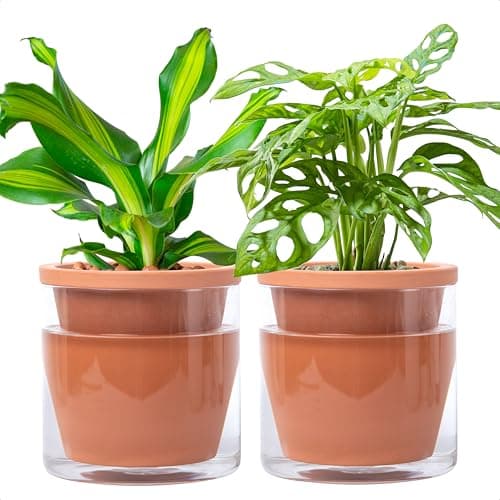 D'vine Dev Self-Watering Terracotta Planter Pot, 6 in, 2-PackA small plant on a desk where you want to see the water going down D'vine Dev Self-Watering Terracotta Planter Pot, 6 in, 2-PackA small plant on a desk where you want to see the water going down | Best overall, and the only visible water level | 8.6 | $38.99 - View on Amazon |
| 2 | 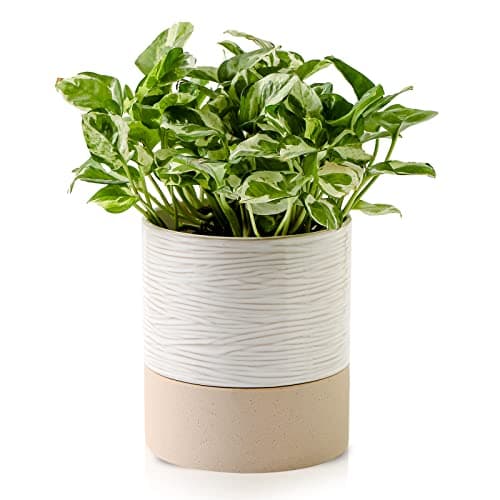 Nihow Ceramic Self-Watering Plant Pot, 6 inA 6-inch houseplant you want to keep evenly moist and still be able to flush Nihow Ceramic Self-Watering Plant Pot, 6 inA 6-inch houseplant you want to keep evenly moist and still be able to flush | Best glazed pot you can still flush | 8.2 | $26.99 - View on Amazon |
| 3 | 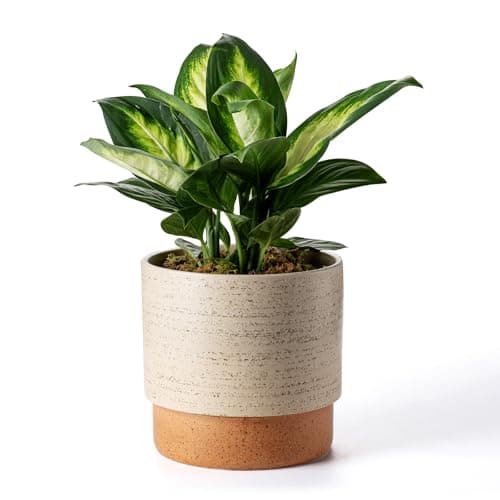 Chubacoo Ceramic Self-Watering Planter, 8 inA pothos, peace lily or fern that has outgrown a 6-inch pot Chubacoo Ceramic Self-Watering Planter, 8 inA pothos, peace lily or fern that has outgrown a 6-inch pot | Best for a bigger plant | 7.6 | $39.99 - View on Amazon |
| 4 | 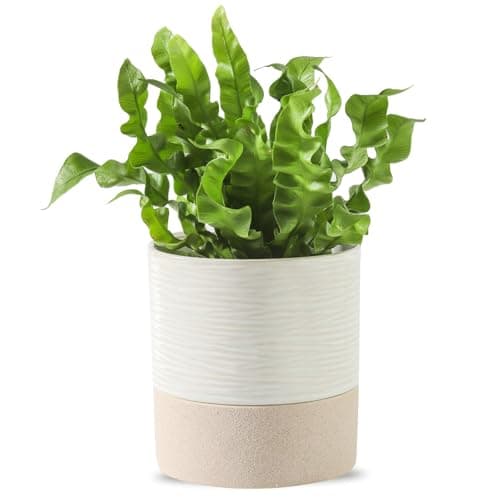 Nihow Ceramic Self-Watering Plant Pot, 4.5 inA single small plant, a windowsill herb or a cutting that has rooted Nihow Ceramic Self-Watering Plant Pot, 4.5 inA single small plant, a windowsill herb or a cutting that has rooted | Best small pot | 7.3 | $18.99 - View on Amazon |
| 5 | 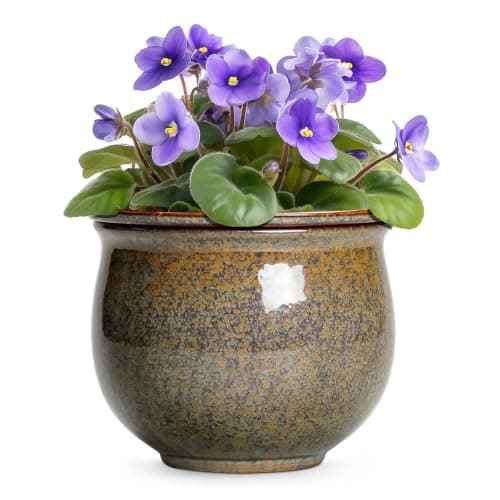 Teagas Ceramic Self-Watering Pot, 8 inSomeone buying the two-piece violet design in a larger, decorative size Teagas Ceramic Self-Watering Pot, 8 inSomeone buying the two-piece violet design in a larger, decorative size | Skip unless the glaze is the point | 6.3 | $49.99 - View on Amazon |
Scores are our editorial judgment from published specifications. They are not test results, and they are deliberately not marked up as ratings in this page’s structured data.
Pick #1 - Best overall, and the only visible water level
D'vine Dev Self-Watering Terracotta Planter Pot, 6 in, 2-Pack
A small plant on a desk where you want to see the water going down
The only pot on this page where you can see how much water is left, because the reservoir is a clear glass cup rather than an opaque ceramic saucer. The delivery mechanism is the one this site already trusts elsewhere: unglazed clay, which moves water through its wall as the mix dries rather than pushing a fixed amount at it.
#ad Price as of September 21, 2026, from Amazon. Prices change. How we make money.
Published specification
- Reservoir capacity
- Not published
- How it delivers
- Porous terracotta wall draws from a glass reservoir; no drainage hole
- Fill instruction
- Fill the glass container so the water covers half of the pot
- Pot dimensions
- 6.2 in diameter x 5.9 in high; 6.2 in overall height with the glass
- What is in the box
- Two terracotta pots and two clear glass cups
- Finish
- Handcrafted terracotta, published as varying slightly in size
- Reservoir capacity: Checked on the D'vine Dev listing
- How it delivers: D'vine Dev published description
- Fill instruction: D'vine Dev published description
- Pot dimensions: D'vine Dev published listing specification
- What is in the box: D'vine Dev published listing specification
- Finish: D'vine Dev published description
Refill interval - computed, not tested
Not computed - no published capacity
Our refill interval divides a published reservoir by the volume of one thorough watering. D'vine Dev publishes a fill instruction (water covering half the pot) but no volume, and the glass cup is not sold as a measured reservoir. With no number to divide, there is nothing to compute - which is exactly why the visible water line matters here.
Assumes: None - the input figure does not exist. Light, temperature, humidity, soil mix and season all change how fast a pot dries, so treat this as a planning range and not a guarantee.
What is good about it
- A clear glass reservoir, so the water level is visible instead of guessed
- Unglazed clay delivers on demand as the mix dries, the same principle as an olla or a ceramic cone
- A published fill instruction, which most of this category does not give either
- Two pots in the box
What is not
- No published reservoir capacity, so no duration claim can be checked
- No drainage hole, so you cannot water through the pot to flush accumulated salts
- Six inches is a small pot, and the 2-pack is two of the same size
- Handcrafted, so the maker publishes that sizes vary slightly
Skip this one if
Skip it if the plant is big enough to need an 8-inch pot, or if you fertilize heavily. Without a drainage hole there is no way to leach salts out of the mix, and Virginia Cooperative Extension's leaching guidance assumes water can run through and out.
How it scored
- Published detail
- 7.0
- Water level visible
- 10.0
- Delivery mechanism
- 9.0
- Flushing and drainage
- 4.0
- Value for money
- 8.0
- Overall
- 8.6 / 10
Our editorial score, from published specifications and computed intervals. Not a test result. Specification source: D'vine Dev 6-inch self-watering terracotta pot retail listing.
Pick #2 - Best glazed pot you can still flush
Nihow Ceramic Self-Watering Plant Pot, 6 in
A 6-inch houseplant you want to keep evenly moist and still be able to flush
A conventional glazed ceramic pot with two drainage holes, a cotton wick and a deep saucer to wick from. It is the only pick here that publishes the saucer dimensions, and the drainage holes mean you can still top-water it to flush salts - the thing the sealed terracotta pots cannot do.
#ad Price as of September 21, 2026, from Amazon. Prices change. How we make money.
Published specification
- Reservoir capacity
- Not published
- How it delivers
- Cotton wick through two drainage holes into the saucer below
- Saucer size
- 6 x 2.5 in
- Pot dimensions
- 6.1 x 6.1 x 6.9 in
- Drainage
- Two holes, with rubber plugs and a mesh screen included
- Weight
- 4.4 lb empty
- Reservoir capacity: Checked on the Nihow listing
- How it delivers: Nihow published description
- Saucer size: Nihow published listing specification
- Pot dimensions: Nihow published listing dimensions
- Drainage: Nihow published description
- Weight: Nihow published listing dimensions
Refill interval - computed, not tested
Not computed - no published capacity
Nihow publishes a saucer measuring 6 x 2.5 in, which is the closest thing to a capacity figure anywhere in this category. We will not turn it into one: the pot stands in that saucer and displaces an unpublished part of it, so any volume we calculated would be a guess dressed as arithmetic.
Assumes: None - the input figure does not exist. Light, temperature, humidity, soil mix and season all change how fast a pot dries, so treat this as a planning range and not a guarantee.
What is good about it
- Drainage holes mean you can top-water to flush salts and then go back to wicking
- Rubber plugs and a mesh screen are included, so you can close one hole or stop soil washing out
- The saucer size is published, which is more than most of this category offers
- A standard cotton wick, replaceable with string you already own
What is not
- No published reservoir capacity
- Glazed ceramic is opaque, so the water level is invisible - you check by lifting or looking in the saucer
- Wick delivery depends on the wick staying in contact with both mix and water
- A 2.5-inch-deep saucer is a small buffer for a 6-inch pot
Skip this one if
Skip it for succulents and cacti. A wick keeps the mix continuously moist, which is the condition those plants are least able to tolerate.
How it scored
- Published detail
- 7.5
- Water level visible
- 4.0
- Delivery mechanism
- 7.5
- Flushing and drainage
- 9.0
- Value for money
- 8.5
- Overall
- 8.2 / 10
Our editorial score, from published specifications and computed intervals. Not a test result. Specification source: Nihow 6-inch ceramic self-watering pot retail listing.
Pick #3 - Best for a bigger plant
Chubacoo Ceramic Self-Watering Planter, 8 in
A pothos, peace lily or fern that has outgrown a 6-inch pot
The largest ceramic pot we could verify in stock, built as a two-piece set: an absorbent upper pot standing in a water-storage saucer. Chubacoo is also the only maker here that puts a number on the duration - up to 5 to 8 days - without publishing the capacity that would let you check it.
#ad Price as of September 21, 2026, from Amazon. Prices change. How we make money.
Published specification
- Reservoir capacity
- Not published
- How it delivers
- Absorbent upper pot draws from a water-storage saucer
- Maker's duration claim
- Soil stays moist for up to 5 to 8 days
- Dimensions
- 8 x 8 x 8 in
- Drainage
- Drainage hole in the upper pot
- Included
- Cleaning brush
- Reservoir capacity: Checked on the Chubacoo listing
- How it delivers: Chubacoo published description
- Maker's duration claim: Chubacoo published description
- Dimensions: Chubacoo published listing dimensions
- Drainage: Chubacoo published listing specification
- Included: Chubacoo published listing specification
Refill interval - computed, not tested
Not computed - no published capacity
Chubacoo publishes a duration (5 to 8 days) instead of a capacity, which is backwards: duration depends on the plant, the light and the season, while capacity is a fixed property of the pot. With no volume published there is nothing to divide, and we will not repeat the day count as though we had checked it.
Assumes: None - the input figure does not exist. Light, temperature, humidity, soil mix and season all change how fast a pot dries, so treat this as a planning range and not a guarantee.
What is good about it
- Eight inches, where most self-watering ceramic tops out at six
- Two-piece design with a drainage hole, so flushing is still possible
- The upper pot is published as absorbent, so delivery is through the clay rather than a wick
- A cleaning brush is included, which the saucer will need
What is not
- No published reservoir capacity behind the 5 to 8 day claim
- Opaque ceramic on both halves, so the water level is invisible
- The duration claim names no plant size, light level or season
- Eight inches of ceramic plus wet mix is heavy to lift for a refill
Skip this one if
Skip it if you want to know what you are buying. The 5 to 8 day figure is the only quantity on the listing, and it is the one number a maker cannot actually know for your plant.
How it scored
- Published detail
- 5.5
- Water level visible
- 4.0
- Delivery mechanism
- 8.0
- Flushing and drainage
- 8.5
- Value for money
- 7.0
- Overall
- 7.6 / 10
Our editorial score, from published specifications and computed intervals. Not a test result. Specification source: Chubacoo 8-inch ceramic self-watering planter retail listing.
Pick #4 - Best small pot
Nihow Ceramic Self-Watering Plant Pot, 4.5 in
A single small plant, a windowsill herb or a cutting that has rooted
The same wick-and-saucer design as Nihow's 6-inch pot, shrunk to 4.5 inches and sold for less. It is the cheapest honest way into this category, and the smaller saucer - a published 4.5 by 1.75 inches - is a genuinely small buffer.
#ad Price as of September 21, 2026, from Amazon. Prices change. How we make money.
Published specification
- Reservoir capacity
- Not published
- How it delivers
- Cotton wick through two drainage holes into the saucer below
- Saucer size
- 4.5 x 1.75 in
- Pot dimensions
- 4.5 x 4.5 x 4.7 in
- Drainage
- Two holes, with rubber plugs and a mesh screen included
- Reservoir capacity: Checked on the Nihow listing
- How it delivers: Nihow published description
- Saucer size: Nihow published listing specification
- Pot dimensions: Nihow published listing dimensions
- Drainage: Nihow published description
Refill interval - computed, not tested
Not computed - no published capacity
As with the 6-inch version, the only published figure is the saucer footprint, and the pot displaces an unpublished part of it. What is worth saying plainly is the direction: a 4.5-inch saucer holds less than a 6-inch one, so this pot needs topping up sooner, not later.
Assumes: None - the input figure does not exist. Light, temperature, humidity, soil mix and season all change how fast a pot dries, so treat this as a planning range and not a guarantee.
What is good about it
- The cheapest pick here, and the design is identical to the 6-inch version
- Drainage holes, plugs and mesh, so flushing salts is still possible
- Published saucer dimensions
- Small enough for a windowsill that will not take a 6-inch pot
What is not
- No published reservoir capacity
- A 4.5 by 1.75 in saucer is the smallest buffer on this page
- NC State Extension's container guidance is blunt about small pots: less volume means more frequent watering
- Nothing to choose between this and the 6-inch except size, so buying both is buying the same pot twice
Skip this one if
Skip it if the plant is already in a 6-inch pot. Moving down a size to get a self-watering saucer costs you root room and buys you the smallest reservoir here.
How it scored
- Published detail
- 7.5
- Water level visible
- 4.0
- Delivery mechanism
- 7.5
- Flushing and drainage
- 9.0
- Value for money
- 8.0
- Overall
- 7.3 / 10
Our editorial score, from published specifications and computed intervals. Not a test result. Specification source: Nihow 4.5-inch ceramic self-watering pot retail listing.
Pick #5 - Skip unless the glaze is the point
Teagas Ceramic Self-Watering Pot, 8 in
Someone buying the two-piece violet design in a larger, decorative size
A glazed outer pot with an absorbent clay inner pot, which is the African violet design scaled up to 8 inches. It is the most expensive pot here, it publishes no capacity, and its two published pot widths contradict each other - the inner pot is listed as wider than the outer one it sits in.
#ad Price as of September 21, 2026, from Amazon. Prices change. How we make money.
Published specification
- Reservoir capacity
- Not published
- How it delivers
- Absorbent clay inner pot standing in a glazed ceramic outer pot
- Fill instruction
- Pour water to about one third of the outer pot
- Outer pot
- 8.1 in wide x 6.7 in high, glazed inside and out
- Inner pot
- Listed as 8.3 in wide x 4.8 in high, which is wider than the published outer pot
- Listing dimensions
- 8.0 x 8.0 x 6.8 in overall
- Reservoir capacity: Checked on the Teagas listing
- How it delivers: Teagas published description
- Fill instruction: Teagas published description
- Outer pot: Teagas published listing specification
- Inner pot: Teagas published listing specification
- Listing dimensions: Teagas published listing dimensions
Refill interval - computed, not tested
Not computed - no published capacity
The fill instruction is a fraction of an unpublished volume: one third of a pot whose internal capacity is never stated. A fraction of an unknown is still an unknown, so there is nothing here to compute or to check.
Assumes: None - the input figure does not exist. Light, temperature, humidity, soil mix and season all change how fast a pot dries, so treat this as a planning range and not a guarantee.
What is good about it
- The two-piece absorbent-inner-pot design, which works, in a larger size than usual
- Both pots are dimensioned on the listing, which is more detail than most
- Glazed inside and out, so the outer pot holds water without seeping
What is not
- The most expensive pot on this page, with no published capacity to show for it
- The published inner pot width, 8.3 in, exceeds the published outer pot width, 8.1 in
- A fill instruction of one third of an unstated volume is not a specification
- Glazed and opaque, so you cannot see the water level
Skip this one if
Skip it unless the glaze is what you are buying. Paying the most on this page for the least checkable specification is a decoration purchase, and there is nothing wrong with that as long as you know that is what it is.
How it scored
- Published detail
- 5.0
- Water level visible
- 4.0
- Delivery mechanism
- 8.0
- Flushing and drainage
- 5.0
- Value for money
- 4.5
- Overall
- 6.3 / 10
Our editorial score, from published specifications and computed intervals. Not a test result. Specification source: Teagas 8-inch ceramic self-watering pot retail listing.
Questions people actually ask
- How much water does a ceramic self-watering pot hold?
No maker we found publishes it. Across fifty-one in-stock ceramic and terracotta self-watering listings we pulled from the Amazon catalog, not one gave a reservoir volume in milliliters, ounces or cups. The closest anyone comes is Nihow, which publishes its saucer footprint - 6 x 2.5 in on the 6-inch pot - and even that is not a capacity, because the pot stands in the saucer and displaces part of it.
- Are ceramic self-watering pots better than plastic?
Not on evidence. Plastic brands like Lechuza publish reservoir capacities you can check and compare; ceramic brands publish dimensions and day counts. Ceramic wins on weight, stability under a tall plant and appearance. Buy ceramic because you want the object, not because you believe it waters better.
- Do self-watering ceramic pots need drainage holes?
They need one if you ever want to flush the mix. Watering from below concentrates fertilizer and tap-water salts, and the standard correction is to water heavily from the top so some drains away - which a sealed pot cannot do. Sealed terracotta pots trade that away for a demand-driven clay wall and, in the case of the D’vine Dev, a water level you can actually see.
- What plants work in a self-watering ceramic pot?
The ones that dislike drying out: peace lilies, ferns, calathea, fittonia, pothos and most soft herbs. Keep succulents, cacti, snake plants and ZZ plants out - they carry their own water and need the mix to dry between drinks. African violets suit the two-piece absorbent-pot design and have their own page here.
- Does terracotta work as a self-watering pot?
Yes, and it is the best mechanism on this page. Unglazed clay is porous, so water crosses the pot wall into the mix as the mix dries and slows when it is already wet - the same principle as an olla or a ceramic watering cone. The trade-offs are that the exposed sides also lose water to the room, and that pots built this way are usually sealed, so you cannot flush them.
Sources
Sources
- D'vine Dev self-watering terracotta planter pot published specification, via retail listing
- Nihow ceramic self-watering plant pot published specification, via retail listing
- Chubacoo 8-inch ceramic self-watering planter published specification, via retail listing
- Teagas 8-inch ceramic self-watering pot published specification, via retail listing
- Plants Grown in Containers, NC State Extension Gardener Handbook chapter 18
- Leaching Fraction: A Tool to Schedule Irrigation for Container-Grown Plants, Virginia Cooperative Extension SPES-128
- Criscione and Holliday-Goulart, Properly Watering Container Houseplants, Virginia Cooperative Extension SPES-804 (2026)
- Daughtry, Watering but Not Overwatering Houseplants, NC State Extension (2022)