Single-product review
GrowOya Review
The one olla maker that publishes a full spec sheet, which lets us do something we cannot do anywhere else in this category: check its coverage claims against its own capacities.
By Scooter M. - Enthusiast. Reads the manuals, compiles the specs, does the math. | Published
Disclosure
We earn a commission if you buy through our links. It does not change what we recommend or what you pay. Full disclosure.
The short answer
What it is, and why it gets a review
An olla is a buried unglazed clay reservoir. You sink it in the soil up to its neck, fill it, and cap it. Water seeps through the porous wall at a rate governed by how dry the surrounding soil is, so the plant effectively draws on demand rather than on a schedule. It is one of the oldest irrigation methods there is, and our olla roundup covers the category.
GrowOya gets a dedicated review for one reason: it is the only maker in this category that publishes a complete specification. Capacity, physical dimensions and claimed coverage diameter, for every size it sells. Every other olla we have looked at publishes one of those three at best, and most publish a duration claim with no capacity behind it.
That matters because a published spec sheet is checkable, and this review is mostly an exercise in checking it.
The published specification
| Size | Capacity | Dimensions | Coverage claim | ml per sq ft covered |
|---|---|---|---|---|
| Small | 1 L (1.1 qt) | 5 in wide x 7 in high | Up to 2 ft diameter | About 318 ml |
| Medium | 3 L (3.2 qt) | 7 in wide x 10 in high | Up to 3 ft diameter | About 424 ml |
| Large | 6.5 L (6.8 qt) | 10 in wide x 13 in high | Up to 4 ft diameter | About 517 ml |
The last column is the only original arithmetic on this page and it is simple division: a 2-foot-diameter circle is about 3.14 square feet, so 1,000 ml spread over it is about 318 ml per square foot. A 4-foot circle is about 12.57 square feet, so 6,500 ml is about 517 ml per square foot.
What that reveals is that the three sizes are not equivalent offers. The large asks you to trust it with 63% more water per square foot of claimed coverage than the small does. Either the small’s 2-foot claim is the optimistic one, or the large’s 4-foot claim is conservative. Both cannot be equally well calibrated.
Where the published claims get loose
Two things are worth flagging, because this is otherwise an unusually well-documented product.
The refill cadence is stated three different ways. The FAQ and setup sections say to refill every 5 to 7 days, or whenever the water level is low. Elsewhere the same page says to water just once a week, and in another place simply to refill weekly. Those are not contradictory so much as imprecise - “5 to 7 days” and “weekly” are different promises when you are planning a trip around them.
The 70% water saving is unsubstantiated. The page claims the pot reduces water consumption by up to 70%, repeated as “70% less water use” and “up to 70% less watering”. No trial, no conditions, no comparison baseline is published alongside it. It is plausible that a buried demand-driven reservoir beats overhead watering substantially, because it loses nothing to evaporation or to wetting bare soil. But a percentage with no stated baseline is a marketing figure, and we are not going to repeat it as a specification.
The thing buyers skip, published by the maker
GrowOya is admirably clear about this and it is still the most common way the product disappoints: it does not work immediately. The setup instruction says to continue surface watering for 7 to 10 days while your roots adjust. The FAQ extends that to the first couple of weeks, and says taproot plants may need surface watering until roots are established at around 10 to 14 days.
The mechanism makes this obvious once stated. An olla only waters roots that have grown to it. Water seeps a short distance into the surrounding soil; roots that are six inches away in a different part of the bed get nothing. Until the root system has found the clay wall, the pot is a buried ornament.
So this is not a product you install the day before a holiday. It is a product you install two or three weeks before you need it, and the people who report that it “does not work” are very often people who buried it on a Friday and left on the Saturday.
The frost problem, which is an annual chore
The maker publishes it plainly: remove the pot at the end of the growing season, and in frost-prone climates bring it indoors before frost, because the clay can crack or shatter at freezing temperatures.
Worth weighing properly. A 10-inch-wide, 13-inch-tall clay vessel buried in a bed has to be dug out every autumn and stored, then re-buried every spring - and re-burying it means another 7-to-10-day establishment period before it does anything. For a permanent raised bed in a cold climate that is a real recurring cost in effort, and it does not apply to a hose timer or to a plastic drip system.
Maintenance, also published
Porous clay clogs. That is inherent: the pore structure that lets water through is the same structure that mineral deposits and biofilm accumulate in. GrowOya publishes the routine - remove plant growth, wash with 10 parts water to 1 part vinegar using a stiff brush if needed, and air dry before storing.
A vinegar solution is a mild acid, which is the correct treatment for the calcium deposits hard water leaves in clay. If your water is hard, expect to do this annually rather than occasionally - and it is worth knowing which you have, because it is the same deposit that crusts the surface of your pots.
Against the alternatives
| Product | Published capacity | Who publishes a capacity | Needs establishing |
|---|---|---|---|
| GrowOya Large | 6.5 L | Yes, for all three sizes | 7 to 10 days |
| Generic terracotta olla | Often 14 to 32 oz, inconsistently stated | Sometimes | Yes, same mechanism |
| Back to the Roots olla | 700 ml | Yes | Yes, same mechanism |
| Blumat Classic stake | No reservoir - about 75 ml/day delivery | Yes, as a rate | No - works immediately |
| Watering spikes on a bottle | Whatever bottle you supply | n/a | No - works immediately |
The comparison that matters most is the last two rows. A Blumat ceramic stake publishes a delivery rate rather than a capacity, works the day you install it, costs a fraction of a large Oya, and does not have to be dug up before winter. What it does not do is hold a reservoir in the soil, so it needs a water container sited within 12 inches of the cone.
If what you want is a bed that waters itself for a week with nothing attached to it, the Oya is the better design. If you want something cheap that works immediately and survives frost, it is not.
The availability problem, as of this review
Worth stating because it affects what you can actually buy. When we checked the retailer catalog for this review, the medium - the 3-liter size, and the one that suits the most situations - returned as not currently in stock with a future availability date rather than a live offer. The small and the large were both available.
We have left the medium in this review because it is a real product with a published specification and it is the size we would recommend for a mid-sized bed. But its buy link now goes to a search rather than a pinned listing, because sending you to a page you cannot order from is worse than making you look. Check before you plan around it.
The verdict
What it does better than anything else in the category: publishes its numbers. Capacity, dimensions and coverage for every size, plus a frost warning, a cleaning routine and an establishment period it could easily have left out. On a site that spends most of its time complaining that makers publish nothing, that deserves saying clearly.
What it does worse: price. It is the most expensive single watering device featured anywhere on this site, it has to come indoors every winter, and it does nothing for the first week to two weeks after you bury it.
Who should buy it: someone with a raised bed or a large container, in a climate where lifting it each autumn is either unnecessary or acceptable, who wants a genuinely week-long unattended interval and will install it well before they need it. Buy the large if it is a bed, the small if it is a container, and treat the coverage claims as the maker’s optimism rather than our arithmetic.
Who should not: anyone watering houseplants in pots. One thorough watering of a 12-inch pot is about 2,800 ml by our published figures, so a 6.5-liter buried vessel is both physically too large and the wrong tool. A reservoir planter is the indoor answer, and globes and spikes cover the cheap end.
The product reviewed
The product, and what to buy instead
Chosen from the same registry as our roundups, on published specifications and the computed refill interval.
GrowOya Oya Watering Pot, Large (6.5 liter)
A raised bed, where a weekly refill is the point
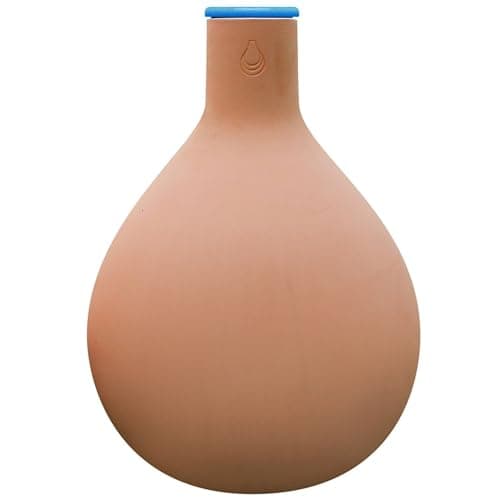
The size whose numbers hold up best. At 6.5 liters over a published 4 ft coverage diameter it carries about 517 ml of reservoir per square foot - the most generous ratio in the range - and it is the one size where a weekly refill on a real raised bed is a plausible claim rather than an optimistic one. It is also the most expensive single watering device on this site.
#ad Price as of October 29, 2026, from Amazon. Prices change. How we make money.
Published specification
- Reservoir capacity
- 6.5 L (6.8 quarts)
- Dimensions
- 10 in wide x 13 in high
- Coverage claim
- Up to 4 ft in diameter
- Refill claim
- Every 5 to 7 days, or whenever the water level is low
- Establishment requirement
- Continue surface watering for 7 to 10 days while roots adjust; 10 to 14 days for taproot plants
- Cleaning
- Wash with 10 parts water to 1 part vinegar, stiff brush if needed, air dry
- Reservoir capacity: GrowOya published specification, growoya.com
- Dimensions: GrowOya published specification, growoya.com
- Coverage claim: GrowOya published specification, growoya.com
- Refill claim: GrowOya published FAQ, growoya.com
- Establishment requirement: GrowOya published setup instructions, growoya.com
- Cleaning: GrowOya published care instructions, growoya.com
What is good about it
- Best reservoir-per-square-foot ratio in the range, so its coverage claim is the most defensible
- 6.5 liters is enough that a weekly refill on a bed is credible
- Capacity, dimensions and coverage all published for every size, which is unique in this category
- Buried depth of 13 in puts water into the root zone rather than onto the surface
What is not
- The most expensive single watering device featured anywhere on this site
- A 10 in wide buried pot takes real planting space out of a bed
- Must come indoors before frost or the clay can crack
- Porous clay clogs over time and needs the vinegar-and-brush routine the maker publishes
Skip this one if
Skip it if you are watering containers rather than beds. In a 12 in pot one thorough watering is about 2,800 ml, so a 6.5 liter buried pot is both physically too large and a poor use of the money.
How it scored
- Publishes capacity
- 10.0
- Coverage claim credibility
- 8.5
- Build and lid
- 9.0
- Setup honesty
- 9.5
- Value for money
- 5.5
- Overall
- 8.6 / 10
Our editorial score, from published specifications and computed intervals. Not a test result. Specification source: GrowOya Large Oya retail listing.
GrowOya Oya Watering Pot, Small (1 liter)
A large container or a grow bag, refilled weekly
The size to buy for a container rather than a bed, and the one whose coverage claim is the most optimistic of the three. GrowOya publishes 1 liter at 5 in wide by 7 in high, covering up to 2 ft in diameter - which works out to about 318 ml of reservoir per square foot of claimed coverage, against 517 ml for the large. Same maker, same clay, least water per square foot it asks you to trust it with.
#ad Price as of October 29, 2026, from Amazon. Prices change. How we make money.
Published specification
- Reservoir capacity
- 1 L (1.1 quarts)
- Dimensions
- 5 in wide x 7 in high
- Coverage claim
- Up to 2 ft in diameter
- Refill claim
- Every 5 to 7 days, or whenever the water level is low
- Establishment requirement
- Continue surface watering for 7 to 10 days while roots adjust; 10 to 14 days for taproot plants
- Frost warning
- Published as needing to come indoors before frost - the clay can crack or shatter at freezing temperatures
- Reservoir capacity: GrowOya published specification, growoya.com
- Dimensions: GrowOya published specification, growoya.com
- Coverage claim: GrowOya published specification, growoya.com
- Refill claim: GrowOya published FAQ, growoya.com
- Establishment requirement: GrowOya published setup instructions, growoya.com
- Frost warning: GrowOya published care instructions, growoya.com
What is good about it
- Capacity and dimensions both published, which most olla makers never manage
- Includes a silicone lid, so evaporation from the neck is controlled
- Demand-driven: the clay only releases water as the surrounding soil dries
- The cheapest way into the range if you want to test the method on one container
What is not
- Reservoir per square foot of claimed coverage is the lowest in the range, so the 2 ft claim is the one to be most skeptical of
- Needs 7 to 10 days of ordinary surface watering before it does anything, which buyers skip
- Must come indoors before frost or risk cracking, which makes it an annual chore
- Expensive per liter of reservoir against a generic terracotta olla
Skip this one if
Skip it if you are covering a bed rather than a container. Scale up to the medium or large; a 1 liter reservoir spread over 2 ft of bed is the thinnest promise in the range.
How it scored
- Publishes capacity
- 10.0
- Coverage claim credibility
- 6.0
- Build and lid
- 9.0
- Setup honesty
- 9.5
- Value for money
- 6.0
- Overall
- 8.2 / 10
Our editorial score, from published specifications and computed intervals. Not a test result. Specification source: GrowOya Small Oya retail listing.
GrowOya Oya Watering Pot, Medium (3 liter)
A raised bed or a big patio container, refilled once a week
The olla whose maker publishes capacity for every size it sells - 1, 3 and 6.5 liters - and whose refill claim of every five to seven days is the one figure in this category that lines up with our arithmetic. The medium is the size that suits a raised bed or a large container.
#ad We do not currently hold a live price for this, so we do not show one. How we make money.
Published specification
- Reservoir capacity
- 3 liters (small 1 liter and large 6.5 liters also published)
- Manufacturer refill claim
- Every 5 to 7 days, or when the level is low
- Watering method
- Buried porous clay reservoir; roots draw water through the wall as the soil dries
- Setup requirement
- Surface-water for the first couple of weeks while roots find the pot
- Maintenance
- Clean with a wire brush and vinegar solution
- Reservoir capacity: GrowOya published specification
- Manufacturer refill claim: GrowOya published listing
- Watering method: GrowOya published description
- Setup requirement: GrowOya published listing
- Maintenance: GrowOya published listing
Refill interval - computed, not tested
Not computed for a garden bed; about 4 to 7 days in a large container
Our cadence bands are for container houseplants, not for a bed of tomatoes in July, so we do not compute a bed interval. In a 12-inch container, one thorough watering is about 2,800 ml, so 3,000 ml is 1.1 waterings, or 3.7 to 7.5 days at once or twice a week. GrowOya's published five to seven days sits inside that.
Assumes: 12-inch tropical container as the only case our bands cover. Light, temperature, humidity, soil mix and season all change how fast a pot dries, so treat this as a planning range and not a guarantee.
What is good about it
- Every size in the range has a published capacity, which no other olla maker here manages
- The refill claim is inside our computed range rather than above it
- Demand-driven: the clay only releases water as the surrounding soil dries
- Sold on its own with a lid, so evaporation from the neck is controlled
What is not
- Expensive per pot compared with the generic terracotta ollas
- Needs two weeks of ordinary surface watering before roots reach it, which the packaging says and buyers skip
- Porous clay clogs over time and needs the wire brush the maker mentions
Skip this one if
Skip it for a houseplant pot. It is sized for a bed or a large container, and the 1 liter small is the version for anything under about 12 inches.
How it scored
- Published capacity
- 10.0
- Computed interval
- 8.5
- Honesty of claims
- 9.0
- Value for money
- 6.5
- Ease of setup
- 7.0
- Overall
- 8.8 / 10
Our editorial score, from published specifications and computed intervals. Not a test result. Specification source: GrowOya published specification, via manufacturer site.
Questions people actually ask
- Does the GrowOya actually work?
Yes, with one condition the maker publishes and most buyers skip: roots have to reach the clay before it does anything. GrowOya says to continue surface watering for 7 to 10 days while roots adjust, and up to 10 to 14 days for taproot plants. Installed and left to establish, a buried porous reservoir delivers on demand as the surrounding soil dries. Buried on Friday and abandoned on Saturday, it does nothing.
- What size GrowOya should I buy?
The large for a raised bed, the small for a large container. Our reason is arithmetic over the maker’s own figures: the large carries about 517 ml of reservoir per square foot of its claimed 4-foot coverage, the medium about 424 ml, and the small about 318 ml over its claimed 2 feet. The large’s coverage claim is the best-supported of the three; the small’s is the thinnest.
- How often do you refill a GrowOya?
GrowOya publishes every 5 to 7 days, or whenever the water level is low - though the same product page also says simply to water once a week in two other places. We have not converted that into a figure of our own for a garden bed, because our cadence bands come from extension guidance for container houseplants rather than for beds. In a large container, the published 5 to 7 days sits inside what our arithmetic gives.
- Can you leave a GrowOya outside in winter?
No. The maker says to remove it at the end of the growing season and, in frost-prone climates, to bring it indoors before frost, because the clay can crack or shatter at freezing temperatures. Factor that in as an annual chore: digging out a 10-inch-wide vessel each autumn, and another 7 to 10 days of establishment when you re-bury it in spring.
- Is the GrowOya worth the price?
It is the most expensive single watering device on this site, so the honest answer is conditional. It is worth it if you want a genuinely unattended week on a bed, you will install it early enough to establish, and lifting it before frost is acceptable. It is not worth it for houseplants in pots, and a Blumat ceramic stake at a fraction of the price works immediately and survives winter, at the cost of needing a water container beside it.
- How do you clean a GrowOya?
The published routine: remove plant growth, wash with 10 parts water to 1 part vinegar, using a stiff brush if needed, then air dry before storing. The vinegar is doing real work - a mild acid is the right treatment for the calcium deposits that clog porous clay. In hard water expect to do this every season rather than occasionally.
Sources
Sources
- GrowOya published Oya specification, sizes and care instructions
- GrowOya Small Oya retail listing
- GrowOya Large Oya retail listing
- Criscione and Holliday-Goulart, Properly Watering Container Houseplants, Virginia Cooperative Extension SPES-804 (2026)
- Blumat Classic published delivery rate and maximum lift, via retail listing