Roundup
Best Watering Cans for Indoor Plants
This is the one product category where every maker publishes the number we care about. So here is what that number means: how many pots you can water before you walk back to the tap.
By Scooter M. - Enthusiast. Reads the manuals, compiles the specs, does the math. | Published
Disclosure
We earn a commission if you buy through our links. It does not change what we recommend or what you pay. Full disclosure.
The short answer
The one category where the number is always published
Most of this site is an argument with manufacturers about missing specifications. Watering globe makers publish a duration instead of a capacity, ceramic pot makers publish nothing at all, and raised bed makers describe a reservoir without sizing it.
Watering cans are the happy exception. Every can on this page states its capacity in ounces, liters or gallons, because capacity is the product. That makes this the easiest ranking we have ever done - and it lets us do the one piece of arithmetic nobody else bothers with: turning a capacity into a number of pots.
How many pots does one fill water?
Our published watering table gives the volume of one thorough watering by pot size: 100 ml for a 4-inch pot, 350 ml for a 6-inch, 800 ml for an 8-inch, 1.6 liters for a 10-inch. Divide a can’s published capacity by those figures and you get the only specification that matters in daily use.
| Can | Published capacity | 4-inch pots | 6-inch pots | 8-inch pots |
|---|---|---|---|---|
| Fiskars 40 oz | 1.2 L | 12 | 3 | 1 |
| LTSUMI stainless | 1.0 L | 10 | 2 | 1 |
| Chapin half-gallon | 1.9 L | 18 | 5 | 2 |
| Chapin 2-gallon | 7.6 L | 75 | 21 | 9 |
| Behrens 2-gallon steel | 7.6 L | 75 | 21 | 9 |
Two things fall out of that table. A one-liter can - the size most people buy for indoor plants, and the size most decorative cans come in - is three 6-inch pots. If you own a dozen houseplants you are filling it four or five times per watering round.
And the jump from half a gallon to two gallons is not incremental. It is the difference between five pots and twenty-one, which is the difference between a chore and a job.
How we ranked them
We have not run a pour test. There is no scale and stopwatch here. What follows is each maker’s published specification, plus our arithmetic on top of it.
Published capacity first, because it decides trips to the tap and because it is the one figure every maker gives.
Dosing precision second. Can you tell how much you have poured? Exactly one can here has volume markings. Everything else is a guess, which is a genuine problem if you are trying to water by the numbers rather than by instinct.
Spout reach third. A long, thin spout puts water on the soil under dense foliage. A shower rose puts it on the leaves, which is right for seed trays and wrong for an African violet.
Then build, warranty and price. A can is a bucket with a handle; the interesting differences are the gasket, the spout joint and how long the maker stands behind it.
Why markings matter more than they sound
This whole site is built on the idea that a watering volume is knowable. Virginia Cooperative Extension’s guidance is to water thoroughly and let the excess drain, and our table turns that into a number per pot size.
A can with printed volume markings lets you act on that. You can put 350 ml into a 6-inch pot, watch what drains, and learn what thorough looks like for your mix. After a few weeks you will not need the markings - but the calibration is what gets you there, and an opaque steel can never offers it.
It matters twice as much if you feed at watering time. Fertilizer dose rates are written per gallon or per liter, so a can you can measure is the difference between following the label and improvising. Chapin publishes both of its cans as fertilizer-safe.
Long spout or shower rose?
Long thin spout for indoor plants. It reaches under leaves, puts water on the mix rather than the crown, and does not splash. This matters most for African violets, whose hairy leaves mark when wetted, and for anything on a shelf where the runoff lands on a book.
Shower rose for trays, seedlings and outdoor containers, where you want a broad gentle fall rather than a jet that digs a hole in the mix. If you are starting seeds, a rose is the right tool and a thin spout will wash your sowing into a corner.
A can with a removable rose gives you both, which is why the two-piece Chapin head earns its place. The Fiskars spout clicks on and off too, though it has no rose option.
How to use it: thorough, then empty the saucer
Clemson Extension’s instruction for indoor plants is specific and worth following exactly: when watering is required, apply water until it runs out of the bottom of the pot. That does two jobs at once - it washes excess salts out of the mix, and it guarantees that the bottom two-thirds of the pot, where most of the roots are, gets water at all.
Then the part people skip: do not let the pot sit in what ran out. Empty the saucer. A pot standing in its own drainage is the waterlogged condition that starts root rot, and it undoes the flushing you just did by leaving the salts in a puddle the mix will draw back up.
If the mix has dried hard and the water runs straight through, Clemson gives a double-watering method: water once, then again half an hour later, or stand the pot in a sink or bucket until the surface is moist and let it drain completely. That is the same problem bottom watering solves, and it is the one job a can genuinely cannot do on its own.
This is also where capacity stops being an abstraction. Watering until it drains means you cannot ration a can across more pots than it holds - if you are giving eight 6-inch pots a proper soak, you need roughly 2.8 liters in total, which is a full 2-gallon can used once or a 1-liter can filled three times.
What goes in the can
Two details from the same Clemson guidance, both easy to get wrong and neither costing anything to fix.
Temperature. Water should be between 62 and 72 degrees F - not hot, not straight from a cold tap in winter. A can filled and left to stand on the counter until you next water solves this by itself, which is a decent argument for leaving the can out rather than storing it under the sink.
Never softened water. Clemson is explicit: do not water plants with softened water, because it adds sodium and chloride to the mix and can damage the plant. If your house runs on a softener, fill from an outside tap or a filtered line. This is the single most common invisible cause of a slow decline in houseplants that are otherwise being cared for correctly.
The can is not the fix for a watering problem
Worth saying on a site like this one: a better can will not save a plant that is being watered on the wrong schedule. If you are here because something is dying, the diagnostic pages are more useful than any purchase - overwatered versus underwatered separates the two symptom sets, and how often to water works through cadence by plant type.
What a can does change is consistency. A container you can measure, carry and aim makes it far more likely that each pot gets a full, thorough drink and then a drying period - which is the pattern nearly every extension service recommends, and the one that hand-watering with a coffee mug almost never achieves.
And if the honest answer is that you will not water on any schedule at all, that is what a reservoir planter is for.
The three mistakes a can makes easy
A splash instead of a soak. The commonest failure, and the one a small can encourages: a quick pour that darkens the surface and reaches two inches down. Clemson’s standard is water until it runs out of the bottom, precisely because that is what gets water to the lower two-thirds of the pot where the roots are. Half a can into six pots is worse than a full can into three.
Watering on a schedule because the can is full. The RHS is direct about this - avoid a routine such as watering once a week, and water less often but more thoroughly, letting the surface dry first. A can does not know what your plant needs; it only knows you filled it. A moisture meter or a finger at depth decides whether today is the day, and the cadence bands are here.
Topping up the saucer. Leaving standing water under a pot looks like generosity and behaves like a reservoir nobody designed - the mix wicks it back up, the lower roots never get air, and the salts you flushed stay in the pot. Empty the saucer twenty minutes after watering.
None of the three is a can problem, exactly. They are habits a can makes convenient, which is why the measurable can wins here: if you know what 350 ml looks like in your own hand, the first mistake stops being possible.
Weight, which decides whether you use the big one
Water weighs about 8.3 lb per US gallon. A full 2-gallon can is therefore around 17 lb of water plus the can itself - 1.22 lb for the Chapin, 2.6 lb for the Behrens steel.
That is fine carried at your side to a patio. It is not fine held out at arm’s length over a bookshelf, and it is the reason we rank the big cans for outdoor rounds and the small ones for indoor shelves rather than declaring one winner. The right answer for a lot of people is one of each.
The honest cons on every pick
Fiskars 40 oz. Only three 6-inch pots per fill. It is plastic and looks it. The spout is a separate part that clicks on, so it can be mislaid, and there is no rose for seedlings.
Chapin 2-gallon. Seventeen pounds of water when full. A shower rose is wrong for a dense indoor shelf. Opaque tank, no markings, and too big for most kitchen sinks.
LTSUMI stainless. A published three-month warranty against Fiskars’ lifetime. No markings at all, and one liter is the smallest capacity here.
Chapin half-gallon. No long spout, so it is a garden can rather than a shelf can. No markings, opaque tank, and a wide pour is wrong for hairy leaves.
Behrens 2-gallon steel. Three times the price of the plastic can for identical capacity, 2.6 lb before you add water, and its published listing dimensions are plainly wrong - which does not inspire confidence in the rest of the listing.
What we would buy
The Fiskars for indoor plants, because markings are worth more than material, and a 2-gallon can for anything outdoors. That pairing costs less than a single designer can and covers both jobs properly.
Buy the steel one if you want an object you will still own in twenty years. Just buy it knowing you are paying for galvanized steel and not for a drop more water than the plastic can holds.
Ranked picks
Quick picks
Ranked on published specifications and the computed refill interval, not on looks. Tap any row for the full write-up, including who should skip it.
| # | Product | Best for | Score | Price |
|---|---|---|---|---|
| 1 | 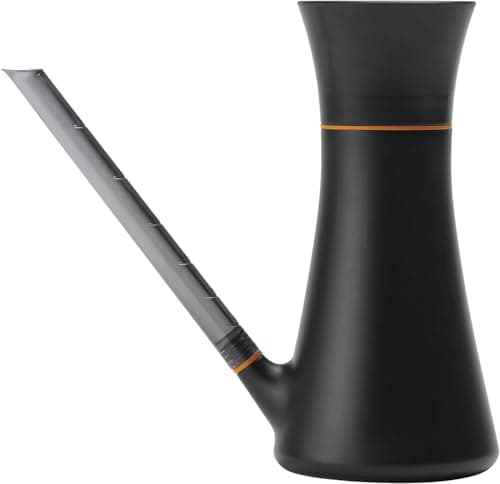 Fiskars 40 oz Indoor Watering CanAnyone who wants to pour a measured dose rather than a guess Fiskars 40 oz Indoor Watering CanAnyone who wants to pour a measured dose rather than a guess | Best overall, the only one with markings | 9.1 | $11.04 - View on Amazon |
| 2 | 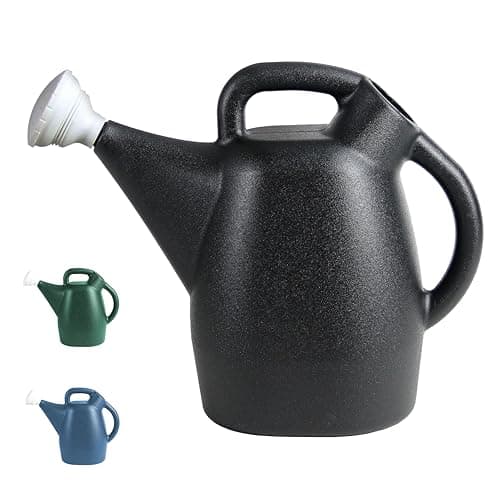 Chapin 47998 2-Gallon Watering CanPatio containers and hanging baskets, where trips to the tap are the work Chapin 47998 2-Gallon Watering CanPatio containers and hanging baskets, where trips to the tap are the work | Best for a patio round | 8.6 | $19.39 - View on Amazon |
| 3 | 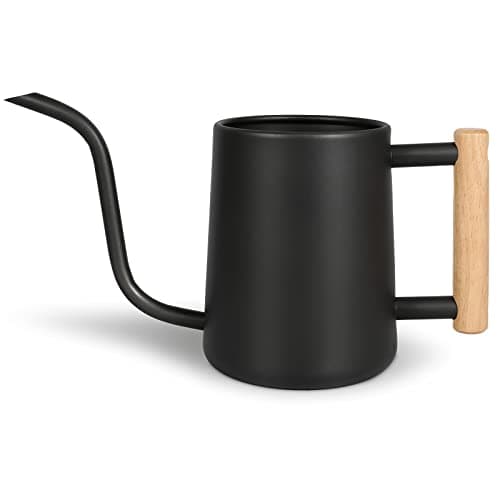 LTSUMI Stainless Steel Watering Can, 35 oz / 1000 mlA small indoor collection where the can lives out on display LTSUMI Stainless Steel Watering Can, 35 oz / 1000 mlA small indoor collection where the can lives out on display | Best metal can for a shelf | 8.4 | $16.99 - View on Amazon |
| 4 | 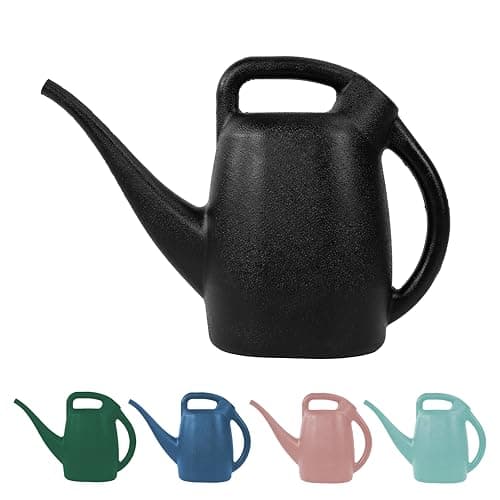 Chapin 48000 Half-Gallon Watering CanA mixed collection where a one-liter can means constant refills Chapin 48000 Half-Gallon Watering CanA mixed collection where a one-liter can means constant refills | Best value, useful middle size | 8.2 | $9.97 - View on Amazon |
| 5 | 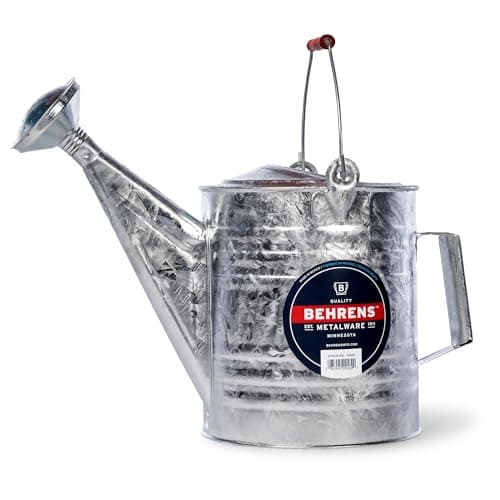 Behrens 2-Gallon Hot-Dipped Steel Watering CanSomeone replacing a can for the last time Behrens 2-Gallon Hot-Dipped Steel Watering CanSomeone replacing a can for the last time | Buy for the steel, not the capacity | 7.4 | $52.63 - View on Amazon |
Scores are our editorial judgment from published specifications. They are not test results, and they are deliberately not marked up as ratings in this page’s structured data.
Pick #1 - Best overall, the only one with markings
Fiskars 40 oz Indoor Watering Can
Anyone who wants to pour a measured dose rather than a guess
The only can we found with volume measurements printed on a translucent nozzle, which turns it from a container into a measuring jug. On a site where one thorough watering of a 6-inch pot is 350 ml, being able to see how much you have poured is the whole argument.
#ad Price as of September 21, 2026, from Amazon. Prices change. How we make money.
Published specification
- Published capacity
- 40 oz (1.2 L)
- Measurement markings
- Volume measurements on a translucent nozzle
- Spout
- Long, slender spout with an anti-drip tip
- Material
- Resin with 30% post-consumer recycled plastic
- Weight
- 0.35 lb empty
- Warranty
- Lifetime, per the maker
- Published capacity: Fiskars published listing specification
- Measurement markings: Fiskars published description
- Spout: Fiskars published description
- Material: Fiskars published description
- Weight: Fiskars published listing dimensions
- Warranty: Fiskars published description
What is good about it
- Printed volume markings, so a 350 ml dose is something you can actually measure
- Anti-drip tip, which matters on a bookshelf far more than it sounds
- Lifetime warranty on a plastic can that costs less than a bag of potting mix
- Light enough empty that filling it at a sink is effortless
What is not
- 1.2 L is about three 6-inch pots, so a large collection means repeated trips
- Plastic, and it looks like plastic next to a steel can
- The spout is a separate part that clicks on, so it is one more thing to lose
- No rose or sprinkler head, so it is wrong for seed trays
Skip this one if
Skip it if you water a balcony of big containers. At 1.2 L you would be refilling it four times to give three 10-inch pots one thorough watering.
How it scored
- Published capacity
- 10.0
- Dosing precision
- 10.0
- Reach into foliage
- 9.0
- Build and warranty
- 9.0
- Value for money
- 10.0
- Overall
- 9.1 / 10
Our editorial score, from published specifications and computed intervals. Not a test result. Specification source: Fiskars 40 oz indoor watering can retail listing.
Pick #2 - Best for a patio round
Chapin 47998 2-Gallon Watering Can
Patio containers and hanging baskets, where trips to the tap are the work
Two gallons - about 7.6 liters - with a two-piece shower head and a rubber gasket to stop the leak every cheap large can develops. By our watering table that is roughly twenty-one 6-inch pots or nine 8-inch pots in one trip, which is what makes a patio manageable.
#ad Price as of September 21, 2026, from Amazon. Prices change. How we make money.
Published specification
- Published capacity
- 2 gallons (about 7.6 L)
- Nozzle
- Two-piece shower head with Tru-Stream precision-flow design, removable for cleaning
- Sealing
- Rubber gasket between head and neck to eliminate leaks
- Material
- 100% recycled polymer tank, chemical and rust-resistant
- Weight
- 1.22 lb empty
- Published capacity: Chapin published listing specification
- Nozzle: Chapin published description
- Sealing: Chapin published description
- Material: Chapin published description
- Weight: Chapin published listing dimensions
What is good about it
- The capacity that makes an outdoor round practical rather than a relay
- Shower head comes apart for cleaning, which is where these cans normally fail
- A published gasket, because the neck joint is the usual leak
- Fertilizer-safe recycled tank
What is not
- Two gallons of water weighs about 17 lb, which is a real consideration
- A shower rose is the wrong delivery for a dense indoor shelf
- No volume markings on an opaque tank
- Too big to fill in most kitchen sinks
Skip this one if
Skip it for indoor use if you have any wrist trouble. A full 2-gallon can held out at arm's length over a shelf is a lot of weight in an awkward position.
How it scored
- Published capacity
- 10.0
- Dosing precision
- 4.0
- Reach into foliage
- 5.0
- Build and warranty
- 8.5
- Value for money
- 9.0
- Overall
- 8.6 / 10
Our editorial score, from published specifications and computed intervals. Not a test result. Specification source: Chapin 47998 2-gallon watering can retail listing.
Pick #3 - Best metal can for a shelf
LTSUMI Stainless Steel Watering Can, 35 oz / 1000 ml
A small indoor collection where the can lives out on display
A liter of stainless steel with a long, thin spout and a wooden handle - the can most people actually want on a shelf. One fill is roughly three 6-inch pots by our watering table, and it looks like an object rather than a tool.
#ad Price as of September 21, 2026, from Amazon. Prices change. How we make money.
Published specification
- Published capacity
- 35 oz (1000 ml)
- Material
- Stainless steel, published as leakproof and rust-resistant, with a wooden handle
- Spout
- Long, thin spout for placing water precisely
- Filling
- Open-top design for refilling without removing anything
- Weight
- 0.86 lb empty
- Warranty
- 3 months, per the maker
- Published capacity: LTSUMI published listing specification
- Material: LTSUMI published description
- Spout: LTSUMI published description
- Filling: LTSUMI published description
- Weight: LTSUMI published listing dimensions
- Warranty: LTSUMI published description
What is good about it
- Steel body that will not crack or go brittle in a sunny window
- Long thin spout reaches under foliage without wetting leaves
- Open top makes filling at a tap quick
- Attractive enough to leave on a shelf, which means you actually use it
What is not
- A published 3-month warranty, against a lifetime warranty on the Fiskars
- No volume markings, so a measured dose is guesswork
- Heavier than plastic before you add any water
- One liter is the smallest useful capacity here
Skip this one if
Skip it if you want to dose accurately. A steel can hides the water line completely, so you are pouring until it looks right rather than until you have delivered what the pot needs.
How it scored
- Published capacity
- 9.0
- Dosing precision
- 4.0
- Reach into foliage
- 9.5
- Build and warranty
- 7.0
- Value for money
- 8.0
- Overall
- 8.4 / 10
Our editorial score, from published specifications and computed intervals. Not a test result. Specification source: LTSUMI 1000 ml stainless watering can retail listing.
Pick #4 - Best value, useful middle size
Chapin 48000 Half-Gallon Watering Can
A mixed collection where a one-liter can means constant refills
Half a gallon - about 1.9 liters - from a manufacturer that has made sprayers for a century, at the lowest price here. It is the sensible middle size: five or six 6-inch pots per fill, and it still fits under a kitchen tap.
#ad Price as of September 21, 2026, from Amazon. Prices change. How we make money.
Published specification
- Published capacity
- 1/2 gallon (about 1.9 L)
- Material
- Black poly tank, published as chemical and rust-resistant
- Handles
- Two - a top handle for carrying and a side handle for pouring
- Fertilizer use
- Published as safe for use with fertilizer solutions
- Origin
- Made in the USA from 100% recycled polymer
- Warranty
- 1-year limited
- Published capacity: Chapin published listing specification
- Material: Chapin published description
- Handles: Chapin published description
- Fertilizer use: Chapin published description
- Origin: Chapin published description
- Warranty: Chapin published listing specification
What is good about it
- Nearly twice the Fiskars capacity for less money
- Two handles make pouring a full can far more controlled
- Published as fertilizer-safe, which matters if you feed at every watering
- Recycled polymer, made in the USA, with a stated warranty
What is not
- No long precision spout - this is a garden can, not a shelf can
- No volume markings
- Opaque tank, so you cannot see how much is left
- A wide pour is wrong for African violets and anything with hairy leaves
Skip this one if
Skip it if your plants are crowded on a shelf. Without a long thin spout you will be watering leaves and windowsills as much as soil.
How it scored
- Published capacity
- 9.5
- Dosing precision
- 4.5
- Reach into foliage
- 4.0
- Build and warranty
- 8.0
- Value for money
- 10.0
- Overall
- 8.2 / 10
Our editorial score, from published specifications and computed intervals. Not a test result. Specification source: Chapin 48000 half-gallon watering can retail listing.
Pick #5 - Buy for the steel, not the capacity
Behrens 2-Gallon Hot-Dipped Steel Watering Can
Someone replacing a can for the last time
Eight quarts of hot-dipped galvanized steel, at roughly three times the price of the plastic 2-gallon can that holds exactly the same amount. You are buying the material, not the capacity, and that is a legitimate thing to buy - as long as you know that is what you are doing.
#ad Price as of September 21, 2026, from Amazon. Prices change. How we make money.
Published specification
- Published capacity
- 8 quarts (2 gallons, about 7.6 L)
- Material
- Hot-dipped galvanized steel, published as rust and corrosion resistant
- Spout
- Published as delivering controlled flow to roots without damaging foliage
- Weight
- 2.6 lb empty
- Listing dimensions
- Published as 3.94 x 1.06 x 0.79 in, which cannot describe a 2-gallon can
- Published capacity: Behrens published description
- Material: Behrens published description
- Spout: Behrens published description
- Weight: Behrens published listing dimensions
- Listing dimensions: Checked on the Behrens listing
What is good about it
- Hot-dipped galvanized steel genuinely outlasts plastic outdoors
- Same 2-gallon capacity as the plastic can, in a body that will not go brittle in UV
- Heavy enough not to blow over empty, which plastic cans do constantly
- The one can here you would expect to hand on to someone
What is not
- By far the most expensive item on this page, for no extra capacity
- 2.6 lb empty plus 17 lb of water is a serious carry
- The published listing dimensions are obviously wrong, which is not confidence-inspiring
- Galvanized steel dents, and a dented can never sits flat again
Skip this one if
Skip it if the job is indoor houseplants. You are paying a premium for weather resistance that a can living beside a kitchen sink will never need.
How it scored
- Published capacity
- 9.0
- Dosing precision
- 4.0
- Reach into foliage
- 5.0
- Build and warranty
- 9.5
- Value for money
- 4.5
- Overall
- 7.4 / 10
Our editorial score, from published specifications and computed intervals. Not a test result. Specification source: Behrens 2-gallon hot-dipped steel watering can retail listing.
Questions people actually ask
- What size watering can do I need for houseplants?
Work it out from your pots. One thorough watering is about 350 ml for a 6-inch pot and 800 ml for an 8-inch, so a 1-liter can covers roughly three 6-inch pots and a half-gallon can covers five. If you own more than about ten houseplants, a 1-liter can means four or five trips to the tap every round - go bigger.
- Do watering cans need a long spout?
For indoor plants, yes. A long thin spout reaches under foliage and puts water on the mix rather than on leaves and crowns, which matters for African violets and anything crowded on a shelf. A shower rose is the better choice for seed trays and outdoor containers, where you want a broad gentle fall.
- How much does a full 2-gallon watering can weigh?
Water is about 8.3 lb per gallon, so two gallons is roughly 17 lb of water plus the can - 1.22 lb for the plastic Chapin, 2.6 lb for the galvanized Behrens. Comfortable carried at your side outdoors, genuinely awkward held out over a bookshelf.
- Are metal watering cans better than plastic?
Better outdoors and in sunlight, where plastic eventually goes brittle. Not better for dosing: steel is opaque, so you cannot see the water line or use volume markings. The Fiskars plastic can here carries a lifetime warranty and printed measurements, which for indoor use beats the metal cans on everything except appearance.
- Can you use a watering can for fertilizer?
Yes, if the maker says the tank is chemical-resistant - Chapin publishes that for both of its cans. Dose rates are written per gallon or per liter, so a can with volume markings makes following the label far easier. Rinse afterwards, and never mix feed into the reservoir of a self-watering planter.
Sources
Sources
- Indoor Plants - Watering, Clemson Cooperative Extension Home & Garden Information Center
- Royal Horticultural Society, Watering plants wisely
- Fiskars 40 oz indoor watering can published specification, via retail listing
- LTSUMI 1000 ml stainless watering can published specification, via retail listing
- Chapin 48000 half-gallon watering can published specification, via retail listing
- Chapin 47998 2-gallon watering can published specification, via retail listing
- Behrens 2-gallon hot-dipped steel watering can published specification, via retail listing
- Criscione and Holliday-Goulart, Properly Watering Container Houseplants, Virginia Cooperative Extension SPES-804 (2026)