Roundup
Best Self-Watering Pots for African Violets
The classic two-piece violet pot is the oldest self-watering design there is, and the only one built for a plant that must never be watered from above. Here is how to choose one, and how not to drown the plant with it.
By Scooter M. - Enthusiast. Reads the manuals, compiles the specs, does the math. | Published
Disclosure
We earn a commission if you buy through our links. It does not change what we recommend or what you pay. Full disclosure.
The short answer
Why violets get their own pot
Most self-watering planters on this site are sold as a convenience. The violet pot is different: it exists because of how the plant fails. University of Minnesota Extension is direct that root rot from overwatering is one of the most common reasons African violets die, and that water on the leaves causes leaf spots. So the plant must be watered from below, the mix must not stay saturated, and the fuzzy leaves must stay dry. A pot that wicks from underneath solves all three at once, which is why growers have used two-piece pots for decades.
The same extension guidance describes the alternatives - setting the pot in an inch of room-temperature water until the surface feels moist, or running a wick through the drainage hole into a container - and notes that self-watering pots are available for the same purpose. A two-piece pot is simply the wick method with the wick built into the pot wall.
How we ranked them
Fill visibility first. Every pot here works. What separates them is whether you can tell how much water is in the outer pot without lifting the plant out. Fill lines or a clear reservoir turn a guess into a glance, and the guess is where violets die.
Published capacity second, and it is a gap. We asked the same question of these pots that we ask of every reservoir product on this site: how much does it hold? None of the three publishes a figure. That is not unusual for the category, but it means no maker’s duration claim can be checked, and we score all three down for it.
Build third. An unglazed inner pot fired to the right porosity is the working part. Too dense and it wicks poorly; too soft and it stains and crumbles. We can only go on what the makers publish about the firing, and on the honest observation that all three are ceramic and will chip.
| Pot | Reservoir capacity | Fill visibility | Published claim |
|---|---|---|---|
| Thriving Thicket 6 in | Not published | Molded fill lines in the reservoir | Up to 21 days, results vary |
| Fayoula 6 in glass | Not published | Clear glass outer pot | None stated |
| BUYMAX 6 in ceramic | Not published | None, opaque outer pot | None stated |
The mechanism, and the one way to break it
The inner pot is unglazed clay. Water in the outer pot soaks into the clay wall and moves through it toward the drier mix inside, and it keeps moving for as long as the mix is drier than the wall. When the mix is wet, the gradient flattens and the transfer slows. That is the same self-throttling that makes terracotta spikes better behaved than glass globes, and it is the reason a violet pot does not need a valve.
It also tells you how to break it. If the reservoir is never allowed to run down, the clay wall is never drier than saturated, the mix above it never dries at all, and you have built exactly the condition NC State Extension names for root rot: wet, poorly drained soil in which Pythium, Phytophthora, Rhizoctonia and Fusarium thrive. The violet pot is not a set-and-forget device. It is a fill-and-let-it-empty device.
So the rule is simple and it applies to all three pots: fill the reservoir, let it go dry, wait a day or two, fill it again. A pot with fill lines makes that cycle visible. A clear pot makes it obvious. An opaque pot with no lines makes it a matter of lifting the plant out to look, which most people stop doing after the first month.
Why we do not publish a refill interval here
Everywhere else on this site we divide a published reservoir by one thorough watering for the pot and multiply by the published cadence. The method is here. It needs a numerator, and no violet pot maker gives us one. We will not estimate it, because a made-up numerator produces a real-looking answer.
What we can say is the scale. A 4-inch violet takes about 100 ml per thorough watering in our pot table, and Virginia Cooperative Extension publishes the tropical cadence as once or twice a week. So every 100 ml the outer pot holds is roughly 3.5 to 7 days. A reservoir the size of a coffee cup is a week or two; a 21-day claim implies something well over half a liter, in a pot 6 inches across. Read the claim in that light.
What you fill it with
Not tap water straight from a softener. University of Minnesota Extension advises against softened or chlorinated water for violets and recommends room-temperature distilled or rain water. The same guidance describes feeding through the wick at about an eighth of the recommended fertilizer strength, which applies directly to a reservoir pot: a weak, constant feed, not a monthly dose into the outer pot.
Fertilizer in the reservoir also changes what a moisture meter reads, because these meters respond to dissolved salts. If you check the inner pot with a probe, expect it to read wetter than an unfed pot would.
Which violets belong in one
Standard and semi-miniature violets in 4-inch pots, which is the size they are sold in and the size the 4-inch opening on these pots is cut for. A violet that has outgrown a 4-inch pot wants dividing rather than a bigger reservoir; crowded crowns and a wet base are how the rot starts.
Light matters as much as water. The same extension page puts violets in a bright, cool spot - north, northwest or northeast windows - with 14 to 16 hours of light a day to flower. A violet in a dim corner in a reservoir pot draws very little water, the reservoir stays full for weeks, and the mix never dries. That is the combination to avoid.
What we would not buy for a violet
A granulate-based planter like the Lechuza Classico. It is an excellent planter for a 6-inch tropical, and it is the wrong tool here: too large for a 4-inch root ball, and built around a substrate layer rather than a wicking wall. Nor a watering globe, which delivers to a zone in the mix and wets the crown. The two-piece pot is the right design for this plant, and the only decision is which one.
The same two-piece design is now sold in larger sizes for ordinary houseplants, alongside wicking pots and sealed terracotta. Our ceramic and terracotta roundup ranks those, and reaches the same conclusion about the reservoir that this page does: nobody publishes how much it holds.
Ranked picks
Quick picks
Ranked on published specifications and the computed refill interval, not on looks. Tap any row for the full write-up, including who should skip it.
| # | Product | Best for | Score | Price |
|---|---|---|---|---|
| 1 | 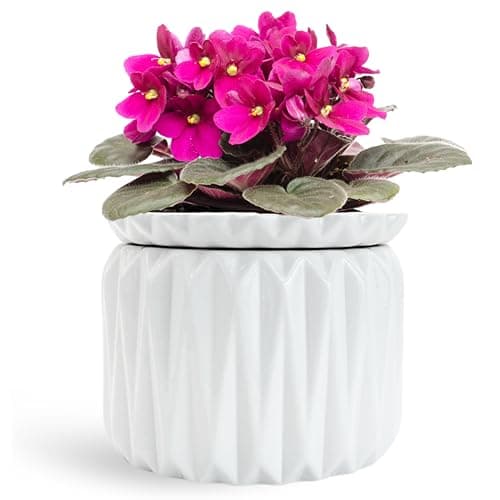 Thriving Thicket 6-Inch Self-Watering African Violet Pot with Fill LinesA first African violet, where over-filling the reservoir is the likeliest mistake Thriving Thicket 6-Inch Self-Watering African Violet Pot with Fill LinesA first African violet, where over-filling the reservoir is the likeliest mistake | Best overall, for the fill lines | 7.9 | $26.96 - View on Amazon |
| 2 | 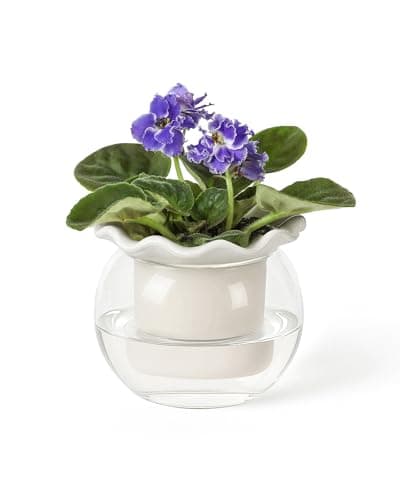 Fayoula 6-Inch Glass-Reservoir Self-Watering African Violet PotAnyone who wants to see the water level without lifting the plant Fayoula 6-Inch Glass-Reservoir Self-Watering African Violet PotAnyone who wants to see the water level without lifting the plant | Best if you want to see the water | 7.6 | $29.99 - View on Amazon |
| 3 | 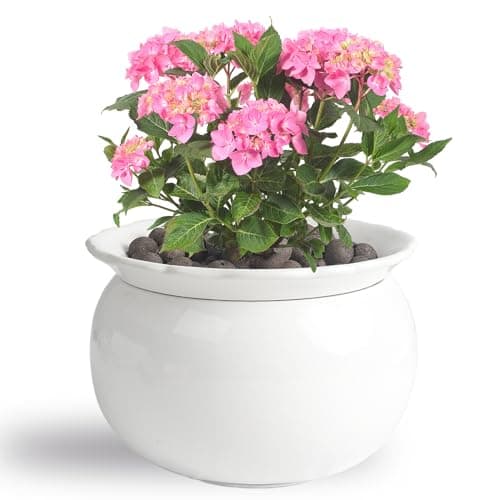 BUYMAX 6-Inch Self-Watering Ceramic African Violet PotThe standard violet pot at the standard price BUYMAX 6-Inch Self-Watering Ceramic African Violet PotThe standard violet pot at the standard price | Best plain version on a budget | 7.4 | $20.99 - View on Amazon |
Scores are our editorial judgment from published specifications. They are not test results, and they are deliberately not marked up as ratings in this page’s structured data.
Pick #1 - Best overall, for the fill lines
Thriving Thicket 6-Inch Self-Watering African Violet Pot with Fill Lines
A first African violet, where over-filling the reservoir is the likeliest mistake
The one two-piece violet pot we found whose maker thought about the only thing that goes wrong with them: knowing how much water is in the outer pot. Molded fill lines on the reservoir turn a guess into a glance, which in this category is a genuine feature.
#ad Price as of September 21, 2026, from Amazon. Prices change. How we make money.
Published specification
- Outer pot diameter
- 6 in, with a 4 in opening for the inner pot
- Reservoir capacity
- Not published by the manufacturer
- Fill indicator
- Molded water-level lines inside the reservoir
- Manufacturer duration claim
- Up to 21 days, results vary by soil and plant
- Material
- Kiln-fired ceramic, unglazed absorbent inner pot
- Outer pot diameter: Thriving Thicket published listing
- Reservoir capacity: Checked the listing; fill lines are published, the volume they mark is not
- Fill indicator: Thriving Thicket published listing
- Manufacturer duration claim: Thriving Thicket published listing
- Material: Thriving Thicket published listing
Refill interval - computed, not tested
Cannot be computed, and we will not estimate it
Our refill interval is reservoir capacity divided by the volume of one thorough watering. The maker publishes fill lines but not the volume they mark, so the numerator does not exist. For reference, a 4-inch violet takes about 100 ml per thorough watering, so every 100 ml the outer pot holds is roughly 3.5 to 7 days at the published tropical cadence.
Assumes: 4-inch inner pot, tropical cadence band. Light, temperature, humidity, soil mix and season all change how fast a pot dries, so treat this as a planning range and not a guarantee.
What is good about it
- Fill lines are the single most useful thing a violet pot can have, and almost none have them
- Bottom-watering by design keeps water off the leaves, which is the whole reason violet growers use these
- A 4-inch opening matches the pot size violets are actually sold in
What is not
- The 21-day claim is not checkable, because the reservoir volume is not published
- Glazed outer pot hides the water level between the lines, so you still lift the inner pot to be sure
- Ceramic, so it will chip if it meets a tiled floor
Skip this one if
Skip it if your violet is already in a 6-inch pot. The inner pot is a 4-inch fit, and a violet that has outgrown that wants dividing, not a bigger reservoir.
How it scored
- Published capacity
- 3.0
- Fill visibility
- 8.5
- Build and materials
- 8.0
- Value for money
- 8.0
- Honesty of claims
- 5.5
- Overall
- 7.9 / 10
Our editorial score, from published specifications and computed intervals. Not a test result. Specification source: Thriving Thicket 6-inch African violet pot retail listing.
Pick #2 - Best if you want to see the water
Fayoula 6-Inch Glass-Reservoir Self-Watering African Violet Pot
Anyone who wants to see the water level without lifting the plant
Same two-piece idea, but the outer reservoir is glass. That solves the one real problem with violet pots - you can see exactly how much water is left and whether it has gone green - at the cost of a reservoir that will not survive a fall.
#ad Price as of September 21, 2026, from Amazon. Prices change. How we make money.
Published specification
- Outer pot diameter
- 6 in
- Reservoir capacity
- Not published by the manufacturer
- Construction
- Absorbent ceramic inner pot in a clear glass outer reservoir
- Watering method
- Bottom-up wicking through the inner pot wall
- Outer pot diameter: Fayoula published listing
- Reservoir capacity: Checked the listing, no volume given
- Construction: Fayoula published listing
- Watering method: Fayoula published listing
Refill interval - computed, not tested
Cannot be computed, and we will not estimate it
The reservoir is glass, so you can see the level, but the volume is still not published and we will not guess it. Each 100 ml it holds is roughly 3.5 to 7 days for a 4-inch violet at the published tropical cadence.
Assumes: 4-inch inner pot, tropical cadence band. Light, temperature, humidity, soil mix and season all change how fast a pot dries, so treat this as a planning range and not a guarantee.
What is good about it
- The water level is visible at all times, which removes the only guesswork in a violet pot
- You can also see algae starting, which is the cue to empty and rinse before it clogs the clay
- Same bottom-wicking mechanism as the ceramic versions
What is not
- Glass. On a windowsill above a tiled floor that is a real consideration
- A clear reservoir in a bright window grows algae faster than an opaque one
- Costs more than the plain ceramic pot for the same function
Skip this one if
Skip it if it will sit in direct sun. Light on standing water is an algae culture, and a green reservoir wicks badly.
How it scored
- Published capacity
- 2.5
- Fill visibility
- 10.0
- Build and materials
- 6.5
- Value for money
- 6.5
- Honesty of claims
- 7.0
- Overall
- 7.6 / 10
Our editorial score, from published specifications and computed intervals. Not a test result. Specification source: Fayoula glass African violet pot retail listing.
Pick #3 - Best plain version on a budget
BUYMAX 6-Inch Self-Watering Ceramic African Violet Pot
The standard violet pot at the standard price
The plain version of the classic two-piece violet pot, and the one most people should start with: an unglazed inner pot that wicks from a glazed outer reservoir, with a flat base so the inner pot works on its own. No fill lines, no window, nothing to go wrong.
#ad Price as of September 21, 2026, from Amazon. Prices change. How we make money.
Published specification
- Outer pot diameter
- 6 in
- Reservoir capacity
- Not published by the manufacturer
- Construction
- Two-piece: absorbent unglazed inner pot, glazed outer reservoir
- Material
- Dolomite clay, fired at varying temperatures for the two parts
- Inner pot base
- Flat, so the inner pot doubles as a standalone planter
- Outer pot diameter: BUYMAX published listing
- Reservoir capacity: Checked the listing, no volume given
- Construction: BUYMAX published listing
- Material: BUYMAX published listing
- Inner pot base: BUYMAX published listing
Refill interval - computed, not tested
Cannot be computed, and we will not estimate it
No reservoir volume is published, so there is no numerator. A 4-inch violet draws about 100 ml per thorough watering, so each 100 ml the outer pot holds is roughly 3.5 to 7 days at the published tropical cadence.
Assumes: 4-inch inner pot, tropical cadence band. Light, temperature, humidity, soil mix and season all change how fast a pot dries, so treat this as a planning range and not a guarantee.
What is good about it
- The exact mechanism violet growers have used for decades, at the low end of the price bracket
- Unglazed inner pot wicks evenly around the whole root ball rather than from one wick
- Flat-bottomed inner pot means you can lift it out and use it as an ordinary pot
What is not
- No fill lines and an opaque outer pot, so you cannot see the water level without lifting the plant
- Reservoir capacity is not published
- Fired clay chips, and the unglazed inner pot stains with mineral deposits over time
Skip this one if
Skip it if you know you will over-fill. An opaque reservoir with no lines relies on restraint, and the first thing a new violet grower does is fill it to the top.
How it scored
- Published capacity
- 2.5
- Fill visibility
- 4.0
- Build and materials
- 8.0
- Value for money
- 8.5
- Honesty of claims
- 7.0
- Overall
- 7.4 / 10
Our editorial score, from published specifications and computed intervals. Not a test result. Specification source: BUYMAX 6-inch African violet pot retail listing.
Questions people actually ask
- Are self-watering pots good for African violets?
Yes, and they are the traditional way to grow them. Extension guidance is that violets should be watered from below to keep water off the leaves and the crown, and a two-piece pot with a porous inner pot does that automatically. The risk is keeping the reservoir permanently full, which keeps the mix saturated and causes the root rot that kills most violets.
- How often should I fill an African violet self-watering pot?
Let it run dry first. Fill the reservoir, allow it to empty, wait a day or two, then refill. No maker here publishes the reservoir volume, so we cannot give you a day count - but every 100 ml the outer pot holds is roughly 3.5 to 7 days for a 4-inch violet at the published tropical cadence.
- Can I put fertilizer in the reservoir?
Yes, weakly. University of Minnesota Extension describes wick-feeding violets at about an eighth of the recommended fertilizer strength. A constant weak feed suits a reservoir pot; a full-strength dose in the outer pot does not, and it will also make a moisture meter read wetter than the mix really is.
- Why is my violet wilting in a self-watering pot?
Check the roots before you add water. In these pots, wilting is more often rot from a mix that never dried than thirst. If the roots are firm and white and the mix is dry, the inner pot may have lost contact with the water or clogged with mineral deposits - lift it, soak it, and refill.
- What size self-watering pot for an African violet?
A 6-inch two-piece pot with a 4-inch inner opening, which matches the pot size standard violets are sold and grown in. Bigger is not better here: a violet likes to be slightly root-bound, and a large reservoir under a small root ball just means a mix that stays wet longer.
Sources