Roundup
Wicks for Self-Watering Pots
Half the pots sold as self-watering need a wick and half do not, which is why the answer to do I need one starts with working out which kind you own.
By Scooter M. - Enthusiast. Reads the manuals, compiles the specs, does the math. | Published
Disclosure
We earn a commission if you buy through our links. It does not change what we recommend or what you pay. Full disclosure.
The short answer
First, work out which pot you have
This is a thirty-second check and it decides everything that follows. Lift the plant out, or look down the fill tube.
If you can see a rope, a felt strip or a fabric tail reaching down into a water chamber, you have a wicking pot. The wick is the only transport path there is, and when it fails the pot stops working while still looking full.
If the mix itself sits on or dips into the water - a granulate layer, a slotted false floor, a column of soil reaching down - you have a sub-irrigated reservoir pot. Capillary rise happens through the growing medium. Adding a rope to one of these changes nothing useful.
Some designs use both: a granulate layer with a wick to start the column. Our comparison of the two mechanisms goes through how each one fails and how you would know. This page is about what to buy once you know you need a wick.
The specification nobody publishes
Everywhere else on this site the number that decides a recommendation is reservoir capacity, or a delivery rate in milliliters per day. The Blumat stakes publish about 75 ml per day. GrowOya publishes capacity for every size it sells.
Not one wicking cord on the market publishes a delivery rate. Not one publishes a service life either. What you get is a diameter and a length, which is two facts short of being able to compute anything.
That absence is why the mixed-diameter set is ranked first. It is not a better cord than the single-diameter spools - it is the same cotton rope. It is ranked first because when the maker will not tell you the rate, the only way to find the right diameter for your pot and your mix is to fit one, watch it for a week, and change it if the mix is too wet or too dry. Five diameters in one cheap pack is that experiment.
How we judged these
Diameter range offered. A wick that is too thick keeps a small pot permanently saturated, which is the condition that causes root rot in reservoir pots. Too thin and an 8-inch pot dries out. Diameter is the only variable you control, so being able to choose it matters more than anything else here.
Length per dollar. A wick is a consumable. It mineralizes, and in hard water it mineralizes faster. Buying enough cord that replacing one is a two-minute job rather than another order is the practical difference between a working setup and an abandoned one.
Material behavior in hard water. Cotton is the default and it works, but it rots eventually and stiffens as calcium deposits build in the fibers. Nylon does not rot. Nothing in this category publishes a service life for either, so this is judged on material properties rather than on a maker’s figure.
Whether a wick is the right tool at all. Two of the five picks here are not cord, because for a tray of small pots a felt mat is a better answer, and for someone who would rather not assemble anything a pot with the wick already fitted is the honest recommendation.
| Product | Diameter | Length | Delivery rate | Service life |
|---|---|---|---|---|
| ORIMERC 5-diameter set | 1/12 to 1/4 in | 30 ft total | Not published | Not published |
| ORIMERC 1/4 in spool | 1/4 in | 50 ft | Not published | Not published |
| ORIMERC 1/6 in spool | 1/6 in | 60 ft | Not published | Not published |
| Felt capillary mat | n/a - flat mat | Varies by variant | Not published | Not published |
| Wavyleaf pot, wick fitted | Nylon, not stated | n/a - fitted | Not published | Not published |
Which diameter for which pot
With no published rates, the only sound basis for this is the volume of water the pot actually needs, which this site does compute. One thorough watering is about 100 ml for a 4-inch pot, 350 ml for a 6-inch, and 800 ml for an 8-inch - the full derivation is on the methodology page.
A thicker wick moves more water per day. So the sizing logic is simply that the water demand rises steeply with pot diameter - an 8-inch pot wants eight times what a 4-inch pot does - and the wick has to keep up without overshooting.
| Pot diameter | One watering | Start with | If the mix stays soggy |
|---|---|---|---|
| 4 in | About 100 ml | 1/12 or 1/8 in | Go thinner, or shorten the wick's soil run |
| 5 to 6 in | 200 to 350 ml | 1/6 in | Drop to 1/8 in |
| 6 to 8 in | 350 to 800 ml | 1/4 in | Drop to 1/6 in |
| 10 in and up | 1,600 ml and up | A reservoir pot, not a wick | A wick is the wrong tool here |
The last row is the honest one. A wick has a limited delivery rate, and a large plant in a 10-inch pot will outrun it in summer. For a floor plant the answer is capillary rise through the medium itself, which is what a large reservoir planter does, not a rope.
How to fit one
Four steps, and the third is the one people get wrong.
1. Soak the cord first. A dry wick does not start wicking on its own reliably - capillary action needs a continuous water column. Wet it through before you fit it.
2. Run it up into the root zone, not just into the soil. The top of the wick should sit in the middle third of the root ball. A wick that stops at the base of the pot wets the bottom inch and nothing else.
3. Keep the reservoir close. Capillary lift has a limit. Blumat publishes 12 inches as the maximum lift for its ceramic cones, and a cotton wick is working against the same physics. The further below the pot your water sits, the less arrives.
4. Leave the drainage hole working. A wick threaded through a drainage hole should not plug it. If the pot cannot drain when you top-water it, you cannot do the flush that a bottom-watered pot needs, and salts will build up on the surface.
How far below the pot can the water sit?
Capillary rise has a hard limit and it is the constraint people design around last. Blumat publishes 12 inches as the maximum lift for its ceramic cones - the reservoir has to sit no more than a foot below the cone or the vacuum cannot pull water up. A cotton wick is working against the same physics with less engineering behind it.
In practice that means the reservoir belongs immediately under the pot, not on the floor beside a plant stand. The common failure is a jar of water placed tidily at floor level with a long wick running up to a pot on a shelf: the wick is wet at the bottom, dry at the top, and the plant gets nothing while the jar stays full.
It also means height is the first thing to change when a setup underperforms. Raising the reservoir two inches costs nothing and does more than switching to a thicker cord.
What goes wrong, and how to read it
A wicking setup fails in one of four ways, and each has a distinct signature. This is worth knowing because the symptoms look identical from above the soil, which is the problem this whole site keeps running into.
Full reservoir, dry soil. The transport path has failed. Either the wick has mineralized stiff, it has lost contact with the mix, or the reservoir sits too low. This is the diagnostic that tells you the wick is the problem rather than the watering.
Empty reservoir, soggy soil. The wick is over-delivering for that pot - too thick, or too much of its length buried in the mix. Go thinner.
Soil wet at the bottom, dry at the top. The wick stops short. The top of it needs to sit in the middle third of the root ball, not at the base of the pot.
Pale crust on the surface, tips browning. Not a wick fault at all - that is salt accumulation from feeding a pot that never drains, and the fertilizer page covers the fix. A wick makes it more likely because water only ever travels upward.
Cotton or nylon
Cotton is what almost every wicking cord on the market is, and it works well. It is absorbent, cheap and flexible. It also rots, because it is an organic fiber held permanently wet, and in hard water it stiffens as calcium deposits accumulate in the fibers until it stops transporting.
Nylon does not rot and is slower to mineralize, which is why the one fitted-wick pot here uses it. The trade is absorbency: a synthetic fiber wicks by surface tension between filaments rather than by soaking, so it tends to be less forgiving about contact with the mix.
Nobody publishes a service life for either, so there is no number to settle this. The practical rule: if your water is hard, expect to replace a cotton wick and buy enough cord that doing so is trivial. If you do not know whether your water is hard, that is a cheap thing to measure and it affects more than your wicks.
Two thin wicks or one thick one?
This comes up because the honest answer to “what diameter?” is “try it and watch”, and people reasonably ask whether they can tune the rate without buying another spool.
You can, and two wicks is the more controllable of the two routes. Doubling the number of cords roughly doubles the cross-section carrying water, so two 1/6-inch cords land somewhere near one 1/4-inch cord - but you can remove one of them without replacing anything, which you cannot do with a single thicker cord. For a pot that is marginal in winter and thirsty in July, that is a genuinely useful adjustment.
The practical limit is contact area in the mix. Two cords entering at the same point do less than two cords spread to opposite sides of the root ball, because a wick only wets the mix it touches. Spread them, and keep both tops in the middle third of the root ball rather than coiled together at the base.
When a mat beats a wick
For a group of small pots, individually wicking each one is more work than the problem deserves. A felt capillary mat sits under a tray with its edge in water, and every pot standing on it draws through its own drainage holes. One component, no threading.
The limits are real. A pot with no drainage hole gets nothing. A single large plant draws more than a mat can move through its base. And permanently damp felt under a tray of pots is a fungus gnat habitat, which is a genuine cost rather than a theoretical one.
For vacation use specifically, a mat is usually the better of the two - our capillary mat page covers that case including how long one actually lasts. For a permanent setup on a windowsill, wicks give you per-pot control a shared mat cannot.
What we would buy
Converting pots you already own, mixed sizes: the five-diameter set. It costs less than a single planter, and finding out what your pots want beats guessing once.
You already know your diameter: the matching single spool. Fifty or sixty feet means you will never think about it again.
A tray of seedlings or small pots: the felt mat. Then read the seed tray page, because that is a solved problem with purpose-built kit.
You want it to just work: buy a planter with the wick fitted, or better, buy a reservoir planter that needs no wick at all and publishes its capacity. The indoor roundup covers those, and they are the ones whose refill interval we can actually compute.
Ranked picks
Quick picks
Ranked on published specifications and the computed refill interval, not on looks. Tap any row for the full write-up, including who should skip it.
| # | Product | Best for | Score | Price |
|---|---|---|---|---|
| 1 | 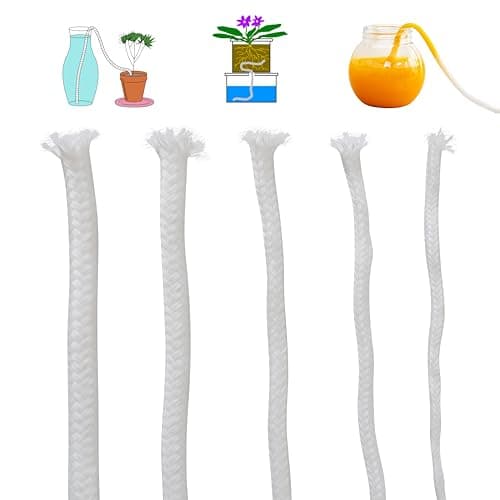 ORIMERC Self-Watering Wick Rope, 5 Mixed Diameters, 30 ftWorking out which diameter your pots and your mix actually want | Best first buy, five diameters to test | 8.7 | $4.99 - View on Amazon |
| 2 | 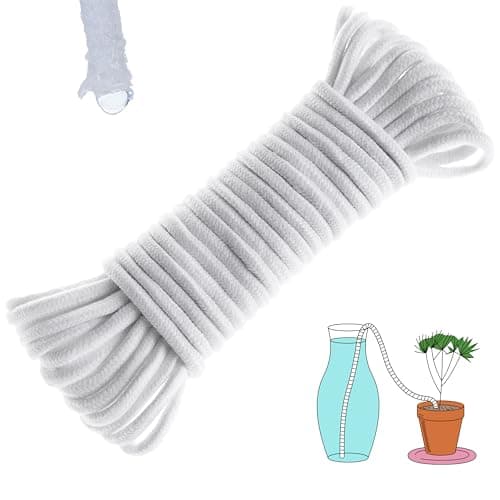 ORIMERC Self-Watering Wick Cord, 1/4 in x 50 ftWicking a 6 to 8 inch pot, and having spare cord for the next three | Best single diameter for 6 to 8 in pots | 8.6 | $6.99 - View on Amazon |
| 3 | 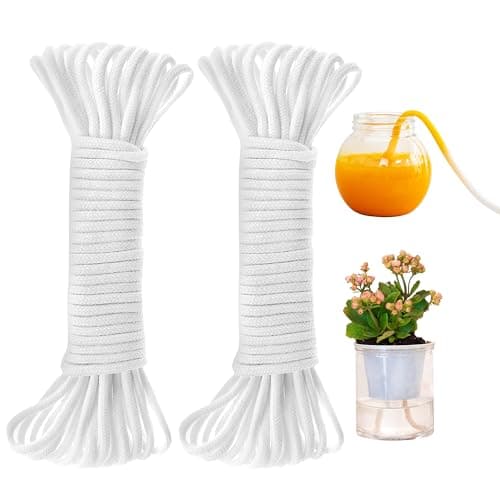 ORIMERC Wicking Rope, 1/6 in x 60 ftSmaller pots, and anyone who would rather err dry than wet | Best for small pots, and most cord per dollar | 8.4 | $4.99 - View on Amazon |
| 4 | 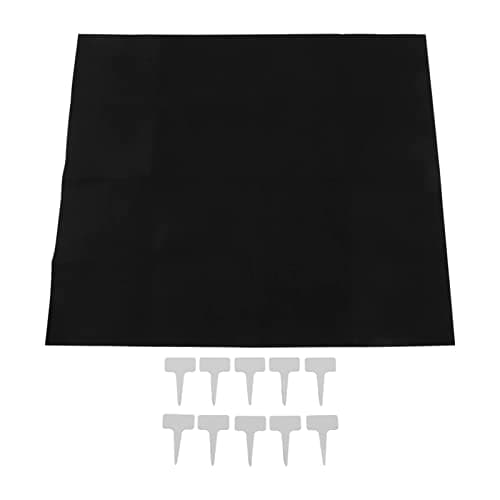 Mtlavishness Felt Capillary Watering MatA tray of small pots that all want the same thing | Best for a tray of small pots instead | 7.6 | $17.09 - View on Amazon |
| 5 | 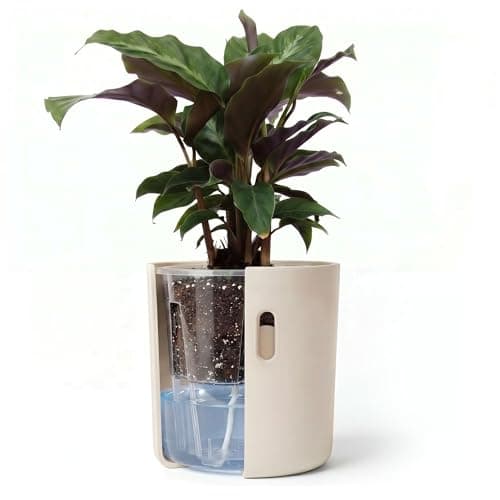 Wavyleaf Self-Watering Planter, 4 in, Nylon Wick and Clear Inner PotSomeone who wants a wicking pot without cutting any cord | Best if you would rather buy the wick fitted | 7.4 | $18.99 - View on Amazon |
Scores are our editorial judgment from published specifications. They are not test results, and they are deliberately not marked up as ratings in this page’s structured data.
Pick #1 - Best first buy, five diameters to test
ORIMERC Self-Watering Wick Rope, 5 Mixed Diameters, 30 ft
Working out which diameter your pots and your mix actually want
Buy this one first if you have pots of several sizes, because the single thing nobody publishes in this category is a delivery rate - which means the only honest way to find the right diameter for your pot and your mix is to try two and watch. Five diameters in one pack, from 1/12 to 1/4 inch, is the cheapest version of that experiment.
#ad Price as of October 29, 2026, from Amazon. Prices change. How we make money.
Published specification
- Diameters included
- 1/4 in, 1/5 in, 1/6 in, 1/8 in, 1/12 in
- Total length
- 30 ft
- Material
- Cotton-based wicking rope
- Published delivery rate per diameter
- Not published by the manufacturer
- Published service life
- Not published by the manufacturer
- Diameters included: Published product title, via retail listing
- Total length: Published product title, via retail listing
- Material: Published product description, via retail listing
- Published delivery rate per diameter: No ml-per-day figures stated on the retail listing
- Published service life: No replacement interval stated on the retail listing
What is good about it
- Five diameters removes the guesswork that an unpublished delivery rate forces on you
- The thin 1/12 and 1/8 inch cords are the ones that suit 4 inch pots, and they are hard to buy alone
- Cheapest entry in this category outright
- One pack covers a windowsill of mixed pot sizes
What is not
- Thirty feet total across five diameters is not much of any one size
- No published delivery rate for any diameter, so the sizing is still trial and observation
- Cotton in hard water will mineralize, and no service life is published
- If you already know your diameter, a single-size spool is better value per foot
Skip this one if
Skip it if every pot you own is the same size. Buy the single diameter that fits and get far more cord for the money.
How it scored
- Right diameter for common pots
- 10.0
- Published specification
- 4.0
- Cost per pot
- 9.0
- Hard-water durability
- 5.0
- Value for money
- 10.0
- Overall
- 8.7 / 10
Our editorial score, from published specifications and computed intervals. Not a test result. Specification source: ORIMERC 5-diameter wick rope set retail listing.
Pick #2 - Best single diameter for 6 to 8 in pots
ORIMERC Self-Watering Wick Cord, 1/4 in x 50 ft
Wicking a 6 to 8 inch pot, and having spare cord for the next three
The diameter to buy if you are buying one. A quarter inch is thick enough to move water at a rate a 6 to 8 inch pot can use, and fifty feet is enough cord to wick every pot in a house several times over - which matters, because a wick is a consumable that mineralizes and eventually stops moving water.
#ad Price as of October 29, 2026, from Amazon. Prices change. How we make money.
Published specification
- Diameter
- 1/4 in
- Length
- 50 ft
- Material
- Cotton-based wicking rope
- Published delivery rate
- Not published by the manufacturer
- Published service life
- Not published by the manufacturer
- Diameter: Published product title, via retail listing
- Length: Published product title, via retail listing
- Material: Published product description, via retail listing
- Published delivery rate: No ml-per-day figure stated on the retail listing
- Published service life: No replacement interval stated on the retail listing
What is good about it
- A quarter inch is the diameter that suits the pot sizes most houseplants are in
- Fifty feet means a wick failure is a two-minute fix rather than another order
- Cuts to length with scissors, so one spool covers every pot size you own
- Cheapest possible way to convert a pot you already own into a wicking pot
What is not
- No published delivery rate, so you cannot compute an interval the way a reservoir capacity lets you
- Cotton mineralizes in hard water and eventually stops wicking, with no published service life
- A wick that is too thick for a small pot keeps the mix wetter than the plant wants
- Needs a reservoir and a route into the pot, neither of which is included
Skip this one if
Skip it if your pots are 4 inches or smaller. A quarter-inch wick overwaters a small pot; take the thinner cord or the mixed set instead.
How it scored
- Right diameter for common pots
- 10.0
- Published specification
- 4.0
- Cost per pot
- 10.0
- Hard-water durability
- 5.0
- Value for money
- 9.5
- Overall
- 8.6 / 10
Our editorial score, from published specifications and computed intervals. Not a test result. Specification source: ORIMERC 1/4 in x 50 ft wick cord retail listing.
Pick #3 - Best for small pots, and most cord per dollar
ORIMERC Wicking Rope, 1/6 in x 60 ft
Smaller pots, and anyone who would rather err dry than wet
The most cord for the least money here, at a diameter that suits a 5 to 6 inch pot. A sixth of an inch moves water more slowly than a quarter, which in a wicking setup is usually the safer error - a wick that under-delivers leaves a dry pot you will notice, and one that over-delivers leaves a wet column you will not.
#ad Price as of October 29, 2026, from Amazon. Prices change. How we make money.
Published specification
- Diameter
- 1/6 in
- Length
- 60 ft
- Material
- Cotton-based wicking rope
- Published delivery rate
- Not published by the manufacturer
- Published service life
- Not published by the manufacturer
- Diameter: Published product title, via retail listing
- Length: Published product title, via retail listing
- Material: Published product description, via retail listing
- Published delivery rate: No ml-per-day figure stated on the retail listing
- Published service life: No replacement interval stated on the retail listing
What is good about it
- Sixty feet is the most cord of any single-diameter option here
- A slower delivery rate is the forgiving direction to be wrong in
- Suits the 5 to 6 inch pots most houseplants are sold in
- Doubling a length gives you a thicker effective wick, so one spool covers two rates
What is not
- Too slow for an 8 inch pot or anything thirsty in summer
- No published delivery rate, same as everything else in this category
- Cotton mineralizes in hard water with no published service life
- Thin cord is fiddlier to thread through a drainage hole than a quarter inch
Skip this one if
Skip it if your plants are in 8 inch pots or larger. The delivery rate will not keep up, and you want the quarter-inch cord or a reservoir pot instead.
How it scored
- Right diameter for common pots
- 8.5
- Published specification
- 4.0
- Cost per pot
- 10.0
- Hard-water durability
- 5.0
- Value for money
- 10.0
- Overall
- 8.4 / 10
Our editorial score, from published specifications and computed intervals. Not a test result. Specification source: ORIMERC 1/6 in x 60 ft wicking rope retail listing.
Pick #4 - Best for a tray of small pots instead
Mtlavishness Felt Capillary Watering Mat
A tray of small pots that all want the same thing
The alternative to wicking each pot individually: one felt mat under a tray of pots, with the mat's edge in water, and capillary action does the rest through the drainage holes. It is the right answer for a group of small pots and the wrong one for a single large plant, because a mat delivers through the base rather than into the root zone.
#ad Price as of October 29, 2026, from Amazon. Prices change. How we make money.
Published specification
- Material
- Felt capillary mat
- Reservoir
- Whatever tray or basin you supply
- Requirement
- Pots must have drainage holes and sit flat on the mat
- Published delivery rate
- Not published by the manufacturer
- Published dimensions
- Not published consistently; check the listing variant you order
- Material: Published product title, via retail listing
- Reservoir: Published product description, via retail listing
- Requirement: Published product description, via retail listing
- Published delivery rate: No ml-per-day figure stated on the retail listing
- Published dimensions: Dimensions vary by listed variant
What is good about it
- One mat covers a whole tray, so there is nothing to thread through anything
- Works with the nursery pots plants already arrive in
- Trivially removable, which makes it the easiest option to abandon if it does not suit
- Felt is washable and reusable across seasons
What is not
- Only delivers through drainage holes, so a pot without them gets nothing
- A single large plant draws more than a mat can move through its base
- Permanently damp felt under pots is a fungus gnat habitat
- No published delivery rate, and no published dimensions you can rely on
Skip this one if
Skip it if you have one big floor plant. A mat cannot feed a large root ball from the base; that is a reservoir pot's job.
How it scored
- Right diameter for common pots
- 6.0
- Published specification
- 3.0
- Cost per pot
- 8.5
- Hard-water durability
- 6.0
- Value for money
- 8.0
- Overall
- 7.6 / 10
Our editorial score, from published specifications and computed intervals. Not a test result. Specification source: Mtlavishness felt capillary watering mat retail listing.
Pick #5 - Best if you would rather buy the wick fitted
Wavyleaf Self-Watering Planter, 4 in, Nylon Wick and Clear Inner Pot
Someone who wants a wicking pot without cutting any cord
The pot for anyone who read this page and decided they would rather not make anything. It ships with its wick already fitted, and the wick is nylon rather than cotton - which is the material choice that matters in hard water, because nylon does not rot and is slower to mineralize. The clear inner pot is the other genuinely useful detail: you can see the water level and the roots.
#ad Price as of October 29, 2026, from Amazon. Prices change. How we make money.
Published specification
- Pot size
- 4 in
- Wick material
- Nylon
- Inner pot
- Clear, so the water level and root zone are visible
- Reservoir capacity
- Not published by the manufacturer
- Published refill interval
- Not published by the manufacturer
- Pot size: Published product title, via retail listing
- Wick material: Published product title, via retail listing
- Inner pot: Published product title, via retail listing
- Reservoir capacity: No capacity in ml or oz stated on the retail listing
- Published refill interval: No interval stated on the retail listing
What is good about it
- The wick is fitted, so there is no threading, cutting or improvising
- Nylon resists the rot that eventually takes a cotton wick
- A clear inner pot means the water level is visible rather than guessed at
- A 6 in version of the same design exists, so a pair covers most houseplants
What is not
- No published reservoir capacity, which is the one number that would let us compute an interval
- No published refill interval either, so both of the figures that matter are missing
- 4 in is small - a mature plant outgrows it within a year or two
- Costs several times what a spool of cord and a pot you own would
Skip this one if
Skip it if you already own pots you like. A spool of wick cord converts them for a fraction of this, and the Lechuza-style reservoir planters publish the capacity this one does not.
How it scored
- Right diameter for common pots
- 7.0
- Published specification
- 2.0
- Cost per pot
- 5.0
- Hard-water durability
- 9.0
- Value for money
- 6.5
- Overall
- 7.4 / 10
Our editorial score, from published specifications and computed intervals. Not a test result. Specification source: Wavyleaf 4 in self-watering planter retail listing.
Questions people actually ask
- Do self-watering pots need a wick?
It depends which kind you own. A sub-irrigated reservoir pot - where the growing medium itself sits on or dips into the water - does not need one, because capillary rise happens through the mix. A wicking pot, where a separate chamber holds water the soil never touches, cannot work without one. Lift the plant out and look: if you see a rope or felt strip, that is the transport path and it is replaceable.
- What kind of rope do you use for self-watering pots?
Cotton wicking cord is the standard and what nearly every purpose-sold product is. Nylon is the alternative and does not rot, which matters in hard water. Avoid anything with a waterproof coating or a synthetic core that will not absorb. Soak whichever you use before fitting it, because a dry wick does not reliably start drawing on its own.
- What diameter wick should I use?
No maker publishes a delivery rate, so this is sizing by water demand and observation. As a starting point: 1/12 to 1/8 inch for a 4-inch pot, 1/6 inch for 5 to 6 inches, 1/4 inch for 6 to 8 inches. Then watch for a week. If the mix stays soggy, go thinner. Above a 10-inch pot a wick cannot keep up and a reservoir planter is the right answer.
- How often do you replace a wick in a self-watering pot?
Nobody publishes a figure, so the honest answer is when it stops working rather than on a schedule. The symptom is specific and easy to read: the reservoir stays full while the soil dries out. Cotton stiffens as mineral deposits build in the fibers, so hard water shortens the life. Buy a spool rather than a single length and replacing one becomes a two-minute job.
- My reservoir is full but the soil is dry. What happened?
The transport path has failed, and in a wicking pot that means the wick. Either it has mineralized and stopped drawing, it has lost contact with the mix, or the reservoir sits too far below the pot for capillary lift to reach - Blumat publishes 12 inches as the limit for its ceramic cones, and a cotton wick fights the same physics. Lift the plant, rinse or replace the wick, and raise the reservoir.
- Can I make a wicking pot myself?
Yes, and it is the cheapest conversion in this category: a cotton or nylon cord threaded through a drainage hole into a water container below, with the top of the wick sitting in the middle third of the root ball. Keep the reservoir close to the pot base, do not plug the drainage hole, and remember you still need to top-water occasionally to flush salts out.
Sources
Sources
- ORIMERC 1/4 in x 50 ft self-watering wick cord retail listing
- ORIMERC 5-diameter self-watering wick rope set retail listing
- ORIMERC 1/6 in x 60 ft wicking rope retail listing
- Mtlavishness felt capillary watering mat retail listing
- Wavyleaf 4 in self-watering planter with nylon wick retail listing
- Criscione and Holliday-Goulart, Properly Watering Container Houseplants, Virginia Cooperative Extension SPES-804 (2026)
- Plants Grown in Containers, NC State Extension Gardener Handbook chapter 18